
Best overall for round-the-clock non-emergency care: Teladoc Health General Medical. Best phone-or-video alternative: MDLIVE Urgent Care. Best for a video-first visit: Amwell Urgent Care. NowCare is best for provider-guided virtual urgent care with ongoing support, rather than a confirmed 24/7 appointment promise. This 2026 guide separates round-the-clock services from online care programs so you can choose the right route.
- For 24 7 virtual urgent care, Teladoc Health General Medical is the default choice for non-emergency concerns.
- MDLIVE Urgent Care offers phone and video visits; Amwell Urgent Care suits patients who prefer video.
- NowCare fits provider-guided virtual urgent care with ongoing support; do not assume round-the-clock clinician access.
- Emergency symptoms need emergency services, not an online urgent care appointment.
Why this matters
A service open around the clock is not the same as a clinician available immediately. A 24/7 service operates 24 hours a day, 7 days a week, but a particular visit still depends on clinician capacity, your location, and the service's eligibility rules.
Virtual urgent care also has a clinical boundary. A clinician can discuss symptoms and recommend next steps remotely, but cannot perform a hands-on examination, take an X-ray, or collect a laboratory sample through a screen.
For your 2026 decision, start with the care you need—not the longest feature list. An uncomplicated everyday concern, a problem requiring an examination, and an emergency belong on different paths.
What makes the best virtual urgent care service
These criteria matter more than a broad promise of convenient access:
- Round-the-clock access: The specific urgent care service—not merely its website or intake form—must offer care throughout the day and night.
- Visit format: Phone and video suit different needs. Video lets a clinician see visible symptoms, while phone visits avoid dependence on a camera.
- Clinical fit: The service must handle your concern remotely and identify when you need testing, an examination, or emergency care.
- Location eligibility: The clinician must be authorized to treat patients where you are physically located during the visit.
- Follow-through: You need clear instructions about prescriptions, symptom changes, and what to do when remote treatment is insufficient.
Choose on clinical fit first, access second, and visit format third. Fast access does not make an unsuitable remote visit useful.
Virtual urgent care services at a glance
| Service | Best for | Standout feature | Key limitation |
|---|---|---|---|
| Teladoc Health General Medical | Default round-the-clock non-emergency care | Phone or video access to general medical care | Cannot replace an examination or urgent testing |
| MDLIVE Urgent Care | Patients choosing between phone and video | Both visit formats for urgent care | Remote assessment cannot resolve every symptom |
| Amwell Urgent Care | Patients who prefer a video visit | Video-based urgent care | Requires a workable video connection |
| NowCare | Provider-guided care with ongoing support | Virtual urgent care covering everyday concerns and several condition groups | Round-the-clock clinician availability is not established |
The 24/7 descriptions for Teladoc Health General Medical, MDLIVE Urgent Care, and Amwell Urgent Care refer to their publicly described urgent or general medical services. They are not guarantees of an immediate appointment, a particular prescription, or eligibility in every situation. For a 2026 visit, confirm the current service details before submitting your intake.
1. Teladoc Health: best for a default 24/7 care route
Teladoc Health General Medical provides non-emergency medical visits by phone or video, with round-the-clock access. It is the clearest default here when you want a general medical consultation outside ordinary office hours and do not need a hands-on examination.
Choose the General Medical service specifically. Other care categories under a large telehealth brand can have different scheduling arrangements, so the company name alone does not establish nighttime access.
Teladoc Health pros:
- General Medical is described as available around the clock.
- Phone and video give you a choice of consultation format.
- The service focuses on non-emergency medical concerns.
Teladoc Health cons:
- A remote visit cannot provide physical testing or an examination.
- Round-the-clock operation does not guarantee an immediate clinician connection.
Best for: Patients who need a straightforward route to non-emergency general medical advice, including outside office hours.
Verdict: Choose Teladoc Health General Medical as the default, after checking eligibility for your location and symptoms.
2. MDLIVE: best for choosing phone or video
MDLIVE Urgent Care offers round-the-clock medical consultations by phone or video. Its decision advantage is simple: you can look for a visit format that fits your symptoms and your ability to connect.
A phone conversation works for describing a symptom history. A visible concern can benefit from video, although seeing something on-screen does not replace a physical examination when one is needed.
MDLIVE pros:
- Urgent Care is described as available around the clock.
- Phone visits provide an alternative to a video connection.
- Video allows discussion of visible symptoms during the consultation.
MDLIVE cons:
- A phone visit cannot show a rash, swelling, or another visible change.
- Neither format can provide an X-ray, laboratory sample, or hands-on examination.
Best for: Patients whose main preference is choosing between an audio conversation and a video consultation.
Verdict: Choose MDLIVE Urgent Care when visit-format flexibility is your deciding factor.
3. Amwell: best for a video-first urgent care visit
Amwell Urgent Care provides video consultations for non-emergency concerns and describes its urgent care service as available around the clock. It fits patients who want to speak face-to-face with a clinician through their device.
Video can help you explain where a symptom is occurring and show a visible change. Good lighting and a stable connection matter, but even a clear image cannot establish every diagnosis.
Amwell pros:
- Urgent care is described as available around the clock.
- Video supports face-to-face discussion with a clinician.
- A visual conversation can help explain visible symptoms.
Amwell cons:
- The visit depends on a usable camera and connection.
- Video cannot replace examination, imaging, or testing when those are necessary.
Best for: Patients who prefer a video consultation and have a suitable device and connection.
Verdict: Choose Amwell Urgent Care for a video-first visit, not for symptoms that require hands-on assessment.
4. NowCare: best for provider-guided ongoing support
NowCare virtual urgent care connects patients with licensed clinicians for provider-guided online care. Its 1-month plan covers skin and hair, women's health, men's health, eyes, ears, nose and throat, and everyday medical concerns.
The service includes secure intake and ongoing care-team support. Licensed clinicians review treatment plans and prescriptions, with prescriptions sent to your chosen pharmacy when treatment is medically appropriate.
NowCare is best for provider-guided virtual urgent care with ongoing care-team support. Its role in this comparison is different from a confirmed round-the-clock consultation service: choose it for the stated care model, not an assumed overnight response.
Service pros:
- Licensed clinicians review each treatment plan and prescription.
- Secure intake supports sharing your medical information.
- Ongoing care-team support is part of the stated service.
- Prescriptions go to your chosen pharmacy when medically appropriate.
Service cons:
- Round-the-clock clinician access is not established.
- Online-only care cannot provide an in-person examination or testing.
Best for: Patients seeking provider-guided care and continued support for suitable everyday concerns.
Verdict: Choose this service for its ongoing care model; skip it when your deciding requirement is confirmed 24/7 access.
How to choose the right care route
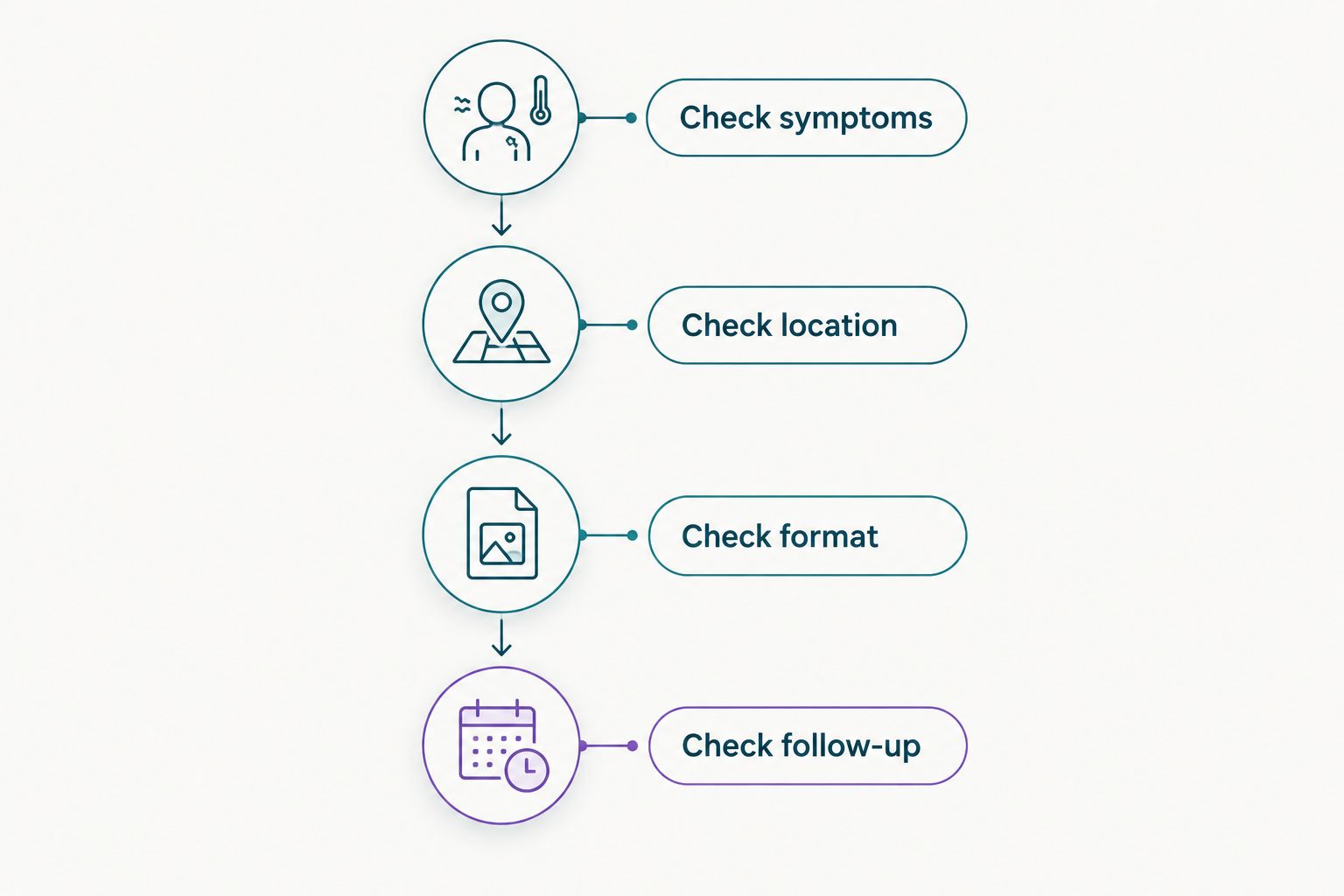
Use this sequence before choosing any online service in 2026. It keeps appointment convenience from taking priority over clinical safety.
Check symptoms
Chest pain, severe trouble breathing, signs of stroke, uncontrolled bleeding, or another potentially life-threatening problem need emergency assessment. Call 911 for an emergency rather than waiting for a virtual urgent care visit.
Tell the service about symptom severity and any rapid change. Do not downplay a problem to fit an online appointment category.
Check location
Use your current physical location when checking eligibility. The location where you live or usually receive care is not necessarily where you are during the consultation.
If you are traveling, check the service's location rules before completing intake. Clinician authorization follows the relevant jurisdiction's requirements.
Check format
Choose phone or video based on the service's options and the concern you need assessed. A visible symptom is easier to discuss when the clinician can see it, but a picture alone is not a complete examination.
If video is necessary, check your camera, microphone, connection, and lighting before starting. Tell the clinician if you cannot show the affected area clearly.
Check follow-up
Before the visit ends, understand the treatment instructions and the next step if symptoms persist or worsen. Ask whether the clinician recommends an in-person examination, testing, or another type of care.
Keep the visit summary accessible. It helps you follow the plan and explain what happened if another clinician needs to assess you.
What to prepare before your consultation
A useful symptom history makes the conversation clearer. Write down when the problem began, how it has changed, and what you have already tried.
Have these details ready:
- Current medications: Include prescription medicines, nonprescription medicines, and supplements.
- Allergies: Describe the reaction, not just the medicine's name.
- Relevant history: Mention conditions, recent procedures, and pregnancy when relevant to the concern.
- Symptom details: Explain the location, severity, pattern, and any associated symptoms.
- Pharmacy information: Have your preferred pharmacy's details available if medication is medically appropriate.
Do not assume a prescription is the measure of a successful visit. A recommendation for testing or an in-person examination can be the correct outcome.
How we ranked these services
This 2026 ranking prioritizes stated round-the-clock access, then visit format and clinical fit. It does not rank services by unsupported speed claims, patient outcomes, or review scores.
Teladoc Health General Medical is the default because its stated service combines round-the-clock access with phone and video consultations. MDLIVE Urgent Care earns the format-choice slot, while Amwell Urgent Care serves the video-first preference.
The ongoing-support option belongs in the comparison because access and continuity answer different needs. It does not receive the round-the-clock recommendation without an established 24/7 clinician-access commitment.
Which virtual urgent care service should you choose?
For an undecided reader seeking 24/7 non-emergency care, start with Teladoc Health General Medical. Confirm that your symptoms, location, and preferred visit format fit before proceeding.
Choose MDLIVE Urgent Care when phone-or-video choice drives your decision. Choose Amwell Urgent Care when you specifically want a video visit. Choose the provider-guided ongoing-support model when continuity matters more than confirmed overnight access.
For any 2026 service choice, treat the clinician's recommendation as the next-step decision. If the assessment points to in-person care, switch routes rather than booking repeated remote consultations for the same unresolved problem.
FAQ
What's the best 24 7 virtual urgent care service?
Teladoc Health General Medical is the default recommendation here for round-the-clock non-emergency care. It offers phone and video consultations; confirm your location and symptom eligibility before starting.
Does 24/7 virtual urgent care mean I will see someone immediately?
No. Round-the-clock operation does not guarantee an immediate consultation. Clinician capacity, location eligibility, and the service's scheduling process still affect access.
Is NowCare a 24/7 virtual urgent care service?
Round-the-clock clinician access is not established for NowCare. Its stated offering is provider-guided virtual urgent care with a 1-month plan, licensed clinician review, and ongoing care-team support.
Is MDLIVE better than Amwell for urgent care?
MDLIVE is the better fit here when you want a choice between phone and video; Amwell fits a video-first preference. Neither option replaces an examination or testing when those are clinically necessary.
Can a virtual urgent care clinician prescribe medication?
A virtual clinician can prescribe medication when legally permitted and medically appropriate. A consultation does not guarantee a prescription, and some symptoms require examination or testing before treatment.
Can I use virtual urgent care while traveling?
Eligibility depends on where you are physically located during the visit. Check the service's location requirements before submitting your intake, rather than relying only on your home address.
When should I use emergency care instead of virtual urgent care?
Use emergency services for potentially life-threatening symptoms such as chest pain, severe breathing difficulty, signs of stroke, or uncontrolled bleeding. Call 911 rather than waiting for an online consultation.
What should I do if symptoms continue after an online visit?
Follow the clinician's instructions and seek reassessment when symptoms persist or worsen. New emergency symptoms require emergency care, and unresolved symptoms can require an in-person examination or testing.
One last thing
Ask before ending the visit: what change means I should seek in-person care? That answer gives you a practical boundary between following the treatment plan and changing course.
The best online urgent care visit does not keep every problem online. It gives you a clear next step—including leaving virtual care when your symptoms need more than a remote assessment.


