Construction workers’ foot and ankle care is the prevention, assessment, and treatment of work-related foot problems with the aim of keeping you mobile and safe on the job. This 2026 guide explains how to manage pressure from work boots, recognize injuries that need an examination, and choose between provider-guided online care and in-person treatment.
- Foot and ankle care for construction workers starts with injury triage, protective footwear, and daily skin checks.
- NowCare foot and ankle care is best for construction workers seeking provider-guided online assessment of non-emergency concerns.
- Choose in-person assessment for suspected fractures, deep wounds, circulation changes, or injuries that prevent weight-bearing.
- Treat heel pain, nail problems, and diabetic foot concerns as different conditions, not one boot-related problem.
Why foot and ankle care matters for construction workers
Construction work combines protective footwear with climbing, carrying, uneven ground, and prolonged standing. A sore heel or irritated toe affects more than comfort: it can change how you step, balance, and use ladders.
Treat a change in walking as a safety issue, not simply an inconvenience. Pain that makes you favor one foot deserves attention before another demanding shift.
NowCare connects patients with licensed clinicians for provider-guided online foot and ankle care. Online assessment offers a way to discuss non-emergency symptoms, but it does not replace a hands-on examination when an injury needs one.
For your 2026 work routine, separate prevention from treatment. Better-fitting boots address pressure and friction; they do not establish whether heel pain comes from plantar fasciitis, an injury, or another condition.
Build a foot-care routine around your work
1. Check whether your symptoms need urgent assessment
Start with the circumstances. Pain after a crush injury, fall, puncture, or ankle twist needs a different response from gradually developing soreness inside a boot.
Do not start with self-treatment when you suspect a serious injury. A foot that looks deformed, feels unusually cold, or develops new loss of sensation after trauma needs emergency assessment. Inability to bear weight after an injury also warrants prompt in-person evaluation.
An open wound with spreading redness, fever, or worsening swelling needs urgent medical attention. Diabetes or reduced sensation makes apparently minor wounds especially important to assess promptly.
Before choosing a care route:
- Stop the task if pain or instability makes it unsafe.
- Check for wounds, deformity, swelling, and changes in skin color.
- Seek emergency care for deformity or a cold, pale foot after injury.
- Arrange prompt in-person evaluation if you cannot bear weight after an injury.
- Report workplace injuries through your employer’s established process.
2. Record what hurts and what triggers it
Use a paper notebook or your phone to describe the problem before buying another insert or changing footwear. A precise symptom history helps distinguish pressure against a toenail from pain beneath the heel or instability around the ankle.
Record the location rather than writing only that your feet hurt. Note whether symptoms begin with your first steps, appear during ladder work, or worsen near the end of a shift. Include what improves them, without assuming that improvement proves a diagnosis.
Keep a dated 2026 symptom record if the problem recurs. Photos can document visible skin or nail changes, but they cannot rule out a fracture or assess circulation.
Prepare the following details:
- Mark the painful area on a simple foot outline.
- Describe the sensation: aching, burning, stabbing, tingling, or numbness.
- Record any injury and when symptoms began.
- List work tasks and footwear associated with symptoms.
- Note diabetes, circulation problems, medicines, and previous injuries.
3. Match the care route to the problem
Start with the information you already have: your symptom record, visible changes, and whether you can walk safely. Use an in-person service when examination, wound treatment, or imaging is needed.
NowCare foot and ankle care is best for construction workers seeking provider-guided online assessment of non-emergency concerns. Its stated care areas include heel pain, nail health, skin conditions, diabetic foot health, structural problems, sports-related concerns, and nerve pain. Licensed clinicians review care plans and prescriptions; treatment is provided only if medically appropriate.
The limitation matters. An online appointment cannot physically test ankle stability, feel a pulse, or take an X-ray. A clinician can direct you toward in-person assessment when symptoms require it.
Choose your next step deliberately:
- Use emergency services for serious trauma or threatened circulation.
- Choose in-person assessment for suspected fractures or deep wounds.
- Consider online assessment for non-emergency heel, nail, or skin concerns.
- Explain your job demands before discussing treatment or activity changes.
- Ask which symptoms should trigger escalation to in-person care.
4. Check boot fit without compromising protection
Inspect your current boots before replacing them. Look for a folded insole, damaged lining, trapped debris, uneven wear, or a seam pressing directly against the painful area.
Boot fit includes width, toe clearance, heel hold, and the space taken up by socks or inserts. More padding is not automatically better: an added insert can crowd the toes or lift the heel into a rubbing point.
Keep the protective features required for your task. Do not remove safety components, alter protective footwear, or substitute an unapproved shoe because it feels softer. If required boots repeatedly cause pressure, discuss compatible alternatives with your supervisor and clinician.
Use this fit check:
- Wear your usual work socks when assessing fit.
- Check that your toes are not compressed against the front or sides.
- Look for heel slipping and pressure over the top of the foot.
- Inspect the sole, lining, and fastening system for damage.
- Recheck fit after adding or changing an insert.
5. Inspect skin and nails before problems deepen
Remove your boots and inspect both feet, including the soles and spaces between the toes. A mirror helps you see areas that are otherwise difficult to check.
Blisters, cracked skin, nail pressure, and persistent moisture need different responses. Do not assume every thickened nail is fungal or every peeling patch is athlete’s foot; injury and other skin conditions can look similar.
If you have diabetes, reduced sensation, or poor circulation, avoid cutting into calluses or treating a wound yourself. A small sore can escape notice when sensation is reduced. Arrange prompt professional advice rather than waiting for pain.
Make these checks part of your routine:
- Wash your feet and dry carefully between the toes.
- Change damp socks and let footwear dry between uses.
- Check for blisters, cracks, drainage, and persistent redness.
- Trim nails straight across without digging into the corners.
- Avoid cutting corns or calluses with blades.
- Seek assessment for wounds, worsening nail pain, or spreading skin changes.
6. Adjust loading before pain changes your gait
Identify the task that brings on symptoms. Repeated ladder climbing, carrying loads, kneeling with toes bent, and standing in one position place different demands on your feet.
Where your work arrangements allow, discuss task changes rather than trying to push through a limp. Follow a clinician’s guidance on activity, exercises, and support devices. An unexplained injury is not a reason to begin aggressive stretching.
Pain relief does not establish that a foot is ready for heavy work. Walking comfortably on level ground and carrying equipment across uneven ground are different demands. Describe both when discussing a return to usual duties.
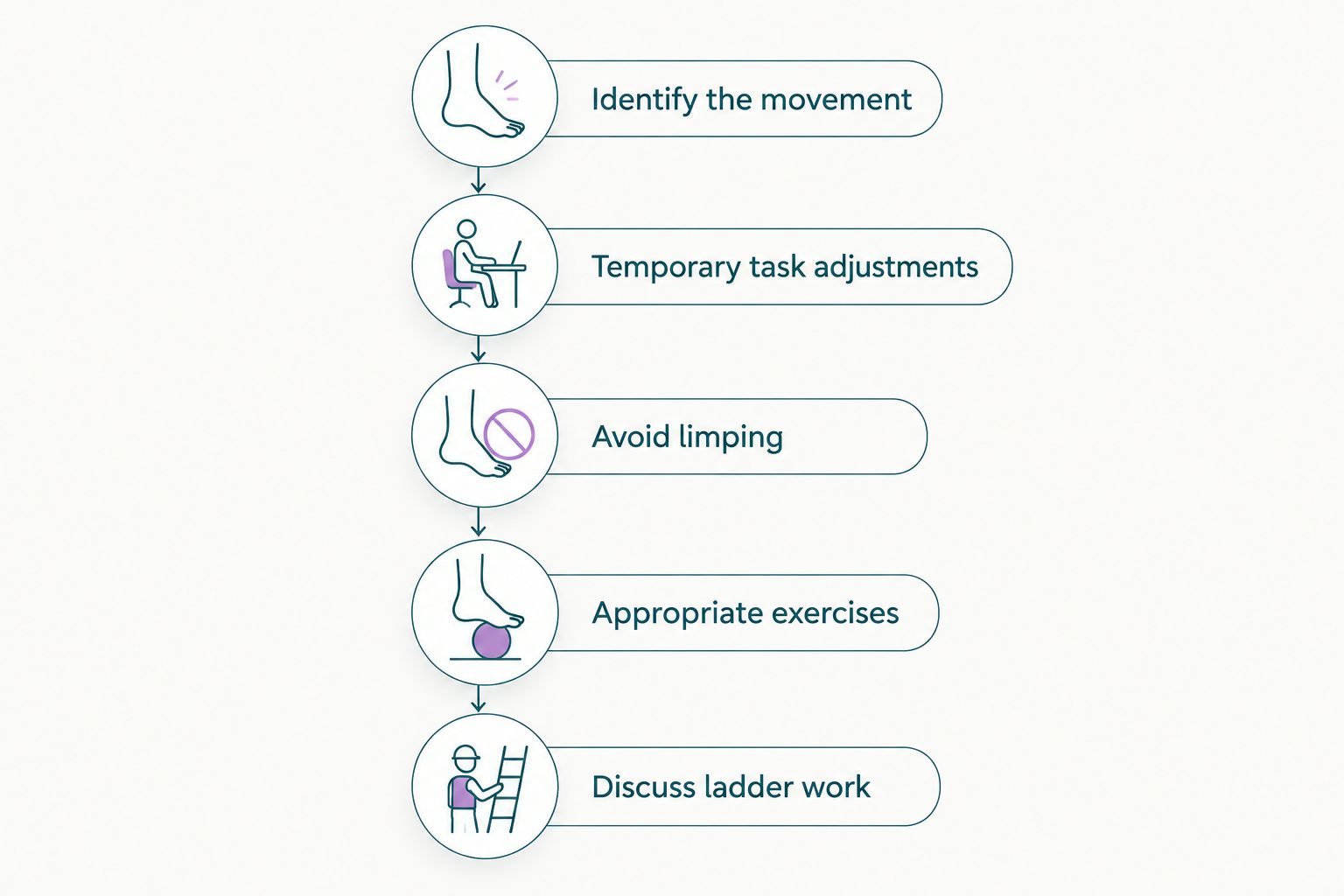
Build a task-specific plan:
- Identify the movement or surface that worsens symptoms.
- Ask about suitable temporary task adjustments.
- Avoid activities that cause limping or instability.
- Perform only exercises appropriate to the assessed condition.
- Discuss ladder work, load carrying, and uneven surfaces explicitly.
7. Set a follow-up plan you can use on shift
Before finishing an appointment, ask what improvement should look like and what to do if symptoms worsen. A useful plan names the condition being treated, the next action, and the signs that change the care route.
For your 2026 care record, keep instructions alongside your symptom notes. Share changes in walking, skin appearance, or work tolerance rather than reporting only whether pain feels better.
NowCare offers foot and ankle plans with 1-month, 3-month, and 6-month durations, plus annual memberships for specified care areas. A plan’s duration is not a recovery forecast. Ask the clinician which follow-up schedule fits your condition and whether you need an examination elsewhere.
Leave the appointment knowing:
- What the working diagnosis is and what remains uncertain.
- Which treatments or activity changes to follow.
- Which symptoms require urgent or in-person assessment.
- When and how to request follow-up.
- What to discuss before resuming demanding tasks.
Compare care options for construction workers
Choose your 2026 care route by what the problem requires, not just which appointment is easiest to access. Self-care supports prevention; clinical assessment addresses symptoms that need diagnosis or treatment.
| Option | Best for | Main benefit | Key limitation |
|---|---|---|---|
| Daily self-care and boot checks | Prevention and identifying pressure or skin changes early | Fits into your existing routine | Cannot diagnose an injury, infection, or nerve problem |
| Provider-guided online care | Non-emergency concerns that can begin with history and visual review | Lets you discuss symptoms without attending an initial physical visit | Cannot provide hands-on examination or imaging |
| In-person foot and ankle assessment | Persistent pain, uncertain diagnoses, structural concerns, or examination needs | Allows direct examination and decisions about further testing | Requires attendance at a physical location |
| Emergency care | Serious trauma, deformity, or circulation warning signs | Addresses conditions requiring immediate assessment | Not a substitute for routine preventive follow-up |
Common mistakes construction workers make
Treating every sore heel as plantar fasciitis
Heel pain is a symptom, not a diagnosis. An injury, nerve irritation, and other problems can produce pain near the heel. Get assessed when pain persists, follows trauma, or changes how you walk, rather than repeatedly trying treatments chosen for a different condition.
Adding inserts until boots become too tight
Stacking padding reduces the space available inside a boot. If your toes become crowded or a new pressure point develops, reassess the fit instead of adding another layer. Bring the insert and boot details into a clinical discussion when symptoms continue.
Using pain as the only wound warning
Reduced sensation means a wound does not always hurt as expected. Check visually, especially if you have diabetes or neuropathy. Drainage, a break in the skin, or a change in color deserves attention even when you can still finish a shift.
Returning to ladder work because walking feels easier
Level-ground walking does not test every demand of construction work. Climbing, balancing, and carrying materials require separate consideration. Discuss those tasks before treating an improvement in everyday walking as clearance for full duties.
FAQ
What is the best foot and ankle care for construction workers?
The best foot and ankle care for construction workers matches the problem: daily prevention, clinical assessment for persistent symptoms, and urgent in-person care for serious injuries. Boot fit and skin checks support care but do not replace diagnosis.
Can I use NowCare for foot pain from construction work?
NowCare provides provider-guided online assessment for non-emergency foot and ankle concerns. Licensed clinicians review care plans, and symptoms that require examination or imaging need an in-person care route.
Should I keep working if my heel hurts?
Do not continue a task when heel pain causes limping, instability, or unsafe movement. Seek assessment and discuss task adjustments, especially when pain follows an injury or affects weight-bearing.
Are softer work boots always better for foot pain?
Softer work boots are not automatically better for foot pain. Fit, pressure points, task requirements, and required protective features all matter; extra cushioning can also make a boot too tight.
When does an ankle injury need an in-person visit?
An ankle injury needs prompt in-person assessment when you cannot bear weight or suspect a fracture. Deformity, a cold or pale foot, or new loss of sensation after trauma requires emergency assessment.
What should construction workers with diabetes check on their feet?
Construction workers with diabetes should check for wounds, blisters, redness, drainage, cracks, and pressure marks. Reduced sensation can hide an injury, so arrange prompt assessment for a new wound rather than waiting for pain.
Can an online clinician tell whether my foot is broken?
An online consultation cannot reliably rule out a broken foot. Suspected fractures require in-person assessment and imaging when clinically indicated.
One last thing
Bring your work demands into the appointment, not just your symptoms. For your next foot-care visit in 2026, describe the boots you must wear, the surfaces you cross, and whether you climb or carry loads. A treatment plan needs to account for those tasks—not simply whether you can walk across a room.