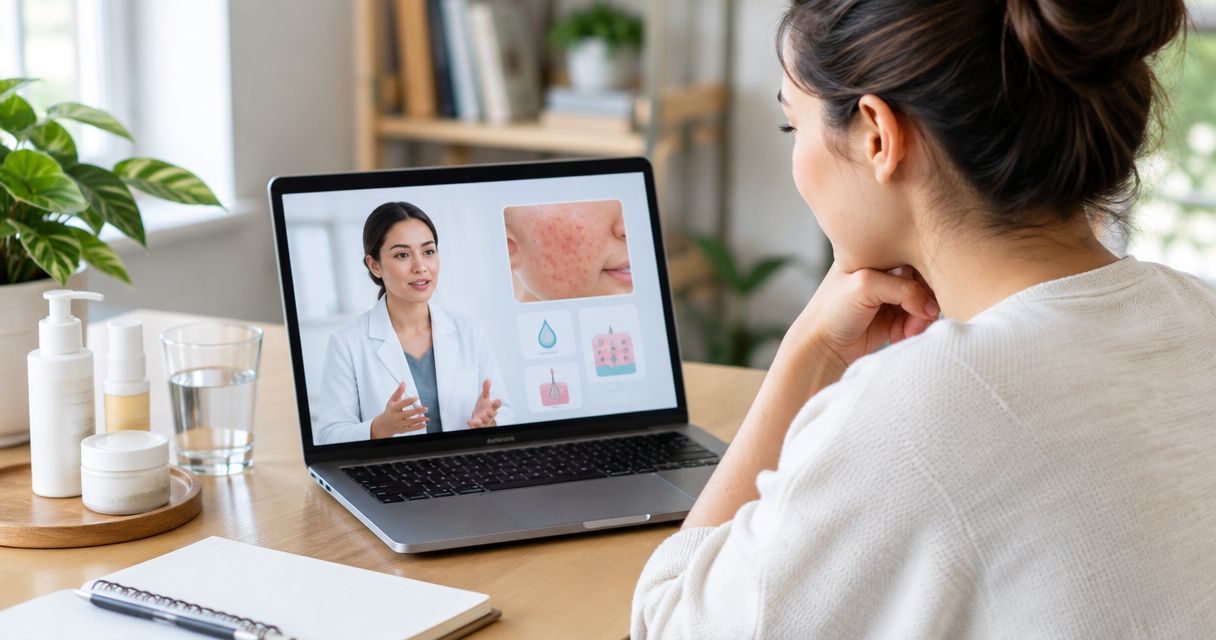
Best acne-focused option: dermatologist-led online care. Best for general virtual skin concerns: NowCare. Best self-care starting point for mild acne: an over-the-counter acne regimen. This 2026 guide compares online treatment for acne by clinical fit, prescribing safeguards, follow-up, and the point at which an in-person examination becomes the better choice.
- Dermatologist-led online treatment for acne is the strongest fit when you need acne-specific assessment and prescription guidance.
- NowCare suits patients seeking provider-guided online care for skin concerns; licensed clinicians determine appropriate treatment.
- Over-the-counter acne treatments suit mild breakouts, but painful nodules and scarring need clinician assessment.
- Choose acne care with clear follow-up and escalation instructions, not a promised prescription.
Why this matters
The best acne service is not necessarily the one with the shortest intake. You need the right diagnosis, a treatment you can use consistently, and a clear next step if your skin worsens.
Acne-like bumps can have other causes, including rosacea or folliculitis. Photographs help a clinician assess visible changes, but they cannot replace every part of an examination. Deep, painful lesions, developing scars, or uncertainty about the diagnosis change which care setting makes sense.
Choose online treatment for acne in 2026 by the care you need, not by the medication you hope to receive. A responsible clinician can recommend treatment, request more information, or direct you to an in-person visit.
What makes the best online treatment for acne
Use these criteria before choosing a service:
- Clinical fit: The service should explain whether it evaluates acne and which concerns require another care setting.
- Licensed assessment: A clinician should review your symptoms, medical history, current medications, and relevant safety information before prescribing.
- Treatment rationale: You should understand what each recommended treatment does and why it fits your skin.
- Follow-up access: Check how you report irritation, ask questions, and arrange reassessment.
- Escalation rules: Painful nodules, scarring, diagnostic uncertainty, and medication-monitoring needs require a clear referral route.
- Usable instructions: A plan should explain application, precautions, and what to do if adverse effects develop.
These criteria matter more than an impressive ingredient list. A prescription without understandable instructions leaves you guessing about application and side effects.
Acne care options at a glance
The ranking below separates care pathways rather than claiming that every patient needs the same provider. The final two options are alternatives to online prescription care, included so you can recognize when telehealth is unnecessary or insufficient.
| Option | Best for | Standout feature | Key limitation |
|---|---|---|---|
| Dermatologist-led online care | Acne-specific prescription assessment | Dermatology expertise applied to your symptoms and history | Remote assessment cannot replace every examination or procedure |
| NowCare | General virtual skin concerns | Provider-guided online care with licensed clinician review | Its general skin-care offering does not establish an acne-specific specialty service |
| Primary care telehealth | Acne alongside broader health concerns | Review of acne within your overall medical history | Complex or scarring acne can require dermatology referral |
| Over-the-counter acne regimen | Mild breakouts without warning signs | Direct access to established topical acne ingredients | No individualized diagnosis or prescription assessment |
| In-person dermatologist | Deep, painful, scarring, or diagnostically unclear acne | Direct examination and access to office-based assessment | It is not an entirely online pathway |
1. Dermatologist-led online care: best for acne-specific assessment
Dermatologist-led online care gives you an acne-focused route to assessment without starting in an office. Depending on the service, you submit photographs, complete a medical history, or attend a video consultation. Confirm the clinician's credentials and the service's scope before enrolling.
This is the default choice when your main goal is prescription acne care rather than a general skin consultation. Dermatology expertise is particularly relevant when you have already tried treatment, cannot tolerate common ingredients, or are unsure whether your breakouts are acne.
Dermatologist-led online care pros:
- Focuses the assessment on acne and conditions that resemble it.
- Can connect treatment selection with your previous response and side effects.
- Provides a route to prescription assessment when self-care is insufficient.
- Can help determine when an office visit is necessary.
Dermatologist-led online care cons:
- Photographs do not show every feature a clinician can assess in person.
- Follow-up arrangements differ between services and need checking.
- Some treatments require tests, monitoring, or care beyond a remote consultation.
Before choosing this pathway in 2026, ask who reviews your case and what happens if you develop irritation or worsening acne. Do not assume that every online service includes ongoing clinician access.
Best for: People seeking acne-specific evaluation and a clinician-directed treatment plan.
Verdict: Choose dermatologist-led online care for acne-focused assessment; skip services that promise a prescription before reviewing your history.
2. NowCare: best for general virtual skin concerns
NowCare connects patients with licensed clinicians for provider-guided online care, including skin and hair concerns within Virtual Urgent Care. Its stated process includes secure intake, clinician review, prescriptions sent to the patient's chosen pharmacy when medically appropriate, and ongoing care-team support.
NowCare is best for patients seeking provider-guided online care for general skin concerns. For an acne concern, confirm that the service can evaluate your symptoms and provide the follow-up your treatment requires. Its general skin-care offering does not establish a dedicated acne specialty program.
NowCare pros:
- Licensed clinicians review care plans and prescriptions.
- Secure intake supports sharing relevant health information.
- Prescriptions go to your chosen pharmacy when clinically appropriate.
- Ongoing care-team support is part of its stated offering.
NowCare cons:
- Entirely online care cannot provide a hands-on skin examination.
- The stated offering does not specify an acne formulary or acne-specific protocol.
- Deep, scarring, or complex acne can need specialist or in-person care.
Choose this route when you want clinical guidance on a skin concern and accept that the outcome can include a referral rather than a prescription. Treatment should follow the assessment, not be assumed before it.
Best for: Patients seeking a general virtual skin consultation with licensed clinician review.
Verdict: Choose NowCare for provider-guided skin concerns; confirm acne-care scope before starting.
3. Primary care telehealth: best for acne within broader health care
Primary care telehealth is a useful starting point when acne is one of several health concerns. A clinician can review your medication list, relevant medical history, and symptoms that affect treatment decisions. An existing primary care relationship also gives you a place to discuss how acne fits into your wider care.
This route is particularly relevant if you need to explain pregnancy plans, a new medication, or other symptoms alongside breakouts. Those details influence which treatments are appropriate; they should not be reduced to an ingredient preference.
Primary care telehealth pros:
- Places acne treatment within your overall medical history.
- Allows discussion of other symptoms or medication concerns.
- Offers a route to dermatology referral when specialist assessment is needed.
Primary care telehealth cons:
- Not every practice manages acne remotely.
- A general consultation is not the same as specialist dermatology assessment.
- Complex treatment or diagnostic uncertainty can require another appointment.
Ask whether the clinician treats acne through telehealth and how reassessment works. Continuity only helps if you know whom to contact when the first plan is not working.
Best for: People who want acne assessed alongside broader health concerns, especially through an established clinician.
Verdict: Choose primary care telehealth for whole-history assessment; request specialist input for scarring or difficult-to-treat acne.
4. Over-the-counter acne care: best for mild breakouts
An over-the-counter regimen is an alternative to online prescription treatment when you have mild breakouts without deep painful lesions or scarring. Established ingredients include benzoyl peroxide and adapalene. They are not interchangeable, and using more products does not automatically produce a better result.
Benzoyl peroxide is available in 2.5% strength formulations. Adapalene 0.1% gel is an over-the-counter topical retinoid in the United States. These figures identify ingredient strengths, not a personalized recommendation; follow product labeling and seek professional advice when needed.
Over-the-counter acne care pros:
- Gives you access to established acne ingredients without a prescription.
- Lets you begin with a simple, clearly labeled routine.
- Can be appropriate for mild acne without warning signs.
Over-the-counter acne care cons:
- Does not provide a diagnosis or individualized safety assessment.
- Active ingredients can cause dryness or irritation.
- Self-care alone is not the right response to painful nodules or developing scars.
The American Academy of Dermatology's patient guidance advises allowing 6 to 8 weeks to see some improvement from acne treatment rather than changing products repeatedly. That guidance is not a reason to ignore significant irritation or worsening symptoms.
If you are pregnant or planning pregnancy, do not start adapalene without discussing suitable alternatives with a clinician. Keep the routine simple and avoid stacking several new active ingredients at once.
Best for: Mild acne when product labeling is appropriate for you and no escalation signs are present.
Verdict: Choose a simple over-the-counter routine for mild breakouts; skip repeated product switching and seek help for worsening acne.
5. In-person dermatology: best for painful or scarring acne
In-person dermatology belongs in an online acne comparison because the best decision is sometimes to leave the online pathway. Deep painful lesions, developing scars, or an unclear diagnosis deserve direct assessment. A clinician can examine your skin and determine whether you need testing, procedures, or more closely monitored treatment.
An online consultation can help identify that need, but it should not delay necessary examination. Treating active acne and treating established acne scars are also different goals.
In-person dermatology pros:
- Allows direct examination rather than relying only on images.
- Supports assessment of deep lesions and scarring.
- Provides a setting for procedures when clinically appropriate.
In-person dermatology cons:
- Requires attending a physical appointment.
- Is not an entirely online treatment route.
- Office assessment does not guarantee a particular prescription or procedure.
Tell the dermatologist which products you have used, how long you used them, and what happened. Bring the names or packaging rather than relying on descriptions such as a strong cream.
Best for: Deep, painful, scarring, persistent, or diagnostically uncertain acne.
Verdict: Choose in-person dermatology when examination or specialist monitoring matters more than remote convenience.
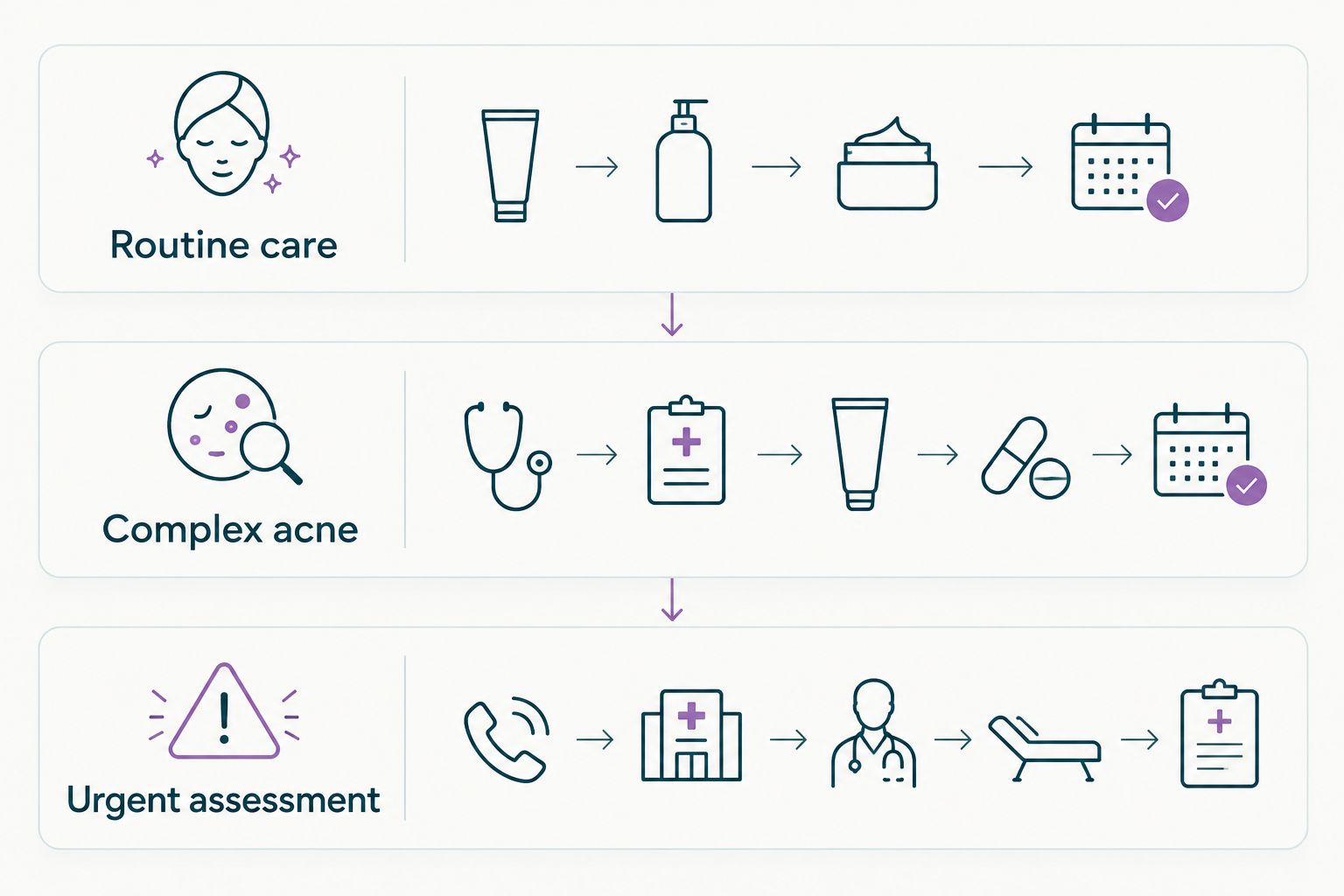
How to choose your care pathway
For online treatment for acne in 2026, start with your symptoms rather than a provider ranking:
- Routine care: Mild breakouts without deep pain or scarring can begin with suitable self-care or a clinician consultation.
- Complex acne: Persistent breakouts, treatment intolerance, deep lesions, or developing scars call for clinician assessment and possible dermatology care.
- Urgent assessment: Fever with spreading redness, marked facial swelling, or swelling around an eye needs prompt medical evaluation rather than a routine acne intake.
A painful bump is not automatically acne. Tell the clinician about sudden changes, drainage, fever, and symptoms near your eyes instead of submitting only a close-up photograph.
Prepare for an online acne consultation
Give the clinician enough information to make a useful assessment. Clear context is more valuable than a long list of treatments you want to request.
- Take clear photographs: Use even lighting, show the affected areas, and avoid filters that alter redness or skin texture.
- List current products: Include cleansers, acne treatments, moisturizers, supplements, and prescription medications.
- Describe the pattern: Explain when breakouts started, where they appear, and whether lesions hurt or leave scars.
- Explain past treatment: Record what you used, how consistently you used it, and whether it helped or caused irritation.
- Share safety information: Include allergies, pregnancy or pregnancy plans, and relevant medical conditions.
Before finishing, ask what improvement to expect, how to handle irritation, and when to arrange reassessment. You should leave with instructions, not just a medication name.
How the options are ranked
This 2026 ranking prioritizes clinical fit, licensed assessment, treatment explanation, follow-up, escalation, and usable instructions. Dermatologist-led online care leads for acne-specific assessment; the other options each serve a different need.
The ranking compares care pathways, not measured outcomes between individual businesses. A general telehealth service should not be treated as an acne specialist simply because it offers skin consultations.
Which acne care option should you choose?
Choose dermatologist-led online care as your default when you want acne-specific prescription assessment. Choose primary care telehealth when the broader medical history is central, and use suitable over-the-counter care for mild breakouts without warning signs.
Choose in-person dermatology for deep, painful, scarring, or unclear lesions. In 2026, the useful distinction is still clinical: what can be assessed remotely, and what requires examination?
FAQ
What's the best online treatment for acne in 2026?
Dermatologist-led online care is the strongest fit for acne-specific assessment and prescription guidance. Mild breakouts can also be managed with suitable over-the-counter care, while painful or scarring acne needs clinician assessment and sometimes an in-person visit.
Can NowCare help me with an acne concern?
NowCare offers provider-guided online care for skin concerns within Virtual Urgent Care. Confirm that your acne concern fits its clinical scope and ask what follow-up is appropriate; treatment is provided only when medically appropriate.
Is online acne treatment better than seeing a dermatologist in person?
Online care is not a replacement for every in-person dermatology visit. It suits concerns that can be assessed remotely, while deep lesions, scarring, diagnostic uncertainty, and some monitoring needs favor direct examination.
How long should I give an acne treatment to work?
The American Academy of Dermatology advises allowing 6 to 8 weeks to see some improvement from acne treatment. Follow your clinician's specific instructions, and report significant irritation or worsening symptoms rather than waiting through them.
Can I get an acne prescription through telehealth?
A licensed clinician can prescribe acne treatment through telehealth when the assessment, applicable rules, and your medical history support it. A consultation does not guarantee a prescription, and some treatments require additional testing or in-person care.
What should I avoid when starting acne treatment?
Avoid introducing several new acne ingredients at once or changing products repeatedly before you can assess the response. Follow application instructions, and discuss pregnancy or pregnancy plans before using a topical retinoid such as adapalene.
When should I stop looking for online acne care and seek urgent help?
Seek prompt medical evaluation for fever with spreading redness, marked facial swelling, or swelling around an eye. These symptoms should not be handled as a routine online acne request.
One last thing
A useful acne plan includes a next step if the first treatment fails. Before you begin, identify whom you contact for side effects, when you reassess progress, and what would trigger an in-person examination. Those instructions matter more than receiving a particular prescription.


