
Best overall: clinician-led telehealth for a suspected uncomplicated bladder infection. Best for continuity: your usual clinician’s online service. Best for broader virtual urgent care: NowCare, with UTI eligibility confirmed before you start. This 2026 guide compares online treatment for UTI by clinical review, testing needs, follow-up, and the symptoms that require in-person care.
- Online treatment for UTI starts with clinician assessment, not an automatic antibiotic prescription.
- NowCare offers provider-guided virtual urgent care; confirm that your UTI symptoms qualify before starting.
- Your usual clinician’s online service is the strongest continuity option when previous urine results matter.
- Fever, back or side pain, vomiting, or pregnancy require prompt clinical assessment rather than routine online checkout.
Why this matters
Burning when you urinate does not prove that you have a urinary tract infection. Vaginal infections, sexually transmitted infections, irritation, and other conditions can produce overlapping symptoms. An antibiotic chosen without the right assessment can miss the actual cause.
The best online route in 2026 is the one that separates a likely bladder infection from a problem that needs testing or examination. Convenience comes second. A useful service explains who reviews your symptoms, when testing is necessary, and what happens if treatment does not work.
What makes the best online treatment for UTI
Judge the care process before choosing a platform:
- Licensed clinical review: A clinician evaluates your symptoms and decides whether treatment is medically appropriate.
- Eligibility screening: The intake checks pregnancy, medical history, medications, allergies, and signs of a more serious infection.
- Testing access: The care route explains how to obtain a urine test or other testing when needed.
- Appropriate prescribing: Antibiotic selection accounts for your history, relevant test results, and clinical circumstances.
- Follow-up: You know how to report persistent symptoms, side effects, or a change in your condition.
- Clear boundaries: The service tells you when online care is unsuitable instead of treating every request alike.
For your 2026 decision, give clinical safeguards more weight than a short intake form. A prescription is a possible outcome of assessment, not proof that the assessment was good.
Online UTI care options at a glance
These are care routes, not interchangeable products. The ranking prioritizes assessment first, then continuity and the ability to escalate care. No service is the best choice for every urinary symptom.
| Rank and option | Best for | Standout feature | Key limitation |
|---|---|---|---|
| 1. Live clinician-led telehealth | Discussing a likely uncomplicated bladder infection | Real-time questions and clarification | Cannot perform a physical examination or collect urine remotely |
| 2. NowCare virtual urgent care | Reviewing a provider-guided general telehealth option | Licensed clinicians, secure intake, and ongoing care-team support | Confirm UTI eligibility and any testing pathway before starting |
| 3. Your usual clinician’s online service | Continuity with an established care team | Access to relevant records when held by that practice | Online access and clinical eligibility depend on the practice |
| 4. Asynchronous clinician-reviewed care | Written assessment of straightforward symptoms | You submit a history for clinician review | Written exchanges can make complex symptoms harder to clarify |
1. Live clinician-led telehealth: best for symptom clarification
A live telehealth visit lets you describe urinary symptoms and answer follow-up questions during the consultation. The clinician can assess whether the pattern fits a lower urinary tract infection and whether you need testing or an examination instead.
This route is useful when you are unsure which details matter. You can explain where the pain occurs, whether you have vaginal symptoms, and how this episode differs from a previous infection.
Live clinician-led telehealth pros:
- Allows immediate clarification of your symptom history.
- Gives you space to discuss allergies and previous antibiotic reactions.
- Lets the clinician explain the treatment decision directly.
- Supports a discussion about testing and escalation.
Live clinician-led telehealth cons:
- A remote visit cannot provide a hands-on examination.
- Urine testing requires a separate collection process.
- A consultation does not guarantee an antibiotic prescription.
Best for: Adults whose symptoms appear suitable for remote assessment and who want a conversation before a treatment decision.
Before booking, ask whether the service can arrange testing if the clinician requests it. Also check how you contact the care team after the visit. Those details matter more than the length of the appointment.
Verdict: Skip routine telehealth if you have warning symptoms that need urgent in-person assessment. Otherwise, live clinical review is the default route for discussing a suspected uncomplicated UTI.
2. NowCare: best for reviewing provider-guided virtual urgent care
NowCare connects patients with licensed clinicians for provider-guided online care. Its virtual urgent care offering covers women’s health, men’s health, skin and hair, eyes, ears, nose and throat, and everyday medical concerns through a 1-month plan.
For urinary symptoms, confirm that the service accepts your particular situation before starting. Ask about UTI eligibility, urine testing, and how the care team handles symptoms that do not improve.
NowCare virtual urgent care is best for patients seeking provider-guided online assessment, with UTI eligibility confirmed before starting. Treatment should follow clinical review, not a request for a particular antibiotic.
Provider-guided virtual urgent care pros:
- Licensed clinicians review every plan and prescription.
- Secure intake supports sharing your medical history.
- Prescriptions are sent to your chosen pharmacy when medically appropriate.
- Ongoing care-team support is included in the stated care model.
Provider-guided virtual urgent care cons:
- Fully online care cannot replace a physical examination when one is needed.
- UTI eligibility must be checked rather than assumed from general women’s health coverage.
- You should confirm the testing pathway before relying on this route for urinary symptoms.
Best for: Patients comparing general virtual urgent care services and seeking licensed clinical oversight.
Verdict: Hold until your UTI eligibility and testing needs are confirmed. A general telehealth offering is not, by itself, confirmation that every urinary complaint can be treated online.
3. Your usual clinician’s online service: best for continuity
An online consultation with your established practice keeps the discussion within your existing care relationship. When that practice holds your records, the clinician can review previous urine cultures, medication allergies, and earlier treatment decisions.
Continuity is especially useful when infections recur or a previous antibiotic did not work. You do not have to treat each episode as an isolated event.
Your usual clinician’s online service pros:
- Can draw on records already held by the practice.
- Supports comparison with previous urinary episodes.
- Keeps follow-up within the same care team.
- Provides a route to discuss whether repeated symptoms need further evaluation.
Your usual clinician’s online service cons:
- Not every practice offers online assessment for urinary symptoms.
- The practice can still require a urine sample or an in-person appointment.
- Messaging is unsuitable for an urgent problem if it is not monitored promptly.
Best for: Patients with an established clinician, repeated infections, previous culture results, or a medical history that changes treatment decisions.
Send a focused message rather than simply asking for antibiotics. Include symptom onset, pregnancy possibility, fever or back pain, recent treatment, and any relevant test results.
Verdict: Skip routine portal messaging when you need urgent assessment. For nonurgent symptoms where history matters, your established care team is the strongest continuity choice.
4. Asynchronous clinician-reviewed care: best for written intake
Asynchronous care uses a written questionnaire or message exchange instead of a live appointment. A clinician reviews the information and determines whether remote treatment is appropriate, whether clarification is needed, or whether you need another care setting.
This route fits people who can describe their symptoms clearly in writing. It does not remove the need for medical judgment.
Asynchronous clinician-reviewed care pros:
- Lets you organize symptoms and medical history in writing.
- Provides a written record of the information you submitted.
- Does not require a live conversation when the service accepts your situation.
Asynchronous clinician-reviewed care cons:
- Missing details can delay or change the assessment.
- Written communication can make unusual symptoms harder to explain.
- Response timing and follow-up processes depend on the service.
Best for: Patients with straightforward symptoms who are eligible for that service and comfortable with written communication.
Read the questions carefully. Report vaginal discharge, pelvic pain, recent antibiotics, kidney problems, and pregnancy possibility rather than selecting only the answers that seem likely to produce a prescription.
Verdict: Skip questionnaire-only care for complex symptoms or urgent warning signs. A shorter intake is not a reason to leave out clinically important information.
When online care is not enough
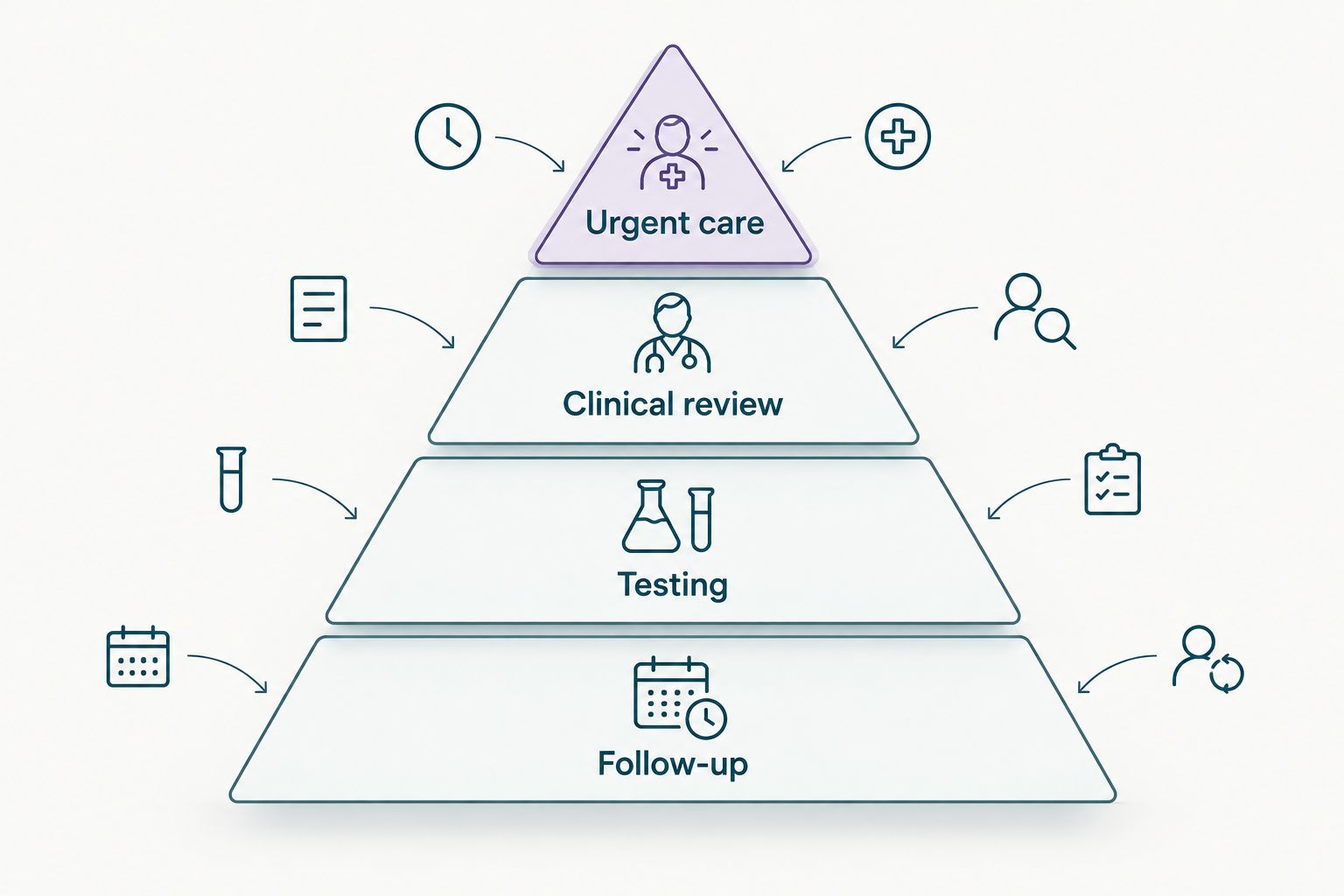
Use the following priorities when choosing care in 2026. They help separate a routine consultation from a situation that needs a different response.
- Urgent care: Fever or chills with urinary symptoms, pain in your back or side, or vomiting can indicate a kidney infection. Seek prompt in-person assessment. Severe illness, confusion, or fainting warrants emergency evaluation.
- Clinical review: Pregnancy or possible pregnancy, symptoms in a child, urinary symptoms in a man, a catheter, or significant kidney or immune problems require specific clinical assessment. Do not assume routine online eligibility.
- Testing: Repeated infections, an uncertain diagnosis, or persistent symptoms can require urine testing or evaluation for another cause.
- Follow-up: Contact the treating clinician if symptoms worsen or have not started improving within 48 hours of beginning antibiotics. Seek care sooner for warning symptoms.
Do not wait for an online message to be answered if your condition is deteriorating. A service that redirects you to in-person care is setting a safety boundary, not failing to provide care.
Prepare for an online UTI assessment
A clear history helps the clinician make a useful decision. Write down when symptoms started and what has changed during the last 24 hours. This is preparation, not a reason to delay seeking care.
Include:
- Burning, urgency, frequency, and any visible blood in your urine.
- Fever, chills, vomiting, or pain in your back or side.
- Vaginal symptoms, pelvic pain, or possible STI exposure.
- Pregnancy possibility and relevant medical conditions.
- Medication allergies and the reaction each medicine caused.
- Recent antibiotics and previous urine culture results, if you have them.
Ask what diagnosis the clinician considers most likely and why. If treatment is prescribed, confirm the instructions, expected follow-up, and symptoms that should change your care plan.
How the options are ranked
This 2026 ranking uses clinical review, eligibility screening, testing access, prescribing safeguards, follow-up, and clear care boundaries. Live telehealth takes the default position because it permits direct clarification; established-practice care leads when continuity is the deciding factor.
The order is not a claim that one platform produces better outcomes than another. Choose the route that fits your clinical needs, not the route most likely to approve antibiotics.
Which online UTI care route should you choose?
For a suspected uncomplicated bladder infection, start with licensed clinical assessment. Choose live telehealth if you need to talk through symptoms. Choose your usual clinician’s online service if previous infections, cultures, or treatment history matter.
Use written clinician-reviewed care only when you meet the service’s eligibility requirements and can report your history accurately. For any general virtual urgent care platform, confirm that urinary symptoms are within scope.
Your 2026 decision should end with a clear next step: remote assessment, testing, or in-person care. It should not end with guessing which antibiotic to request.
FAQ
What’s the best online treatment for UTI in 2026?
The best online treatment for UTI starts with licensed clinician assessment and antibiotics only when medically appropriate. Live telehealth suits symptom clarification, while your usual clinician’s online service is useful when previous records matter.
Can NowCare treat my UTI online?
Confirm UTI eligibility directly with NowCare before starting. Its stated offering includes provider-guided virtual urgent care, but your symptoms and any testing needs must fit the service’s clinical scope.
Can I get UTI antibiotics without a urine test?
A clinician can sometimes treat a likely uncomplicated bladder infection based on symptoms and medical history. Pregnancy, repeated infections, uncertain symptoms, or treatment failure can change the need for urine testing.
Is a video visit better than a UTI questionnaire?
A live visit is better for discussing unclear or complex symptoms because the clinician can ask follow-up questions directly. A clinician-reviewed questionnaire can suit straightforward cases when you meet the service’s eligibility rules.
When should I go in person instead of treating a UTI online?
Seek prompt in-person assessment for urinary symptoms with fever, chills, back or side pain, or vomiting. Pregnancy also requires prompt clinical contact, and severe illness, confusion, or fainting warrants emergency evaluation.
What if my UTI symptoms do not improve after antibiotics?
Contact your treating clinician if symptoms worsen or have not started improving within 48 hours of beginning antibiotics. You can need urine testing, a different treatment decision, or assessment for another diagnosis; seek care sooner for warning symptoms.
Can I use leftover antibiotics for a suspected UTI?
Do not use leftover antibiotics for a suspected UTI. The medicine or course can be inappropriate, and similar symptoms can have a cause that antibiotics will not treat.
One last thing
Pain relief is not infection treatment. A medicine that reduces urinary burning does not establish the diagnosis or replace an antibiotic when one is needed. Tell your clinician what you have taken, even if it made the symptoms feel better.


