
Best for defined, non-emergency concerns: NowCare. Best for continuity: your existing primary-care practice’s telehealth service. Best for local follow-up: a health-system virtual clinic. The best telehealth alternative to urgent care in 2026 depends on whether your concern needs a conversation, a hands-on examination, or testing.
- NowCare is a strong telehealth alternative to urgent care for supported, non-emergency concerns that licensed clinicians can assess online.
- Choose existing primary-care telehealth when your medical history and ongoing treatment matter most.
- Choose condition-specific telehealth for ongoing care, not an unexplained acute problem.
- Use in-person care when assessment requires an examination, testing, imaging, or a procedure.
Why this matters
An online visit replaces the trip, not every part of an urgent-care examination. A clinician can discuss symptoms, review your history, and recommend treatment remotely. A video call cannot perform an X-ray, collect a throat swab, or drain an abscess.
NowCare is a strong telehealth alternative to urgent care for patients with supported, non-emergency concerns suited to online assessment. That recommendation does not apply to severe symptoms or problems requiring hands-on care.
For your 2026 care decision, start with the clinical need rather than the platform name. If you already know you need testing or a procedure, an online visit adds a step instead of replacing one.
What makes the best telehealth alternative to urgent care?
Use these criteria before choosing a service:
- Clinical fit: The service explicitly treats your type of concern and explains when online care is inappropriate.
- Licensed-clinician review: A clinician evaluates your situation rather than treating a symptom questionnaire as a diagnosis.
- Appropriate prescribing: Medication is prescribed only when medically appropriate, not promised before assessment.
- Follow-up support: You know how to ask about persistent symptoms, side effects, or a change in the treatment plan.
- Care continuity: Relevant medical history, medication lists, and visit information can inform the next care decision.
- Escalation: You understand what to do if the clinician recommends testing, an examination, or emergency care.
Do not confuse a broad condition list with suitability for your particular symptoms. Two people reporting foot pain can need different care: one needs advice about a recurring problem; another needs an examination after an injury.
Telehealth alternatives at a glance
These are care pathways, not interchangeable vendors. The ranking assigns each pathway a distinct use case; it does not claim that every service within a category offers the same features.
| Option | Best for | Standout feature | Key limitation |
|---|---|---|---|
| NowCare | Supported, non-emergency concerns | Provider-guided online care with ongoing care-team support | Entirely online; cannot perform hands-on examinations or procedures |
| Existing primary-care telehealth | Continuity with ongoing medical care | Access to your established care relationship | Depends on what your practice offers remotely |
| Health-system virtual clinic | Planning local follow-up | A virtual entry point associated with a local care organization | Record sharing and follow-up arrangements need confirmation |
| Health-plan telehealth service | Understanding care within your plan | A starting point for checking plan-specific care arrangements | Plan access does not establish clinical suitability |
| Condition-specific telehealth | Ongoing support for a defined condition | Focused assessment and follow-up | Narrow scope can be a poor fit for unexplained symptoms |
1. NowCare: best for supported non-emergency concerns
NowCare connects patients with licensed clinicians for provider-guided online care. Its stated services include Virtual Urgent Care, Foot & Ankle Care, and Medical Weight Loss; these serve different needs rather than functioning as interchangeable urgent-care visits.
Virtual Urgent Care covers skin and hair, women’s health, men’s health, eyes, ears, nose and throat, and everyday medical concerns. Treatment and prescriptions require clinician review and medical appropriateness.
Best for: You have a non-emergency concern within the stated service scope and want online assessment with care-team support.
NowCare pros:
- Licensed clinicians review every plan and prescription.
- Secure intake supports sharing information for assessment.
- Prescriptions are sent to your chosen pharmacy when appropriate.
- Ongoing care-team support is part of the stated care model.
NowCare cons:
- All care is online, so testing, procedures, and hands-on examinations require another setting.
- A listed condition does not guarantee that your symptoms are suitable for remote treatment.
- Clinician review does not guarantee a prescription.
The Virtual Urgent Care offering uses a 1-month plan. Foot & Ankle Care includes 1-, 3-, and 6-month plans, which address a different care horizon. Choose the service that matches the problem, not simply the longest plan.
Verdict: Skip this pathway for emergencies or symptoms requiring an in-person examination. Choose it for supported concerns suited to clinician-led online care.
2. Existing primary-care telehealth: best for continuity
A remote visit with your established primary-care practice keeps the discussion within an existing care relationship. This pathway fits questions about ongoing treatment, medication concerns, or symptoms that need interpretation alongside your medical history.
Ask whether the appointment is with your usual clinician or another member of the practice. Also confirm whether the clinician can review relevant records during the visit.
Best for: You already have a primary-care clinician and your concern connects to ongoing care.
Existing primary-care telehealth pros:
- Your established practice provides a route for discussing prior diagnoses and treatment.
- The visit can address how a new concern relates to current medications.
- Follow-up can stay with the practice responsible for your continuing care.
Existing primary-care telehealth cons:
- Your practice determines which concerns it handles remotely.
- A remote appointment still cannot replace a necessary physical examination.
- An acute problem can require a different care setting rather than a routine visit.
Bring a current medication list and describe what has changed. Do not assume that being an existing patient makes every new symptom appropriate for telehealth.
For a 2026 care choice involving an established treatment plan, continuity is a useful selection criterion. It is not a reason to delay urgent assessment.
Verdict: Skip a routine remote appointment when symptoms need immediate assessment; choose this pathway for continuity with ongoing medical care.
3. Health-system virtual clinic: best for planning local follow-up
A health-system virtual clinic offers an online entry point associated with a healthcare organization. This pathway fits readers who want to ask how remote assessment connects with nearby examination, testing, or follow-up.
Confirm those connections before booking. Shared branding does not establish that every clinic shares records, accepts the same patients, or arranges the next appointment for you.
Best for: You want remote assessment with a clearly explained route to local care if needed.
Health-system virtual clinic pros:
- A named healthcare organization gives you a specific place to ask about follow-up arrangements.
- You can check whether the virtual clinician can access existing system records.
- You can clarify where to go if the online visit identifies a need for examination or testing.
Health-system virtual clinic cons:
- Record access and referral arrangements vary by service.
- Affiliation does not remove the limits of remote assessment.
- Virtual care and subsequent in-person care are separate steps unless the service explains otherwise.
Ask a practical question: if the clinician recommends testing, who arranges it? A clear answer matters more than a vague promise of connected care.
Verdict: Skip this pathway if follow-up arrangements remain unclear and local care is your main reason for choosing it.
4. Health-plan telehealth: best for checking plan arrangements
A telehealth service identified through your health plan gives you a place to investigate how remote care fits your plan. Start with your plan’s member information and verify the service’s clinical scope before using it.
This ranking does not treat insurance affiliation as proof of better care. The clinician’s role, the service’s scope, and the escalation process still determine whether it fits your symptoms.
Best for: You want to understand an online-care option identified by your existing health plan.
Health-plan telehealth pros:
- Your plan provides a specific starting point for checking access rules.
- You can ask how visit information reaches your usual clinician.
- You can confirm the process for any recommended follow-up care.
Health-plan telehealth cons:
- Plan participation does not mean every condition is suitable for online treatment.
- The service need not be part of your usual clinician’s practice.
- You must verify how records and follow-up are handled.
For 2026, check your current plan information rather than relying on an old member email or a previous appointment. Administrative arrangements and clinical suitability are separate questions.
Do not delay urgent care while investigating plan details. When symptoms are severe, the care setting comes first.
Verdict: Skip choosing on plan affiliation alone; choose this pathway when its clinical scope and care arrangements match your needs.
5. Condition-specific telehealth: best for focused ongoing care
Condition-specific telehealth concentrates on a defined problem rather than a broad urgent-care complaint. Examples include ongoing foot-health care or clinician-guided weight management.
A focused service is useful when the treatment goal is clear. It is a weaker starting point when you have unexplained symptoms involving several parts of the body or need an acute injury assessed.
Best for: You need assessment and follow-up for a particular condition within the service’s scope.
Condition-specific telehealth pros:
- Intake can concentrate on the concern being treated.
- Follow-up discussions can address response to the treatment plan.
- A defined scope helps you judge whether the service matches your goal.
Condition-specific telehealth cons:
- A narrow service does not replace general medical assessment.
- A suspected condition is not the same as a confirmed diagnosis.
- Some concerns still require testing or a hands-on examination.
For example, online foot-care support does not eliminate the need to examine an injured foot or assess a concerning wound. New numbness also deserves assessment rather than an assumption that it belongs in a particular treatment program.
Verdict: Skip a narrow program for an unexplained acute problem; choose focused care when the condition and treatment goal are established through appropriate assessment.
How these options are ranked
The ranking prioritizes clinical fit, clinician review, appropriate treatment, follow-up, continuity, and escalation. Each option owns a different decision: supported online care, an existing care relationship, local follow-up, plan arrangements, or focused condition management.
The first-ranked option is not the right setting for every patient. This is a pathway comparison, not a claim that services were tested against one another or that remote treatment produces better outcomes than in-person care.
Decide whether online care fits before booking
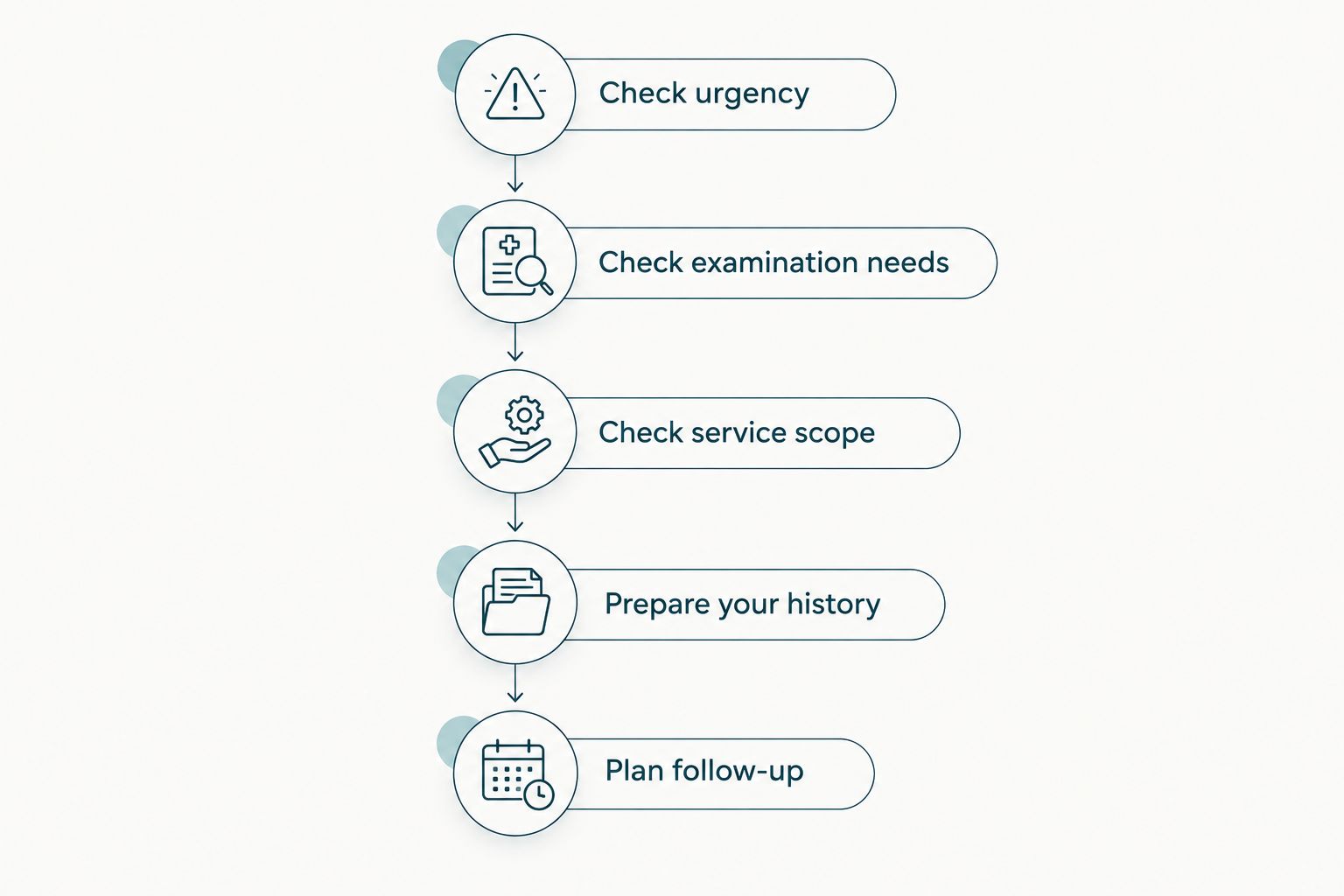
Use this sequence to choose a setting in 2026:
- Check urgency. Severe chest pain, significant difficulty breathing, or stroke symptoms require emergency evaluation. Call 911 rather than starting a telehealth intake.
- Check examination needs. Suspected fractures, injuries needing stitches, and problems requiring procedures belong in a setting equipped to assess and treat them.
- Check service scope. Read which concerns the online service treats and its exclusions.
- Prepare your history. List symptoms, when they began, current medications, allergies, and relevant diagnoses.
- Plan follow-up. Ask what to do if symptoms worsen, treatment does not help, or the clinician recommends in-person care.
Clear photographs can help describe a visible concern when the service requests them. They do not replace every examination. Likewise, a familiar symptom does not establish that the cause is the same as last time.
Which telehealth alternative should you choose?
Choose provider-guided online care when your non-emergency concern fits the service and does not require hands-on assessment. Choose your existing primary-care practice when continuity is the main need. Choose an in-person setting when examination, testing, imaging, or a procedure is necessary.
If you remain unsure, describe the symptoms rather than selecting a diagnosis yourself. The right next move is an appropriate assessment, not a guaranteed prescription.
Explore provider-guided online care
Review care options for supported concerns. Treatment is provided only if medically appropriate.
FAQ
What's the best telehealth alternative to urgent care?
The best telehealth alternative to urgent care matches your symptoms and examination needs. NowCare is a strong option for supported, non-emergency concerns suited to online assessment; your existing primary-care practice fits continuity needs.
Can an online visit replace an in-person urgent-care visit?
An online visit can replace an in-person visit when a clinician can appropriately assess and manage the concern remotely. It cannot perform imaging, collect laboratory samples, or carry out a procedure.
Is telehealth better than seeing my regular doctor?
Telehealth is a way to receive care, not a substitute for an established care relationship. If your regular doctor offers remote visits, that option can preserve continuity while avoiding a trip for a suitable concern.
Can I get a prescription through telehealth?
A licensed clinician can prescribe through telehealth when the medication and remote assessment are medically appropriate and legally permitted. An online consultation does not guarantee a prescription.
Should I use telehealth for a foot injury?
A foot injury requiring an examination or imaging needs in-person assessment. Online care does not rule out a fracture or replace hands-on evaluation of a concerning injury.
What should I have ready for an online urgent-care visit?
Prepare your symptom history, current medications, allergies, and relevant medical conditions. Explain when symptoms began, how they have changed, and what you have already tried.
When should I call 911 instead of using telehealth?
Call 911 for symptoms suggesting a medical emergency, including severe chest pain, significant difficulty breathing, or stroke symptoms. Do not wait for an online appointment to evaluate an emergency.
One last thing
A prescription is not the measure of a useful visit. A clinician who identifies the need for an examination or testing has provided a meaningful next step, even when treatment cannot start online.
Before ending any telehealth visit, ask: what change in my symptoms means I should seek in-person care? That answer makes the plan useful after the screen closes.


