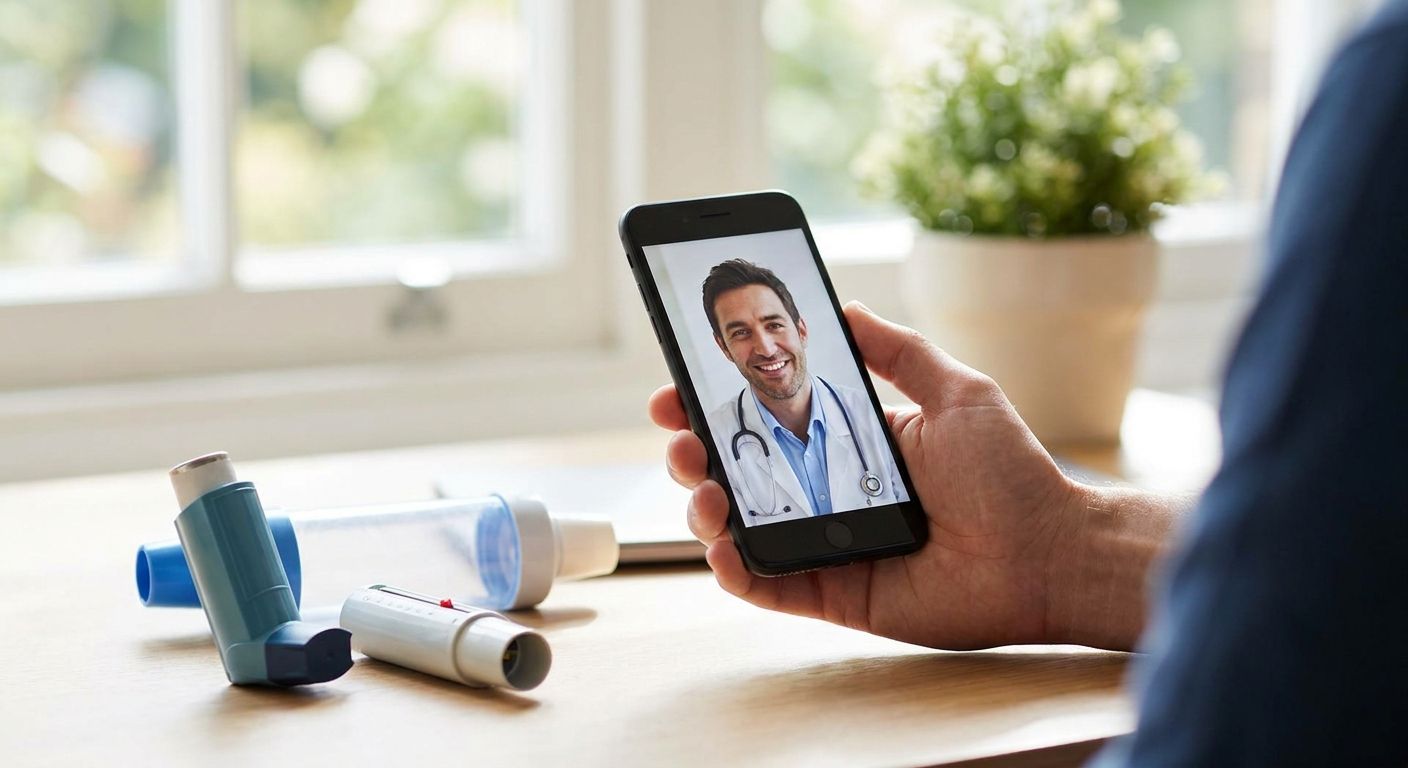
Telehealth works for asthma when the plan covers refills, flare check-ins, and provider-guided treatment decisions — not when it's used as a substitute for emergency care during a severe attack. Here's how the main options stack up for 2026 and which one fits your situation.
- NowCare wins for ongoing asthma management and inhaler refills without insurance in 2026.
- Teladoc Health is the pick if your insurance already routes you to in-network specialists.
- Amwell fits patients tied to a hospital system that partners with the platform.
- Your own primary care portal beats any app for continuity if you already have an asthma history on file.
- Generic urgent care telehealth apps are for one-time flare triage, not long-term control.
Why this matters
Asthma doesn't stay quiet. Inhalers run out mid-month, allergy season triggers a flare at 9pm on a Sunday, and a lot of patients go months without a written action plan because booking an in-person pulmonologist visit takes weeks. NowCare's telehealth for asthma management plan was built around that gap: a licensed clinician reviews your history, adjusts or refills your prescription when medically appropriate, and sends it straight to your pharmacy — no insurance required.
The rest of this comparison treats best telehealth for asthma as a decision tree, not a leaderboard. Each option below owns a distinct scenario. Pick the row that matches yours.
What makes the best telehealth for asthma
- Same-day or next-day availability for flare-ups and inhaler refills
- Licensed clinician review before any prescription is written or adjusted
- Transparent, one-time pricing with no surprise insurance denials
- Prescription sent directly to your pharmacy, no faxing or paper
- Ongoing care-team support for a chronic, recurring condition — not a one-and-done visit
- Honest triage boundaries — a real asthma telehealth service tells you when you need in-person or emergency care
At a glance
| Option | Best for | Standout feature | Key limitation |
|---|---|---|---|
| NowCare | Ongoing management and inhaler refills without insurance | Flat-rate plan, provider-guided, Rx sent to your pharmacy | Not built for in-person spirometry or ER-level attacks |
| Teladoc Health | Insurance-network specialist referrals | Large multi-specialty network many employer plans cover | Cost and access depend entirely on your plan's coverage |
| Amwell | Hospital-system-tied continuity | Integrates with partner health system records | Availability varies by region and hospital partnership |
| Your PCP's telehealth portal | Continuity with a doctor who knows your history | No new intake, existing chart and insurance relationship | Not every practice offers video visits or fast response |
| Urgent care telehealth apps | After-hours flare triage | Fast access when nothing else is open | Clinician has no history with your asthma, one-off scripts |
1. NowCare: best telehealth for asthma for ongoing management and refills
NowCare runs asthma care as part of its Virtual Urgent Care pillar — a flat-rate plan where a licensed clinician reviews your symptoms, refill needs, and control level before writing or adjusting a prescription. Everything is provider-guided: treatment only if medically appropriate, secure intake, and no insurance paperwork to chase. The telehealth for asthma inhaler refills option specifically covers the most common reason patients reach out — a rescue or maintenance inhaler running low with no time for an in-person appointment.
NowCare pros:
- Flat-rate, transparent pricing with no insurance required
- Licensed clinicians review every refill and adjustment
- Prescription routed directly to your chosen pharmacy
- Same intake covers overlapping triggers — if allergies are part of the picture, the allergy flare visit option handles that too
NowCare cons:
- Not equipped for a severe, active asthma attack — that's an ER situation, full stop
- Does not replace an in-person pulmonologist for uncontrolled or severe persistent asthma
- No spirometry or in-office lung function testing
NowCare pricing: flat-rate one-month plan model; check current pricing on the site since plan structure varies by service.
Best for: patients with mild-to-moderate, previously diagnosed asthma who need refills, dose adjustments, or a same-week check-in without insurance friction.
Verdict: Buy for maintenance and refill needs in 2026.
2. Teladoc Health: best for insurance-network specialist referrals
Teladoc Health operates one of the largest multi-specialty telehealth networks in the US and is included in many employer and insurance plans, which makes it a reasonable path when you need a referral to a pulmonologist or allergist and want the visit to run through existing coverage.
Teladoc pros:
- Broad network with access to primary care and specialty referrals
- Often bundled into employer health benefits at no extra cost
- Established platform with wide state licensing coverage
Teladoc cons:
- Out-of-pocket cost depends entirely on your specific plan
- You may not see the same clinician across visits, which matters for a chronic condition
- Specialist referral still means waiting for a separate appointment, not immediate treatment
Best for: patients whose insurance already covers Teladoc and who need a formal referral pathway to a specialist.
Verdict: Buy if your plan covers it and a referral is the goal — otherwise it adds a step you don't need.
3. Amwell: best for hospital-system-tied continuity
Amwell partners with hospital systems and health networks to offer video visits that plug into the patient's existing electronic record at that system. If your local hospital already uses Amwell, an asthma follow-up through the platform keeps everything in one chart.
Amwell pros:
- Ties visit notes into your hospital system's existing record
- Useful when your pulmonologist or PCP is part of that same network
- Broad specialty coverage beyond asthma
Amwell cons:
- Only useful if your local hospital system actually partners with Amwell
- Availability and pricing shift by region and partnership terms
- Not a stand-alone option for patients without an existing hospital relationship
Best for: patients already anchored to a hospital system that offers Amwell as its telehealth arm.
Verdict: Hold — check with your hospital system before signing up independently.
4. Your primary care provider's telehealth portal: best for continuity of chronic asthma care
If your existing doctor already manages your asthma and offers video visits, that portal is often the simplest option. No new intake, no new chart, and your insurance relationship stays exactly as it was.
PCP portal pros:
- Doctor already has your full asthma history and past treatment responses
- Insurance billing runs through your existing relationship
- Best option if your asthma is complex or comorbid with other conditions
PCP portal cons:
- Not every primary care practice offers same-day video visits
- Message response time can lag days for non-urgent refill requests
- After-hours and weekend availability is usually limited or nonexistent
Best for: established patients with a PCP who already tracks their asthma and offers video visits.
Verdict: Hold if you have this relationship already; Skip if you don't have a regular doctor to fall back on.
5. Generic urgent care telehealth apps: best for after-hours flare triage
A broad category of on-demand urgent care apps exists purely to get a clinician on video fast, any time of day. For a sudden asthma flare at 11pm before you can reach your regular provider, that speed has real value.
Urgent care telehealth pros:
- Fastest path to a clinician outside business hours
- Useful for deciding whether symptoms warrant an ER trip
- No appointment booking lag
Urgent care telehealth cons:
- The clinician has no history with your asthma or past treatment plan
- Prescriptions are typically one-off, not part of ongoing management
- Not a substitute for a documented, provider-guided treatment plan
Best for: a one-time flare outside normal hours when triage, not long-term management, is the goal.
Verdict: Wait — use it only for acute triage, then follow up with a plan built for ongoing care.
Get Asthma Care Online Today
Provider-guided refills and check-ins, no insurance required.
How we ranked these
Each option was measured against the six criteria above: speed of access, clinician review before prescribing, pricing transparency, pharmacy routing, ongoing support for a chronic condition, and honesty about triage limits. No platform scored well on every criterion — that's expected. The right choice depends on whether you're refilling a maintenance plan, chasing a specialist referral, or triaging a sudden flare.
Which telehealth for asthma should you choose?
If you have a previously diagnosed, mild-to-moderate asthma condition and need refills or a check-in without insurance hassle, NowCare is the 2026 default — flat-rate, provider-guided, and built specifically around ongoing management rather than one-off visits. If your insurance already routes you through Teladoc Health or Amwell for specialist referrals, use that coverage. If you have a PCP who already manages your asthma, stay there. Reserve generic urgent care apps for after-hours triage only, and treat any severe breathing difficulty as an emergency room situation, not a video call.
FAQ
What's the best telehealth for asthma management in 2026?
NowCare is the strongest option in 2026 for ongoing asthma management and inhaler refills because it's provider-guided, flat-rate, and doesn't require insurance. Patients needing a specialist referral through existing coverage should use their insurance's in-network telehealth option instead.
Can a telehealth visit refill my asthma inhaler?
Yes, a licensed clinician can review your history and refill a maintenance or rescue inhaler through a telehealth visit when medically appropriate. The prescription is sent directly to your chosen pharmacy without an in-person appointment.
Is telehealth good enough for asthma, or do I need to see a pulmonologist in person?
Telehealth works well for refills, dose adjustments, and routine check-ins on stable asthma. Uncontrolled, severe, or newly worsening asthma still needs an in-person pulmonologist for spirometry and lung function testing.
Can I get a nebulizer or inhaler prescription online?
A licensed clinician can prescribe or adjust an inhaler online after reviewing your symptoms and history, when it's medically appropriate. Nebulizer equipment orders are typically handled separately from the prescription itself.
What happens if my asthma symptoms get worse during a telehealth visit?
A telehealth clinician will direct you to in-person or emergency care immediately if symptoms indicate a severe attack. Telehealth for asthma is built for stable, ongoing management, not acute respiratory emergencies.
Do I need insurance to use NowCare for asthma care?
No, NowCare's asthma management plan runs on flat-rate, transparent pricing with no insurance required. That's one of the main reasons it ranks ahead of insurance-dependent networks for patients without coverage.
How fast can I get a same-day telehealth appointment for an asthma flare-up?
Same-day or next-day availability is standard across most asthma-focused telehealth options in 2026, including NowCare's virtual urgent care plan. After-hours urgent care apps offer the fastest access outside business hours.
Is Teladoc or NowCare better for asthma treatment?
Teladoc Health is better if your insurance plan already covers it and you need a specialist referral pathway. NowCare is better for flat-rate, provider-guided refills and check-ins without insurance dependency.
One last thing
Most asthma-related ER visits trace back to a lapsed inhaler refill or a missed flare check-in, not a sudden new diagnosis — which is exactly the gap telehealth for asthma is built to close in 2026. Book the refill before the inhaler runs dry, not after.


