
Best for provider-guided online bunion care: NowCare. Best for continuity: telehealth with your existing podiatrist. Best for broader medical concerns: primary care telehealth. Best for surgical decisions: a foot-and-ankle practice that combines virtual visits with in-person assessment. This 2026 guide compares care routes rather than naming an unsupported overall winner.
- NowCare is a best telehealth bunion treatment option for patients seeking provider-guided online structural foot care.
- Your existing podiatrist is the strongest choice for continuity when that practice offers virtual visits.
- Telehealth supports symptom review and conservative care; it does not straighten a bunion.
- Choose in-person assessment for wounds, severe symptoms, or decisions requiring examination and imaging.
Why this matters
A bunion is more than a bump. It involves a change in alignment around the joint at the base of the big toe, and treatment depends on your pain, footwear tolerance, skin condition, and walking difficulties—not appearance alone.
The best telehealth bunion treatment starts with choosing the right kind of assessment. Online care can help you discuss symptoms and nonsurgical management. It cannot replace a hands-on examination when circulation, sensation, joint movement, or surgical planning needs closer evaluation.
For your 2026 comparison, separate access to advice from the ability to complete treatment. A convenient online visit is useful only when the clinician can identify what belongs online and what needs an examination elsewhere.
What makes the best telehealth bunion treatment?
Judge an online bunion service against these criteria before choosing a provider:
- Condition fit: Look for structural foot care or an explicit willingness to assess bunion symptoms. General virtual urgent care is not automatically a foot-specialist service.
- Licensed clinical review: Treatment decisions belong with a licensed clinician, not a symptom quiz alone.
- Conservative-care guidance: You need advice that connects footwear, pressure relief, activity, and pain management to your symptoms.
- Clear examination limits: A suitable clinician explains when photographs and symptom history are insufficient.
- Follow-up pathway: Know how to ask questions, report worsening symptoms, and arrange an in-person assessment when needed.
- Medical context: Diabetes, reduced sensation, skin breakdown, and circulation concerns change how safely you can manage a painful foot at home.
The strongest choice is not necessarily the service offering the most treatments. It is the care route that matches your current problem without promising correction that an online consultation cannot deliver.
Telehealth bunion care at a glance
These options occupy different use-case slots. The table compares their role and limitations, not unverified provider outcomes.
| Option | Best for | Standout feature | Key limitation |
|---|---|---|---|
| NowCare | Provider-guided online structural foot care | Bunions are included within its Foot & Ankle Care offering | All care is online; physical examination and imaging require another setting |
| Your existing podiatrist's telehealth service | Continuity of established care | Follow-up with a clinician already involved in your treatment | Only an option when your practice offers virtual appointments |
| Primary care telehealth | Bunion symptoms alongside broader medical concerns | Discussion of medical history, medicines, and the need for referral | Does not replace a focused foot examination |
| A hybrid foot-and-ankle practice | Examination and surgical decision-making | Virtual discussion connected to an in-person care pathway | You must verify which assessments and follow-ups are available virtually |
1. NowCare: best online bunion care for provider-guided support
NowCare provides online Foot & Ankle Care that includes structural foot problems such as bunions, flat feet, and hammertoes. Licensed clinicians review care plans and prescriptions, with treatment only if medically appropriate. This makes the service relevant when you want clinical guidance rather than choosing a bunion product on your own.
The platform uses secure intake and offers ongoing care-team support. When a prescription is appropriate, it is sent to your chosen pharmacy; a prescription is not a guaranteed outcome of a consultation.
Best for: Patients seeking an online starting point for bunion symptoms and provider-guided conservative care.
NowCare pros:
- Structural foot problems, including bunions, are explicitly part of the service.
- Licensed clinicians review each plan and prescription.
- Ongoing care-team support provides a route for questions during care.
- No insurance is required to use the service.
NowCare cons:
- The service is entirely online, so it cannot provide a hands-on foot examination.
- An online care plan cannot physically correct bunion alignment.
- Imaging, procedures, and an in-person surgical assessment require care outside the online platform.
The Foot & Ankle Care offering includes 1-month, 3-month, and 6-month plans. These are care-plan durations, not promises that a bunion will resolve within that period. Choose the duration around the clinician's recommendations and your follow-up needs, not an assumed recovery deadline.
Verdict: Choose for an online care starting point; skip as a substitute for an examination that your symptoms require.
2. Your existing podiatrist: best telehealth bunion care for continuity
If a podiatrist already treats your bunion and offers telehealth, virtual follow-up keeps the discussion connected to established care. You can discuss changes in discomfort, problems with footwear, and how an existing treatment plan fits your daily routine.
Ask whether the appointment will be with the clinician who knows your case and whether relevant records are available. Continuity comes from that clinical relationship—not simply from booking another foot-related video visit.
Best for: Patients with an established bunion assessment who need follow-up rather than a fresh diagnosis.
Existing-podiatrist telehealth pros:
- Keeps follow-up connected to the clinician already involved in your care.
- Provides a setting to discuss whether earlier recommendations remain practical.
- Lets you ask whether new symptoms require a return to the examination room.
Existing-podiatrist telehealth cons:
- Virtual appointments depend on what your practice offers.
- New or substantially changed symptoms can still require examination or imaging.
- A video visit cannot reproduce the hands-on checks performed during an office appointment.
Before booking, explain what has changed since your last assessment. Pain in a new location, a new wound, or a sudden loss of function should not be treated as a routine progress update.
For a 2026 follow-up, bring your previous treatment instructions and describe what you actually tried. That is more useful than saying the plan did not work without explaining which parts you followed.
Verdict: Choose for established-care follow-up; skip when you need a fresh hands-on assessment.
3. Primary care telehealth: best for bunion symptoms with medical concerns
Primary care telehealth is a useful route when foot discomfort sits alongside questions about your wider health. A primary care clinician can discuss your symptoms, medical history, medicines, and whether you need a focused foot assessment.
This route is not a replacement for podiatry or orthopedic evaluation. Its value is helping you place the foot problem within your overall care, particularly when you are unsure which clinician to contact first.
Best for: Patients who need medical context or help choosing the next clinical step.
Primary care telehealth pros:
- Gives you a place to discuss foot symptoms alongside existing medical conditions.
- Supports a medication-safety discussion before you choose a pain reliever.
- Helps determine whether referral or in-person assessment is the next step.
Primary care telehealth cons:
- General medical care does not replace a focused structural foot examination.
- Specialist assessment remains necessary for some treatment decisions.
- A referral discussion is not the same as completing the referred assessment.
Describe diabetes, reduced sensation, previous foot wounds, and circulation problems at the start of the consultation. Those details affect the safety of self-care and should not be left until the end.
Verdict: Choose for broader medical questions; skip as your sole route for surgical planning.
4. Hybrid foot-and-ankle care: best for examination and surgical decisions
A hybrid pathway combines virtual discussion with in-person assessment when needed. Choose this route when you want to discuss surgery, have persistent functional limitations, or need findings that cannot be established through a screen.
Bunion surgery decisions involve more than how prominent the bump looks. Symptoms, examination findings, alignment, and appropriate imaging inform the discussion. Confirm that the practice evaluates bunions and explain your goals before arranging an appointment.
Best for: Patients considering surgery or needing a physical assessment connected to follow-up care.
Hybrid foot-and-ankle care pros:
- Connects virtual discussion to a route for hands-on examination.
- Provides a setting for reviewing imaging when clinically appropriate.
- Supports discussion of nonsurgical care and surgical options within the same care pathway.
Hybrid foot-and-ankle care cons:
- In-person attendance remains part of the pathway when examination is necessary.
- Not every appointment or postoperative assessment is suitable for telehealth.
- You must confirm the practice's virtual-visit arrangements before relying on them.
Ask what the first appointment can accomplish. A virtual discussion can explain the evaluation process, but it should not be presented as a complete surgical assessment when examination findings are still needed.
Verdict: Choose for examination-dependent decisions; skip an online-only route when surgery is your main question.
How to prepare for an online bunion assessment
Give the clinician information that helps distinguish pressure-related discomfort from a problem needing closer examination. Do not assume every painful area near the big toe comes from the bunion.
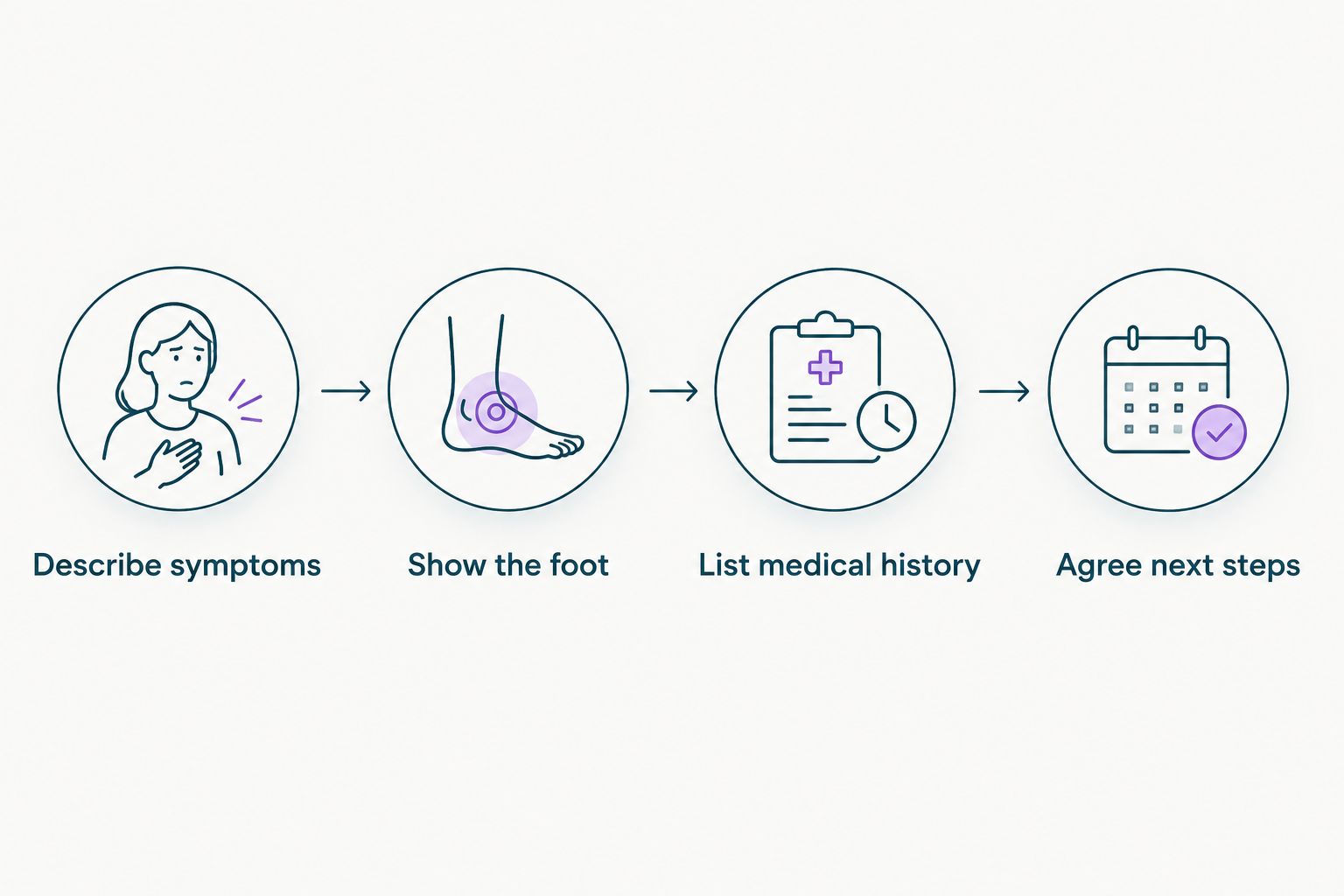
Use this sequence before your appointment:
- Describe symptoms: Explain where pain occurs, when it started, and whether it affects walking, sleep, or ordinary activities.
- Show the foot: If the service requests photographs, provide clear views and follow its submission instructions. Include any visible skin changes.
- List medical history: Include relevant conditions, medicines, allergies, previous foot care, and any existing imaging reports.
- Agree next steps: Ask what you should try, what would count as worsening, and when an in-person examination is needed.
Show or describe the shoes you wear most often. The space around the toes and where the shoe presses against the foot are relevant to a conservative-care discussion.
For your 2026 appointment, keep the description practical: which activity hurts, what you changed, and whether that change helped. Avoid treating photographs as a substitute for telling the clinician how the foot feels and functions.
What online treatment can—and cannot—do
Conservative bunion management focuses on symptoms and pressure. Depending on your assessment, a clinician can discuss wider footwear, padding, activity changes, and appropriate pain management. These measures do not straighten the underlying deformity.
Pressure relief is not structural correction. A device that makes footwear more comfortable should not be treated as proof that the bunion is reversing. Ask what a recommended measure is intended to achieve before using it.
Do not select pain medicine solely from an online list. Your medical history and other medicines affect which options are appropriate, and a clinician or pharmacist can help you check safety.
Avoid applying pads, spacers, or other devices over broken skin without clinical advice. Reduced sensation also makes it harder to judge whether a device is causing harmful pressure.
When to choose in-person care instead
Seek prompt in-person assessment for a foot wound, spreading redness, warmth with worsening swelling, drainage, or fever. Diabetes or reduced sensation makes a new foot wound particularly important to assess promptly.
Sudden severe pain, an injury, or inability to bear weight also needs assessment rather than assuming the bunion is responsible. A cold, pale, or blue foot requires urgent medical attention.
Routine in-person evaluation is also appropriate when pain keeps limiting daily activities despite conservative care, the diagnosis is uncertain, or you want to discuss surgery. Do not wait for an online follow-up when symptoms require urgent examination.
How these options are ranked
This 2026 guide ranks care routes by condition fit, licensed clinical review, continuity, conservative-care support, and access to examination. It does not claim head-to-head testing, compare unverified outcomes, or treat every telehealth service as interchangeable.
The online platform comes first for patients seeking provider-guided structural foot care. An existing podiatrist takes priority for continuity, primary care for broader medical questions, and a hybrid practice for examination-dependent decisions.
Which bunion care option should you choose?
Choose NowCare for provider-guided online bunion care when your goal is an initial clinical discussion and conservative-care guidance. Choose your existing podiatrist instead when you already have an established plan and need follow-up.
If surgery is your main question, start with a foot-and-ankle practice that can examine you. If you have a wound, severe new symptoms, or circulation concerns, prioritize appropriate in-person care over online convenience.
FAQ
What's the best telehealth bunion treatment option?
The best option depends on what your bunion symptoms require. NowCare offers provider-guided online structural foot care; an established podiatrist suits continuity, while examination-dependent decisions need an in-person pathway.
Can an online clinician treat a bunion?
An online clinician can assess your symptom history and guide conservative management when appropriate. Hands-on examination, imaging, procedures, and some diagnostic decisions require in-person care.
Can telehealth straighten a bunion without surgery?
Telehealth does not straighten a bunion. Conservative measures aim to reduce pressure and discomfort rather than correct the underlying alignment change.
Is a podiatrist's video visit better than general telehealth?
A podiatrist's video visit is a stronger fit for continuity when that clinician already manages your bunion. General telehealth is useful for broader medical questions, but neither format replaces an examination when one is needed.
Should I use telehealth if I have diabetes and a sore bunion?
A new wound, spreading redness, drainage, or worsening swelling needs prompt in-person assessment, especially with diabetes. Do not rely on routine online follow-up for a potentially infected or damaged foot.
What should I send before an online bunion appointment?
Send the symptom history and any photographs requested through the service's secure intake process. Include relevant medicines, medical conditions, previous treatments, and existing imaging reports.
Do I need surgery if my bunion looks large?
Appearance alone does not determine whether bunion surgery is appropriate. A clinician considers symptoms, function, examination findings, and appropriate imaging before discussing treatment choices.
When should I stop online care and get examined?
Get examined when symptoms suggest injury, infection, circulation problems, or a diagnosis that remains uncertain. Persistent activity-limiting pain and surgical questions also warrant an in-person evaluation.
One last thing
Judge progress by comfort and function, not photographs alone. Before changing your care plan, identify the activity you want to do more comfortably—walking to work, wearing suitable shoes, or standing through everyday tasks—and tell your clinician whether treatment is helping with that specific goal.


