
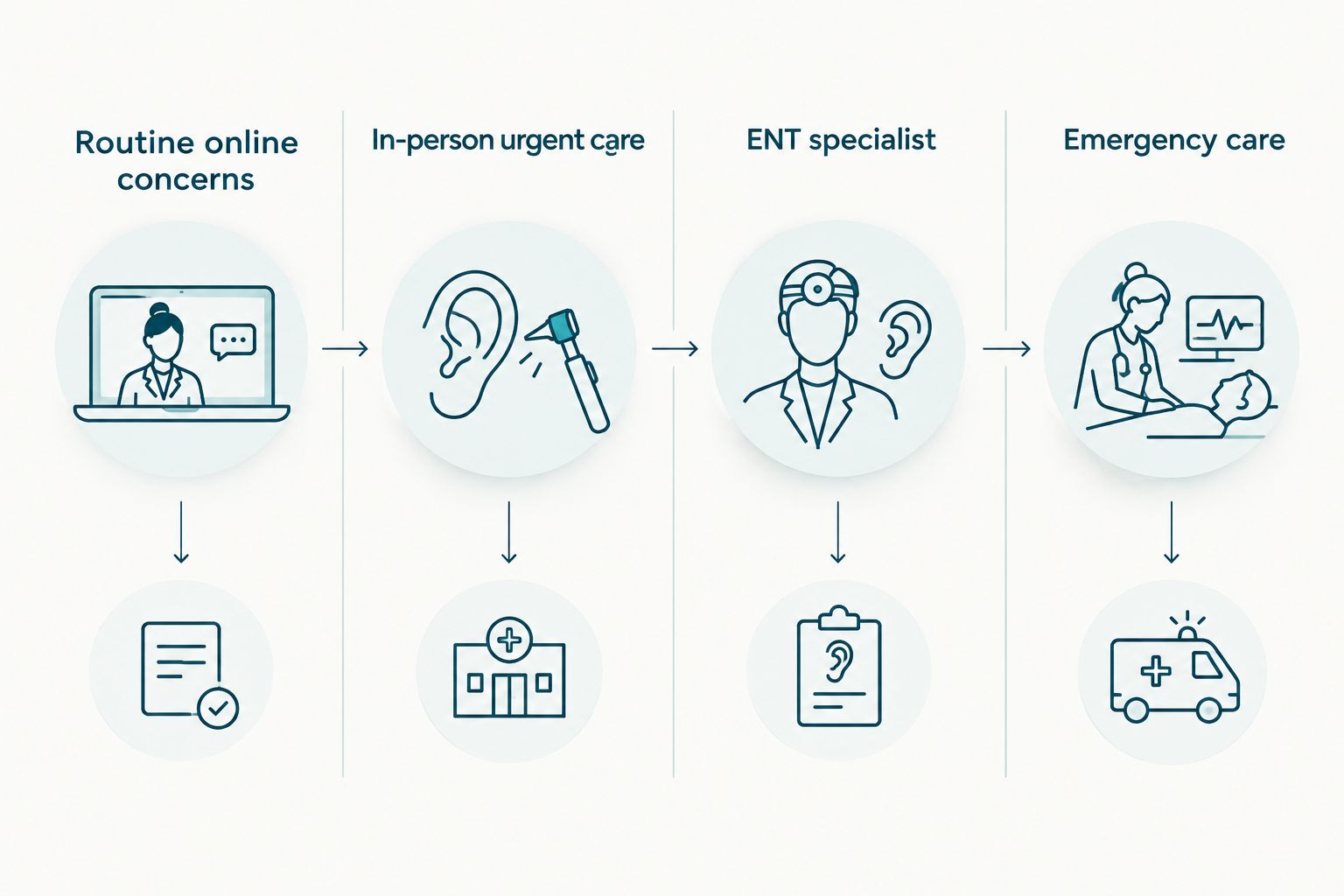
Best for routine online ENT concerns: Nowcare. Best for ear pain that needs an examination: in-person urgent care. Best for persistent or recurring symptoms: an ENT specialist. This guide compares those routes with emergency care so you can choose the right setting for ear, nose, and throat symptoms in 2026.
- Nowcare is the best telehealth ENT care fit here for routine concerns that licensed clinicians can assess online.
- Ear pain with drainage, hearing changes, or significant dizziness needs an assessment that can include a physical examination.
- An ENT specialist is the right route for persistent or recurring ear, sinus, and throat problems.
- Trouble breathing, severe neurological symptoms, or sinus symptoms with vision changes need emergency assessment.
Why this matters
Ear pain and sinus pressure are symptoms, not diagnoses. A blocked ear, an inflamed ear canal, and a middle-ear problem can feel similar, but they do not require the same treatment. Likewise, nasal congestion does not automatically mean a bacterial sinus infection.
The best care route depends on what a clinician needs to assess. An online visit supports a symptom history and treatment discussion; an in-person visit adds an examination and access to tests when indicated. Choosing the wrong setting creates an extra step before you get appropriate care.
For your 2026 decision, start with the examination you need—not the convenience of the appointment. Telehealth is useful when the clinical question can be answered remotely; it is not a substitute for looking inside an ear when that examination matters.
What makes the best telehealth ENT care
Use these criteria before choosing a service or appointment:
- Licensed clinical review: A clinician evaluates your symptoms and decides whether treatment is medically appropriate. A questionnaire alone is not a diagnosis.
- Clear scope: General telehealth care and specialist ENT care serve different purposes. Confirm which type of clinician will assess you.
- Examination boundaries: The service explains when an ear examination, throat examination, hearing assessment, or other in-person evaluation is necessary.
- Medication judgment: Treatment follows the assessment. Antibiotics should not be the promise that persuades you to book.
- Follow-up support: You know how to report worsening symptoms, ask questions, and understand the next step.
- Safe escalation: The care pathway separates routine concerns from urgent symptoms and emergencies.
These criteria matter more than a broad claim that a platform treats everything. In 2026, your safest choice remains the setting that can answer the clinical question—not simply the one that offers an online appointment.
ENT care options at a glance
The following 4 care routes address different needs. The ranking is a decision guide, not a claim that one setting replaces the others.
| Care route | Best for | Standout feature | Key limitation |
|---|---|---|---|
| Nowcare | Routine online ENT concerns | Provider-guided online care with licensed clinicians and ongoing care-team support | Online care cannot perform a hands-on ear or throat examination |
| In-person urgent care | New ear symptoms needing an examination | Physical assessment, including examination of the ear when appropriate | Not a replacement for ongoing specialist evaluation |
| ENT specialist | Persistent or recurring ear, nose, or throat problems | Focused specialty assessment and decisions about further investigation | Not the right route for immediate emergency symptoms |
| Emergency care | Breathing problems or other severe warning signs | Immediate assessment of potentially serious illness | Not the default setting for uncomplicated congestion or mild throat irritation |
Your route changes when your symptoms change. A routine congestion question and sudden hearing loss should not enter the same appointment pathway, even if both involve the ear, nose, and throat.
1. Nowcare: best telehealth ENT care for routine concerns
Nowcare connects patients with licensed clinicians for provider-guided online care, including ear, nose, and throat concerns within Virtual Urgent Care. The service includes secure intake, prescriptions sent to your chosen pharmacy when medically appropriate, and ongoing care-team support.
Nowcare is best for routine ENT concerns that licensed clinicians can assess online. That includes seeking guidance about symptoms and the appropriate next step; it does not mean every ear or sinus complaint can be diagnosed remotely.
The Virtual Urgent Care offering uses a 1-month plan. A plan duration describes the care offering, not how long your symptoms should last or how long you should wait before seeking an examination.
Online care pros
- Licensed clinicians review care and prescription decisions.
- Secure intake lets you describe symptoms and relevant medical history.
- Prescriptions, when appropriate, go to your chosen pharmacy.
- Ongoing care-team support provides a route for questions about your care.
Online care cons
- A standard online consultation cannot directly inspect your eardrum.
- Hands-on examinations and procedures require an in-person setting.
- General ENT concerns within virtual urgent care are not the same as a dedicated ENT specialist assessment.
Best for
Choose this route when you need provider-guided advice about a routine ENT concern and do not have warning signs requiring urgent or emergency assessment. Describe hearing changes, drainage, dizziness, breathing difficulty, and symptom duration clearly rather than labeling the problem yourself.
Verdict: Buy only if online assessment fits your symptoms; skip this route when an examination or emergency assessment is needed.
2. In-person urgent care: best for ear symptoms needing an exam
In-person urgent care lets a clinician take your history and physically examine the affected area. For ear symptoms, looking into the ear helps distinguish problems involving the ear canal, eardrum, or middle ear.
An examination matters when you have ear pain with drainage, a meaningful hearing change, or symptoms that remain unexplained after remote advice. Do not assume that an earache is an infection or that ear drops are suitable before the problem is assessed.
In-person urgent care pros
- A clinician can inspect the ear canal and eardrum.
- The visit supports physical assessment of associated throat or facial symptoms.
- Examination findings help guide treatment rather than relying on symptoms alone.
In-person urgent care cons
- You need to attend a physical location.
- Persistent or complex problems can still require specialist follow-up.
- The available examinations and tests differ between clinics.
Best for
Choose this route for a new ear complaint when an examination is needed and there are no emergency warning signs. Ask whether the clinic evaluates your specific symptoms before arranging the visit.
Sudden hearing loss needs urgent assessment, even without severe pain. Do not treat it as routine congestion or wait for a standard future appointment. Significant dizziness or other accompanying symptoms also change the urgency of the assessment.
Verdict: Buy an in-person assessment when ear symptoms require examination; skip a routine appointment for emergency warning signs.
3. ENT specialist: best for persistent or recurring problems
An ENT specialist evaluates conditions affecting the ears, nose, and throat. This route fits problems that keep returning, remain unresolved, or require focused investigation beyond an initial assessment.
Recurring symptoms deserve a fresh look at the diagnosis, not simply a repeat of the previous prescription. A specialist determines which examinations or tests are appropriate; not every patient needs imaging or a procedure.
ENT specialist pros
- Focused expertise in ear, nose, and throat conditions.
- Assessment of recurring symptoms and unresolved diagnoses.
- Decisions about specialty examinations, tests, and treatment options.
ENT specialist cons
- Some assessments require an in-person visit even when an initial consultation is remote.
- Referral requirements depend on the practice and your coverage arrangements.
- A routine specialist appointment does not replace urgent assessment of sudden or severe symptoms.
Best for
Choose this route when ear, sinus, nasal, or throat symptoms persist despite initial care, repeatedly return, or lead a clinician to recommend specialty evaluation. Bring previous treatment details and describe what improved, what did not, and what came back.
If you book a virtual specialist consultation in 2026, ask what it can resolve remotely. Clarify whether the appointment is for reviewing history, discussing existing results, or deciding on the next examination.
Verdict: Buy specialist assessment for persistent or recurring problems; skip waiting for a routine slot when symptoms are urgent.
4. Emergency care: best for severe warning signs
Emergency care is the correct setting for potentially serious symptoms that need immediate assessment. It is not a competing convenience service; it serves a different clinical purpose.
Seek emergency help for trouble breathing, inability to swallow saliva, severe neurological symptoms, or sinus symptoms accompanied by eye swelling or vision changes. Call emergency services when you cannot travel safely or symptoms are severe.
Emergency care pros
- Immediate assessment of potentially serious illness.
- Access to emergency examination and treatment when indicated.
- Escalation to further hospital care when necessary.
Emergency care cons
- Not the default route for uncomplicated congestion or mild throat irritation.
- Does not replace ongoing follow-up for recurring ENT problems.
Best for
Choose emergency care when symptoms threaten breathing, involve severe neurological changes, or suggest a serious complication. Do not spend time comparing telehealth platforms in that situation.
Verdict: Skip telehealth and seek emergency care for severe warning signs.
Before you book: answer these 3 questions
A useful consultation starts with a clear symptom history. Prepare these 3 questions before booking; they help you describe the problem without deciding the diagnosis yourself.
What changed?
State the main symptom in plain language: ear pain, reduced hearing, nasal blockage, sinus pressure, sore throat, or hoarseness. Explain whether it began suddenly or gradually and whether it affects one side or both.
Mention drainage, dizziness, swallowing difficulty, eye symptoms, or fever alongside the main complaint. A symptom that seems secondary to you can change the care setting a clinician recommends.
How has it progressed?
Explain when symptoms started and whether they are improving, worsening, or returning after improvement. Describe previous episodes and any recent assessment.
Do not use the length of a care plan as a waiting period. Worsening symptoms need reassessment according to the clinical advice you receive, not according to an account or membership timeline.
What have you already tried?
List medicines, nasal products, ear drops, and home treatments you have used. Include prescription medicines, allergies, relevant medical conditions, and any previous ear surgery or known eardrum problem.
Tell the clinician what helped and what caused problems. Avoid starting leftover antibiotics or using someone else's prescription; the right treatment depends on the cause and your medical history.
What an online ENT consultation should resolve
A useful visit gives you more than a prescription decision. You should understand the working assessment, the limits of that assessment, and the next action.
Before the consultation ends, ask:
- What is the likely cause? Ask which features support the assessment and which remain uncertain without examination.
- What should I do now? Confirm the treatment or self-care advice that applies to you.
- What requires reassessment? Get clear instructions about worsening symptoms and warning signs.
- Do I need an examination? Confirm whether the next step is urgent care, primary care, or specialist evaluation.
Antibiotics are not a quality score for an ENT visit. Colds are viral, and sinus symptoms do not automatically establish a bacterial infection. A decision not to prescribe can be appropriate care.
Start with provider-guided care
Describe your routine ENT concern for licensed clinical review and treatment only if medically appropriate.
How the care routes were ranked
This 2026 guide ranks care routes by clinical fit: licensed assessment, examination needs, treatment judgment, follow-up, and safe escalation. Each option occupies a different use case rather than competing for the same patient.
Online care leads for routine concerns suited to remote assessment. In-person urgent care leads when examination matters. Specialist care leads for unresolved or recurring problems, while emergency care takes priority when severe warning signs are present.
Which ENT care route should you choose?
Choose Nowcare for routine ENT concerns suited to provider-guided online assessment. Choose an in-person appointment when ear or throat examination is necessary, and an ENT specialist when symptoms persist or recur.
The default for an undecided reader is to identify the required assessment first. If hearing changes suddenly or severe warning signs appear, stop comparing routine options and seek urgent or emergency assessment as appropriate.
FAQ
What's the best telehealth ENT care for routine ear and sinus concerns?
Nowcare is a fit for routine ear, nose, and throat concerns that licensed clinicians can assess online. An in-person examination is the better route when the diagnosis depends on inspecting the ear or throat.
Can an online clinician diagnose an ear infection?
An online clinician can assess your symptoms, but confirming an ear infection often requires examining the ear. Remote advice does not replace an eardrum examination when that examination is needed.
Is telehealth appropriate for sinus pressure?
Telehealth is appropriate for an initial assessment of routine sinus symptoms without severe warning signs. Eye swelling, vision changes, or severe neurological symptoms require emergency assessment.
Will an online ENT visit always result in antibiotics?
No, an online ENT visit should result in treatment only when medically appropriate. Sinus pressure, nasal congestion, and ear discomfort do not automatically establish a bacterial infection.
Should I choose virtual urgent care or an ENT specialist?
Choose virtual urgent care for routine concerns suited to online assessment and an ENT specialist for persistent or recurring problems. Either route can lead to an in-person examination when the clinical question cannot be answered remotely.
What should I do if my hearing suddenly drops?
Seek urgent medical assessment for sudden hearing loss. Do not assume it is earwax or congestion, and do not wait for a routine future appointment.
What should I prepare for an online ENT appointment?
Prepare your symptom timeline, associated symptoms, medical history, medication list, and details of treatments already tried. Explain whether symptoms began suddenly, affect one side, or have returned after previous care.
One last thing
An ear symptom does not always originate in the ear: jaw and dental problems can cause referred ear pain. That is another reason to describe what you feel rather than arriving with a fixed diagnosis.
For your 2026 care decision, use one rule: choose the setting that can perform the assessment you need, not the treatment you expect to receive.


