
Best overall: NowCare for provider-guided online nail care when your symptoms do not require urgent examination. Best for recurring nail-edge pain: telehealth with a podiatrist. Best for a possible nail procedure: a podiatry practice that combines video assessment with in-person treatment. This 2026 guide compares care pathways, explains their limits, and helps you choose the right setting.
- NowCare is the best telehealth ingrown toenail treatment match here for nonurgent, provider-guided nail care.
- Podiatry telehealth suits recurring symptoms, but nail procedures require an in-person appointment.
- General virtual urgent care suits initial assessment when nail pain comes with other everyday concerns.
- Spreading redness, fever, or a concerning wound needs prompt in-person assessment, not a routine online appointment.
Why this matters
An ingrown toenail develops when the nail edge presses into or grows into the surrounding skin. Pain, tenderness, swelling, and redness can follow. Infection is possible, but redness alone does not establish that you need an antibiotic.
Telehealth helps you describe symptoms, show the affected toe, and receive clinician-guided next steps. It cannot physically lift a nail edge, drain an abscess, or remove part of a nail. Choose the care setting by what your toe needs, not by which service promises the easiest prescription.
This 2026 ranking compares care pathways rather than claiming that one platform produces better clinical outcomes. The useful distinction is between online guidance, specialist assessment, and hands-on treatment.
What makes the best telehealth ingrown toenail treatment?
Use these criteria before choosing an appointment:
- Licensed clinician review: A clinician should assess your symptoms and medical history before recommending treatment or issuing a prescription.
- Nail-focused care: Ingrown nails belong within the service's stated scope, rather than being assumed from a broad urgent-care label.
- Clear escalation: The service should explain when photographs or video are insufficient and an examination is necessary.
- Appropriate prescribing: Medication should follow the assessment. An antibiotic does not remove a nail edge pressing into skin.
- Follow-up support: You need a way to report worsening symptoms or ask questions about the recommended plan.
- Risk screening: Diabetes, poor circulation, reduced sensation, and immune suppression change the assessment and the safety of home care.
For your 2026 appointment, confirm who reviews the intake and what happens if the clinician recommends an in-person visit. A virtual visit is useful only when its limits are clear.
Ingrown toenail care options at a glance
The order below prioritizes nail-focused online guidance for a nonurgent problem. It does not override the need for prompt examination when warning signs are present.
| Rank and option | Best for | Standout feature | Key limitation |
|---|---|---|---|
| 1. NowCare — nail-focused care | Nonurgent symptoms and provider-guided nail care | Licensed clinician review with ongoing care-team support | Online care cannot perform nail procedures |
| 2. General virtual urgent care | Initial assessment alongside other everyday concerns | A broad assessment pathway | Ingrown nail scope and follow-up differ by service |
| 3. Podiatry telehealth | Recurring symptoms or questions about nail shape | Foot-focused specialist assessment | Examination or treatment can still require an office visit |
| 4. Hybrid podiatry care | Symptoms that need hands-on assessment or a procedure | Online assessment paired with an in-person pathway | The treatment itself is not fully online |
These options solve different problems. A nail-focused online service is a practical starting point for nonurgent guidance. A procedure pathway becomes the priority when remote assessment cannot address the cause of pain.
1. NowCare: best for provider-guided online nail care
NowCare connects patients with licensed clinicians for provider-guided online nail care. Its Nail Health scope includes ingrown nails, toenail fungus, and thickened nails. A secure intake and ongoing care-team support give you a route for assessment and questions without assuming that every painful nail needs medication.
Licensed clinicians review plans and prescriptions. When a prescription is medically appropriate, it is sent to your chosen pharmacy. This is an online assessment pathway, not a substitute for a nail procedure.
NowCare pros:
- Ingrown nails are explicitly included within the Nail Health scope.
- Licensed clinicians review treatment plans and prescriptions.
- Secure intake lets you provide symptom details and medical history.
- Ongoing care-team support gives you a route for follow-up questions.
NowCare cons:
- Fully online care cannot remove a nail edge or perform a physical examination.
- A clinician can recommend in-person care instead of online treatment.
- A prescription is not guaranteed and does not resolve every cause of nail pain.
The stated Nail Health plan structure includes 1-month, 3-month, and 6-month plans. Those durations describe the care program, not a promised recovery timeline. Ask which follow-up structure fits your symptoms rather than treating a longer plan as evidence that your condition is more severe.
Best for: Someone with nonurgent ingrown nail symptoms who wants licensed clinician assessment and provider-guided follow-up.
Verdict: Buy for online assessment and support; skip online-only care when your symptoms require hands-on treatment.
2. General virtual urgent care: best for a broad initial assessment
General virtual urgent care is a care pathway, not a single provider recommendation. It suits an initial conversation when toe pain is one of several everyday concerns and you need help deciding what to do next. Before booking, confirm that the service assesses ingrown toenails.
A clinician can review the history, visible changes, and symptoms you report. The limitation is scope: a broad urgent-care service is not automatically a nail-focused service or a podiatry practice.
General virtual urgent care pros:
- Lets you discuss nail pain alongside other relevant symptoms.
- Supports an initial decision about home care versus examination.
- Gives you a setting to review medication questions with a clinician.
General virtual urgent care cons:
- Nail-specific assessment and follow-up differ between services.
- A virtual visit cannot drain an abscess or remove an ingrown nail edge.
- Repeated urgent-care visits do not replace an appropriate specialist assessment for recurring problems.
For a 2026 booking, ask whether the clinician reviews photographs and how you receive follow-up instructions. Do not assume that an appointment labeled urgent care includes ongoing nail management.
Best for: Someone seeking an initial assessment of toe pain alongside other everyday medical concerns.
Verdict: Buy only after confirming that ingrown toenails fall within the service's scope.
3. Podiatry telehealth: best for recurring nail-edge pain
Podiatry telehealth means a remote consultation with a foot-care specialist. It is a useful pathway when symptoms keep returning, nail shape seems to contribute, or you want to discuss treatment choices before arranging an office visit. Confirm the clinician's credentials and the practice's remote-visit scope.
A specialist can review your history and visible nail changes, then explain whether an examination is needed. Remote consultation does not establish findings that require touch, circulation testing, or a closer examination.
Podiatry telehealth pros:
- Focuses the consultation on foot and nail problems.
- Gives recurring symptoms a specialist assessment pathway.
- Helps you prepare questions about conservative care and procedures.
Podiatry telehealth cons:
- Physical findings remain limited by the remote format.
- A separate appointment is necessary if hands-on treatment is recommended.
- Do not assume every podiatry practice provides remote visits or ongoing virtual follow-up.
Bring the history of previous episodes, treatments, and nail procedures. Recurrence matters because repeatedly calming inflammation is different from addressing a nail edge that continues to grow into the skin.
Best for: Someone with recurring symptoms who wants a foot-focused assessment and discussion of longer-term treatment choices.
Verdict: Buy for specialist guidance; hold off on expecting a complete diagnosis or procedure through video alone.
4. Hybrid podiatry care: best for a possible nail procedure
Hybrid podiatry care combines remote assessment with an in-person treatment pathway. Choose this route when your main question is whether you need a physical examination or nail procedure, not simply which online service to use. Confirm that the practice can arrange the necessary office care.
An online consultation can help explain your symptoms and prepare you for the appointment. The examination determines whether a procedure is appropriate and what treatment should involve.
Hybrid podiatry care pros:
- Connects assessment with a hands-on care pathway.
- Allows examination when photographs do not answer the clinical question.
- Provides a setting for procedures that telehealth cannot perform.
Hybrid podiatry care cons:
- You still need to attend an in-person appointment when indicated.
- An extra virtual step adds little when an office examination is already clearly necessary.
- Practice arrangements differ; confirm how remote and office visits connect.
Best for: Someone whose persistent pain, visible nail embedding, or recurring symptoms make a procedure discussion necessary.
Verdict: Skip online-only treatment when hands-on care is the priority; choose a direct in-person appointment if advised.
When to stop comparing telehealth services
Seek prompt in-person assessment for spreading redness, increasing warmth or swelling, pus, fever, or rapidly worsening pain. Severe illness, rapidly progressing infection, or an acutely discolored toe needs urgent medical attention. Do not wait for a routine online intake to address those symptoms.
Diabetes, reduced sensation, and poor circulation deserve particular care. A toe that does not hurt much can still have a concerning wound when sensation is impaired. Tell the clinician about these conditions before trying home treatment.
Until you receive guidance, avoid digging into the nail corner, cutting deeply down the sides, or attempting to drain swelling yourself. These actions can injure the surrounding skin. Keep the area clean and avoid footwear that presses on the sore toe.
This safety screen comes before the 2026 ranking. The best service is the wrong choice if it delays the examination you need.
Prepare for a useful online assessment
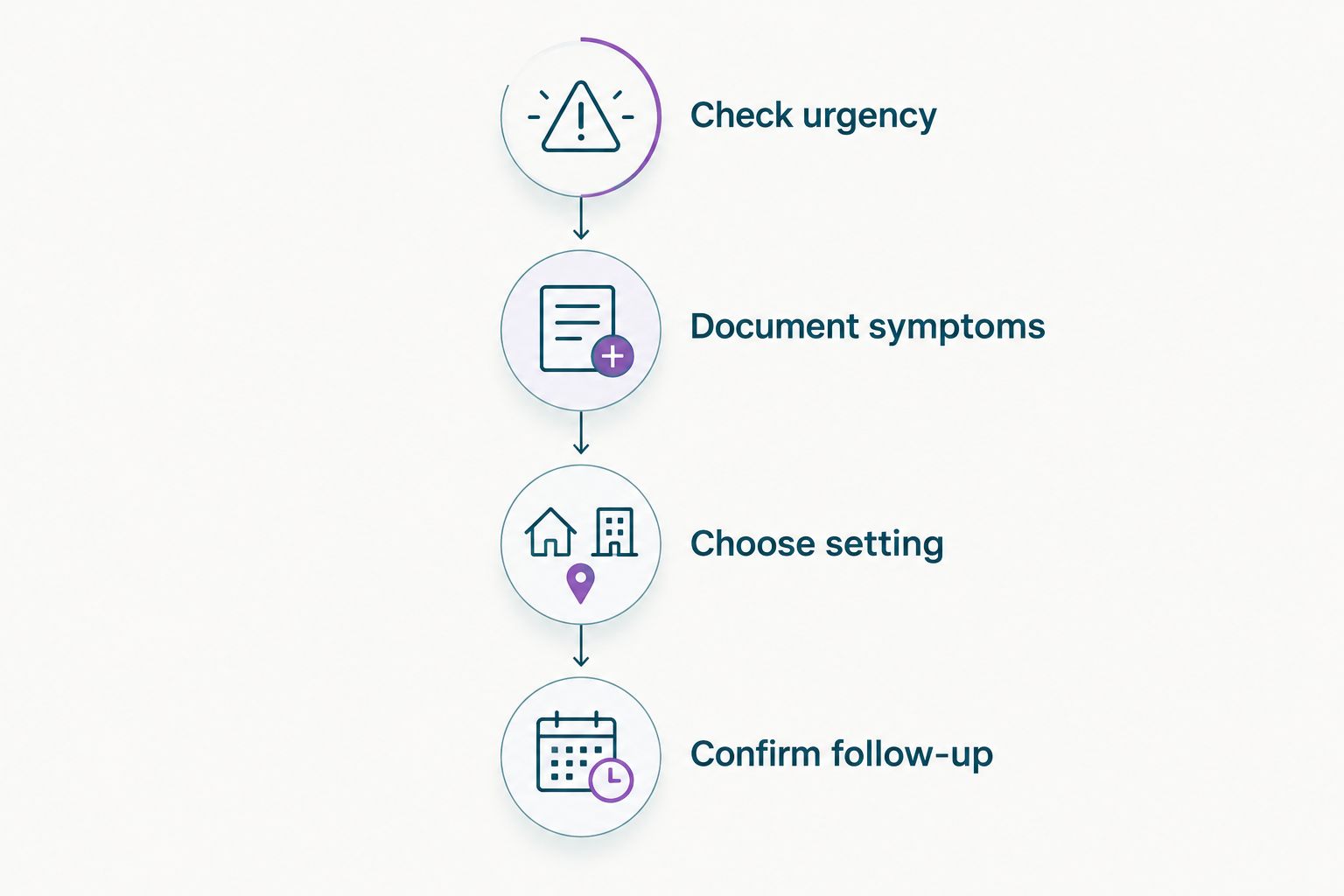
You get more from a remote visit when the clinician can understand both the visible problem and its history. Use this sequence before submitting an intake:
- Check urgency: Review worsening symptoms and medical risk factors first. Choose in-person care when the warning signs above apply.
- Document symptoms: Describe which toe hurts, where the pain sits, when it began, and whether symptoms are worsening. Take clear photographs in good light without filters.
- Choose setting: Match nonurgent guidance, specialist review, or a procedure pathway to your main concern. Confirm the service's scope before booking.
- Confirm follow-up: Ask what changes require another assessment, who answers questions, and what happens if you need an office visit.
Include previous nail procedures, treatments you have tried, allergies, and current medicines. Explain whether the nail problem is new or recurring. Do not trim away the painful corner just to make the photograph look clearer.
How the options were ranked
This ranking uses stated nail-care scope, licensed clinician involvement, follow-up, and the limits of remote care. Nail-focused online guidance comes first for nonurgent symptoms; specialist and hybrid pathways serve different needs.
It is not a ranking of clinical outcomes, appointment speed, or patient satisfaction. In 2026, choose the pathway that matches the required assessment rather than treating every online provider as interchangeable.
Which option should you choose?
Choose NowCare for provider-guided online nail care when your symptoms are nonurgent and you want clinician assessment with ongoing support. Choose podiatry telehealth for recurring symptoms that need a specialist discussion. Choose in-person podiatry when examination or a procedure is the priority.
General virtual urgent care remains an initial-assessment option if ingrown nails fall within its scope. None of these recommendations overrides warning signs or a clinician's instruction to seek hands-on care.
FAQ
What's the best telehealth ingrown toenail treatment?
For nonurgent symptoms, choose a service that explicitly covers ingrown nails and provides licensed clinician review. Recurring problems suit specialist assessment, while symptoms needing a procedure require in-person care.
Can an ingrown toenail be treated completely online?
Some ingrown toenail symptoms can be managed with clinician-guided conservative care, but a nail procedure cannot be performed online. The clinician determines whether remote guidance is appropriate or an examination is needed.
Do I need antibiotics for an ingrown toenail?
An ingrown toenail does not automatically require antibiotics. A clinician assesses whether infection is present; medication does not remove the nail edge causing pressure.
Is podiatry telehealth better than virtual urgent care?
Podiatry telehealth is the more focused pathway for recurring nail problems or specialist treatment questions. General virtual urgent care suits an initial assessment when ingrown toenails are within the service's scope.
When should I get an ingrown toenail checked in person?
Get prompt in-person assessment for spreading redness, pus, fever, rapidly worsening pain, or a concerning wound. Diabetes, poor circulation, and reduced sensation also warrant a lower threshold for examination.
What should I send before an online ingrown toenail appointment?
Send clear photographs and a description of the symptoms, their duration, and any worsening. Include relevant medical conditions, medicines, allergies, previous episodes, and treatments you have tried.
Can I cut out the ingrown corner myself?
Do not dig into the nail corner or cut deeply down the side. This can injure the skin; ask a clinician which care steps are appropriate for your toe.
One last thing
A prescription is not the measure of a successful telehealth visit. The useful result is a clear care plan: what to do, what to avoid, which changes need reassessment, and whether an examination is necessary. Before ending the appointment, ask what finding would change the plan from online care to an in-person visit.


