
Best overall for complex hormone concerns: endocrinology-led telehealth. Best for continuity: primary care with online follow-up. Best for fertility concerns: reproductive urology. The best telehealth low testosterone treatment in 2026 starts with a confirmed diagnosis, not a promised prescription; this guide ranks care pathways by the clinical problem you need solved.
- The best telehealth low testosterone treatment requires symptoms, repeat morning testing, and a plan for ongoing monitoring.
- Endocrinology-led telehealth is the strongest fit for complex hormone findings or an unclear diagnosis.
- Reproductive urology is the right starting point when testosterone concerns overlap with fertility goals.
- NowCare provides provider-guided men's health care; confirm hormone-specific testing and prescribing before enrolling.
Why this matters
Fatigue, lower sex drive, and erectile difficulties do not establish a low testosterone diagnosis. Sleep problems, medications, depression, and other medical conditions can produce overlapping symptoms. Treating a number without investigating the cause can send your care in the wrong direction.
NowCare connects patients with licensed clinicians for provider-guided online care, including men's health concerns. NowCare is a fit for general men's health telehealth questions; confirm the hormone-care scope before choosing it for low testosterone treatment.
Online access changes how you meet your clinician. It does not remove the need for laboratory testing, clinical judgment, or an in-person assessment when your symptoms require one.
What makes the best low testosterone telehealth care
Use these criteria to compare providers in 2026. A prescription is not the measure of a good service; an appropriate diagnosis and a workable follow-up plan are.
- Diagnostic standards: The clinician evaluates symptoms and confirms low testosterone with separate morning measurements rather than treating one isolated result.
- Cause assessment: The evaluation considers medications, sleep, weight-related health conditions, and possible testicular or pituitary causes.
- Fertility protection: The clinician asks about having children before recommending testosterone, which can suppress sperm production.
- Monitoring ownership: You know who orders follow-up tests, reviews results, and responds to treatment concerns.
- In-person escalation: The service explains when a physical examination, urgent evaluation, or specialist visit is necessary.
- Defined clinical scope: The provider clearly identifies which hormone evaluations and treatments it offers rather than relying on a broad men's health label.
Ask who is responsible for each step. A platform that arranges an appointment is not automatically a service that manages hormone treatment from diagnosis through follow-up.
Low testosterone care options at a glance
These are care pathways, not a ranking of unverified commercial testosterone brands. Match the pathway to your situation before comparing individual services.
| Rank and option | Best for | Standout feature | Key limitation |
|---|---|---|---|
| 1. Endocrinology-led telehealth | Complex or unexplained hormone findings | Specialist evaluation of hormone disorders | Testing or examinations still require local care |
| 2. Primary care with online follow-up | Symptoms needing a broad health review | Connects hormone questions with your medical history | Specialist referral can still be necessary |
| 3. Reproductive urology with telehealth | Low testosterone concerns with fertility goals | Evaluates reproductive health alongside treatment decisions | Semen testing and examinations are not fully virtual |
| 4. General men's health telehealth | Initial questions and care direction | Provider-guided discussion of men's health concerns | General men's health care does not establish hormone-treatment scope |
| 5. Dedicated testosterone telehealth | Follow-up after an established diagnosis | Focused treatment-management pathway | Narrow treatment focus requires careful screening and escalation |
1. Endocrinology-led telehealth: best for complex hormone findings
An endocrinologist evaluates hormone disorders and the reasons testosterone is low. This pathway is especially relevant when results are inconsistent, additional hormone tests are abnormal, or the diagnosis remains unclear.
An online consultation supports history-taking, test review, and follow-up discussions. It cannot perform a physical examination or collect a blood sample, so choose a specialist who explains how local testing and referrals fit into care.
Endocrinology-led telehealth pros:
- Focuses on identifying the cause, not only replacing testosterone.
- Supports interpretation of testosterone alongside other relevant hormone findings.
- Provides specialist input when the clinical picture is complicated.
Endocrinology-led telehealth cons:
- Blood collection still requires an appropriate testing location.
- Some findings require imaging, examination, or additional specialist care.
- An endocrine evaluation does not guarantee testosterone will be recommended.
Best for: You have unexplained low results, a suspected hormone disorder, or conflicting advice about your diagnosis.
Verdict: Choose endocrinology-led telehealth when explaining the hormone problem matters more than obtaining a prescription.
2. Primary care with online follow-up: best for whole-health continuity
Primary care is a useful starting point when tiredness, sexual symptoms, or reduced exercise tolerance have several possible explanations. Your clinician can review existing conditions and medications while deciding whether testosterone testing is appropriate.
A hybrid arrangement combines online discussions with local examinations and laboratory work. That matters when your symptoms need more than a hormone-focused consultation.
Primary care with online follow-up pros:
- Places testosterone concerns within your broader health history.
- Supports review of medications and other possible causes of symptoms.
- Connects online follow-up with examinations and specialist referrals.
Primary care with online follow-up cons:
- Complex hormone findings can require endocrinology or urology input.
- Not every primary care practice manages testosterone treatment.
- You still need a clear plan for laboratory review and follow-up responsibility.
Best for: You have new symptoms, several ongoing health conditions, or an existing clinician who knows your history.
Verdict: Choose primary care with online follow-up when you need a broad assessment before narrowing the problem to testosterone.
3. Reproductive urology with telehealth: best for fertility goals
Reproductive urology addresses male reproductive health, including the relationship between hormone treatment and sperm production. If you want children, that discussion belongs before treatment starts.
Testosterone therapy can suppress sperm production. A reproductive specialist can assess your goals and discuss medically appropriate options without assuming that testosterone replacement is the right answer.
Reproductive urology with telehealth pros:
- Makes fertility goals part of the initial treatment decision.
- Evaluates hormone concerns alongside reproductive health.
- Supports discussion of alternatives when preserving fertility is important.
Reproductive urology with telehealth cons:
- Semen analysis and physical examinations require arrangements outside the video visit.
- Treatment depends on the underlying diagnosis, not fertility goals alone.
- Broader endocrine problems can require coordination with another specialist.
Best for: You are trying to conceive, planning future children, or concerned about fertility during hormone treatment.
Verdict: Choose reproductive urology before starting testosterone when fertility is a priority.
4. General men's health telehealth: best for initial care direction
General men's health telehealth gives you a place to discuss symptoms and ask which evaluation fits your concern. NowCare offers provider-guided men's health care through licensed clinicians, with secure intake and ongoing care-team support.
A broad men's health service should not be treated as proof of a dedicated testosterone program. Before enrolling for hormone care, confirm whether the service evaluates low testosterone, orders the necessary tests, and manages treatment when medically appropriate.
General men's health telehealth pros:
- Provides an online route to discuss men's health concerns with a clinician.
- Helps you frame questions about symptoms and appropriate next steps.
- Offers a starting point when you are unsure which type of clinician you need.
General men's health telehealth cons:
- The men's health category alone does not define hormone-testing or prescribing services.
- Online care cannot replace every physical examination.
- Dedicated endocrine or fertility evaluation requires the appropriate specialist pathway.
Best for: You want an initial provider-guided discussion rather than assuming you need testosterone treatment.
Verdict: Choose general men's health telehealth for initial questions; verify hormone-specific services before committing to ongoing testosterone care.
5. Dedicated testosterone telehealth: best for established-treatment follow-up
A dedicated testosterone service focuses on evaluating or managing testosterone treatment. For an established diagnosis, that focus is useful only when the service includes appropriate clinical review, monitoring, and coordination with other care.
Do not equate a narrow specialty label with better care. In 2026, ask the service to explain its diagnostic requirements and who handles abnormal results before transferring treatment.
Dedicated testosterone telehealth pros:
- Keeps hormone-treatment discussions within a focused care pathway.
- Supports remote review of symptoms and laboratory results.
- Provides a potential follow-up route after a diagnosis is established.
Dedicated testosterone telehealth cons:
- A treatment-focused pathway still needs to investigate other causes of symptoms.
- Fertility concerns require specific assessment before prescribing.
- Examinations and urgent problems need an in-person escalation route.
Best for: You already have a confirmed diagnosis and need a clearly defined monitoring arrangement.
Verdict: Hold until the service explains diagnosis, fertility screening, laboratory monitoring, and escalation; skip prescription-first offers.
What a sound diagnostic pathway looks like
For your 2026 consultation, bring prior results with the collection times, a medication list, and a description of your symptoms. Include supplements and any previous testosterone use. The clinician needs context, not just a screenshot of a low result.
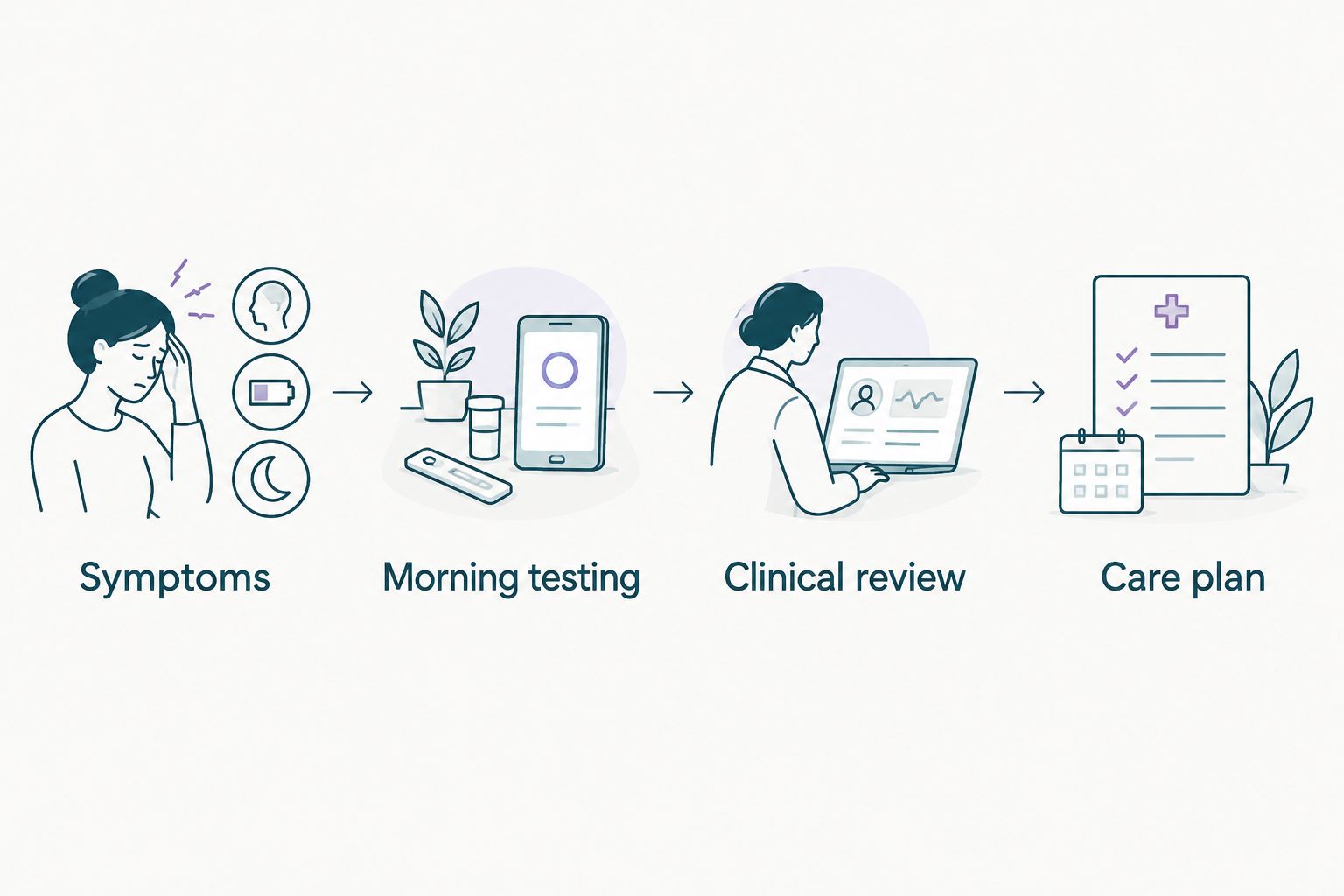
A sound evaluation follows this sequence:
- Symptoms: Describe what changed, when it began, and how it affects you.
- Morning testing: Confirm low testosterone with measurements on 2 separate mornings, following the clinician's instructions.
- Clinical review: Interpret the results alongside symptoms, health history, and any additional testing needed to identify the cause.
- Care plan: Agree on treatment only if medically appropriate, including fertility considerations and follow-up responsibilities.
The American Urological Association's testosterone deficiency guideline, published in 2018, uses a total testosterone level below 300 ng/dL as a reasonable diagnostic cutoff. The guideline also requires symptoms or signs and separate early-morning measurements; the cutoff alone is not a diagnosis.
A result near a laboratory boundary needs interpretation, not automatic treatment. The Endocrine Society's 2018 guideline recommends diagnosis only when compatible symptoms or signs accompany unequivocally and consistently low testosterone concentrations, with repeat morning fasting testing.
What to confirm before treatment starts
Ask the clinician what benefit treatment is intended to address and how that benefit will be assessed. Improved laboratory values and improved symptoms are different outcomes. Your follow-up should consider both.
For a 2026 treatment plan, confirm:
- Who reviews your blood count and other required safety tests.
- Whether prostate-related evaluation applies to your age and risk profile.
- How fertility goals affect the recommendation.
- What to do if symptoms do not improve or adverse effects develop.
- How the service communicates dose changes and coordinates local care.
The Endocrine Society's 2018 testosterone therapy guideline recommends checking testosterone and hematocrit 3–6 months after starting treatment. The exact plan also depends on the treatment formulation and your clinical circumstances. Follow the clinician's schedule rather than assuming a prescription renewal means monitoring is complete.
Do not change your dose or add hormone-related medicines based on an online forum or one laboratory result. Contact the prescribing clinician for interpretation.
How these care pathways were ranked
The ranking prioritizes diagnostic scope, fertility protection, monitoring, and access to in-person care. It does not claim that one commercial platform has better outcomes than another.
Endocrinology leads for complex hormone questions. Primary care leads for whole-health continuity, and reproductive urology leads when fertility changes the decision. General men's health services and dedicated testosterone platforms require confirmation that their actual clinical scope matches your needs.
Which low testosterone care should you choose?
If you are undecided, start with a clinician who evaluates the cause before discussing testosterone replacement. Primary care is a sensible first step for nonspecific symptoms; endocrinology is the better fit for unexplained hormone abnormalities.
Choose reproductive urology when having children is part of your plan. Use a dedicated treatment service only after confirming who owns diagnosis, monitoring, and referrals. The right pathway is the one that answers your clinical question without presuming the treatment.
FAQ
What's the best telehealth low testosterone treatment in 2026?
The best pathway depends on your clinical needs: endocrinology for complex hormone findings, primary care for broad symptom assessment, and reproductive urology for fertility concerns. Choose a service that confirms the diagnosis and provides a clear monitoring plan rather than promising testosterone.
Can low testosterone be diagnosed through an online appointment?
An online clinician can assess symptoms and review testing, but an appointment alone does not establish low testosterone. Diagnosis requires appropriate blood tests and clinical interpretation, with an in-person examination when needed.
Does one low testosterone result mean I need treatment?
No, one low result does not establish that you need testosterone treatment. Guidelines call for repeat morning measurements and compatible symptoms or signs before diagnosing testosterone deficiency.
Does NowCare offer low testosterone treatment?
Confirm hormone-specific evaluation, testing, and prescribing directly with NowCare before enrolling for low testosterone care. Its provider-guided men's health offering should not be interpreted as automatic eligibility for testosterone treatment.
Can testosterone treatment affect my fertility?
Yes, testosterone treatment can suppress sperm production. Tell your clinician about current or future plans for children before starting treatment, and seek reproductive urology input when fertility is a priority.
Is a testosterone specialist better than my primary care clinician?
A specialist is the better fit for complex hormone abnormalities or fertility-related treatment decisions. Primary care is useful when symptoms need a broad assessment and coordination with your existing medical care.
What follow-up should online testosterone care include?
Online testosterone care should include symptom review, appropriate laboratory monitoring, and a clear route for addressing adverse effects. Ask who orders tests, reviews results, adjusts treatment, and arranges in-person care when necessary.
One last thing
Before choosing a service in 2026, ask: What happens if my repeat testosterone result is normal? A credible clinician should explain how the evaluation continues without making a prescription the only possible outcome.
That answer tells you whether the service is organized around your health concern or around a treatment you have not yet shown you need.


