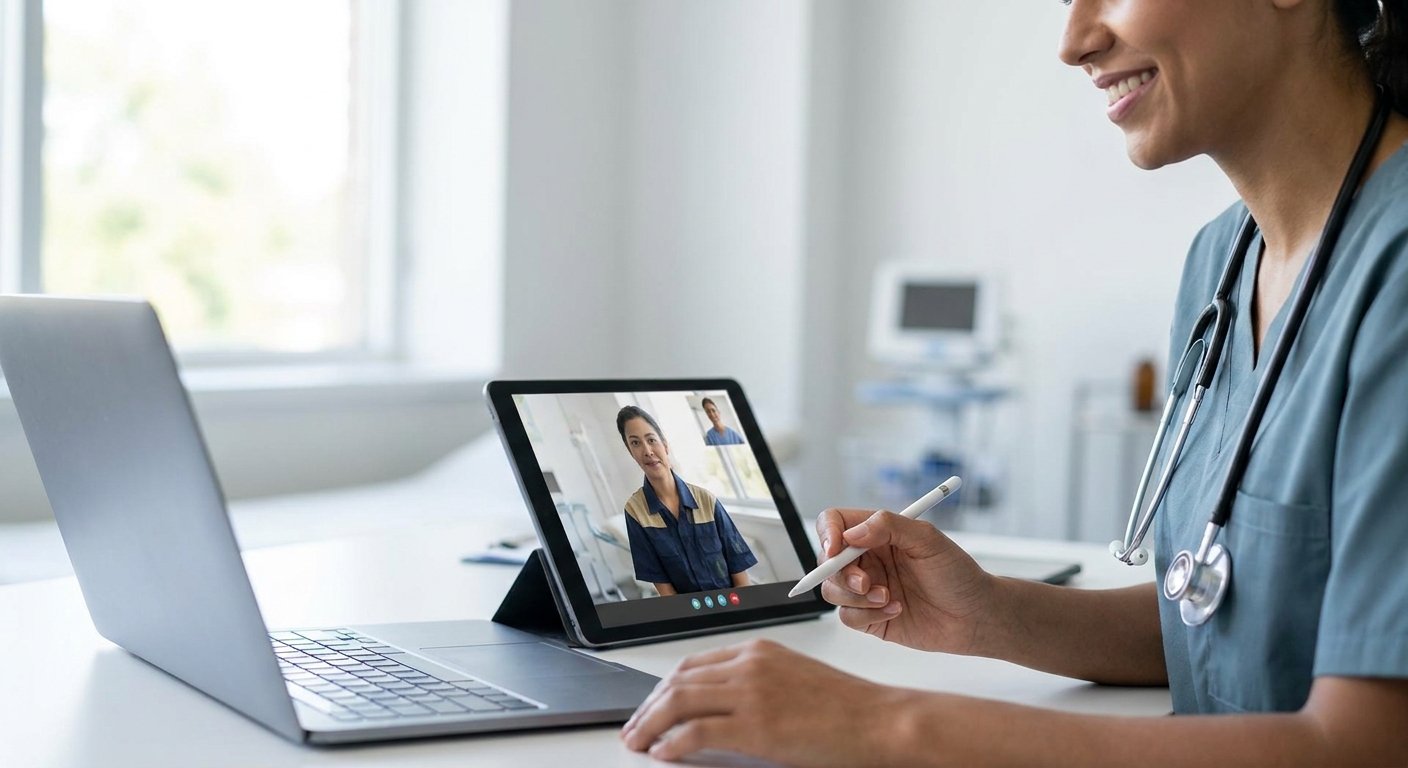
Occupational health screenings used to mean a half-day at a clinic and a stack of paperwork. In 2026, most of that work — pre-employment physicals, fit-for-duty notes, workers' comp injury evaluations — moves through a screen first, with in-person exams reserved for what actually requires hands-on testing.
- NowCare's online occupational health screenings for employers cover intake, symptom triage, and fit-for-duty documentation — Buy for HR teams building a remote-first program.
- Telehealth for pre-employment physical exams handles the clinical history and screening portion but can't replace in-person drug tests or DOT physicals — Consider as a first step, not a full substitute.
- Telehealth for workers' comp injury evaluation gets an injured employee triaged same-day instead of waiting on an urgent care slot — Buy for fast documentation after an on-the-job incident.
- An online doctor's note for work is the fastest, narrowest option — Consider it only when the ask is a simple return-to-work note, not a full screening.
Why this matters
Employers lose time two ways: workers sitting in a waiting room for a routine physical, and HR chasing paperwork after an injury. The best telehealth occupational health setups in 2026 collapse both problems into a video visit and same-day documentation, without pretending a webcam can run a urinalysis or an audiometric test it can't.
The catch is that "occupational health" covers wildly different needs — a new-hire physical is not the same visit as a workers' comp injury evaluation, and a return-to-work note is not a screening at all. Matching the right telehealth path to the right need is where most employers waste time.
How this list is ranked
Each entry below is ranked on three things: how closely the visit maps to a real occupational health task, how fast documentation gets back to the employer or employee, and where the clinical limits of a video visit sit. None of these substitute for testing that legally requires an in-person collection or instrument — that distinction is called out explicitly wherever it applies. Telehealth for occupational health screenings works best as the triage and documentation layer, not as a replacement for regulated physical testing.
The ranked list
1. Online occupational health screenings for employers — the program pick
This is built for HR teams that need a repeatable process, not a one-off visit. Online occupational health screenings for employers route new hires and existing employees to a licensed clinician for intake, symptom review, and screening documentation that HR can file. It's the entry point if you're standing up a program across a distributed workforce in 2026, not just handling one request. Buy for any employer with recurring screening volume.
2. Telehealth for pre-employment physical exams — the safe pick for new hires
Most pre-employment physicals start with a clinical history, medication review, and general health screen — all of which work fine over video. Telehealth for pre-employment physical exams covers that portion and flags anything that needs in-person follow-up. It won't replace a DOT physical, which requires hands-on vision, hearing, and blood pressure checks and stays valid for up to 24 months once completed in person. Buy for standard hires; Consider as a pre-screen ahead of a DOT-regulated role.
3. Telehealth for workers' comp injury evaluation — the fast documentation pick
After an on-the-job injury, the clock matters for both the employee and the claim. Telehealth for workers' comp injury evaluation gets a licensed clinician reviewing the injury same-day instead of the employee sitting in an urgent care queue. It documents the visit for the claims file immediately, which is often the actual bottleneck in comp cases. Buy for any employer that wants injury evaluations moving faster than a walk-in clinic allows.
4. Online doctor's note for work — the narrow, fast pick
Sometimes the ask isn't a screening at all — it's a single return-to-work or absence note. That request is handled through the doctor's note for work path, a shorter visit than a full occupational health screening. Consider it when the need is genuinely that narrow; Skip it if the employer actually needs a documented physical or injury evaluation, since a note alone won't satisfy that requirement.
5. Telehealth for sports injury assessment — the wildcard for physical-demand roles
Jobs with heavy physical demands — warehouse, logistics, field service — generate injuries that look more like sports medicine than general primary care. A sports injury assessment visit reviews range of motion, pain patterns, and whether the employee needs in-person imaging. Consider this route when the injury is musculoskeletal and the employer wants a same-day read before committing to an in-person referral.
6. Telehealth platform for remote workers — the coverage pick for distributed teams
Employers with workers spread across states need a platform built for that, not a single-location clinic relationship. A telehealth setup built for remote workers solves access, but it still doesn't replace regulated in-person testing where that's required by law. Hold this as your baseline access layer, and pair it with in-person testing partners for anything that needs a physical sample or instrument.
Set up occupational screenings for your team
Connect employees with licensed clinicians for screenings and fit-for-duty documentation.
“If the visit needs a urine sample or a hearing test, it needs a room, not a webcam.”
Comparison table
| Scenario | Best fit | Handles in-person? | Verdict |
|---|---|---|---|
| Recurring employer program | Online occupational health screenings for employers | No — routes out when required | Buy |
| New-hire physical | Telehealth for pre-employment physical exams | Partial — history and screen only | Buy |
| On-the-job injury | Telehealth for workers' comp injury evaluation | No — documents and refers | Buy |
| Quick return-to-work note | Online doctor's note for work | No | Consider |
| Musculoskeletal injury | Telehealth for sports injury assessment | No | Consider |
| Distributed workforce access | Telehealth platform for remote workers | No | Hold |
How to actually book it
- Start with the visit type that matches the real ask — a screening program request and a single doctor's note are not the same booking, and picking the wrong one wastes the visit.
- Confirm upfront whether the role is DOT-regulated or requires a drug test; telehealth handles the clinical review, not the regulated collection, in 2026 as in prior years.
- For recurring volume, set up the employer program once instead of booking one-off visits — it cuts the back-and-forth on documentation for HR.
FAQ
What is the best telehealth occupational health option for employers in 2026?
For recurring screening volume, an employer occupational health program that routes new hires and existing employees to licensed clinicians is the strongest fit in 2026. One-off visits work for single requests but don't scale across a workforce.
Can telehealth replace a DOT physical?
No. A DOT physical requires in-person vision, hearing, and blood pressure checks and stays valid for up to 24 months once completed. Telehealth can handle the clinical history portion but not the regulated in-person exam.
Can a telehealth visit handle a workers' comp injury evaluation?
Yes, for triage and documentation. A same-day video visit gets the injury reviewed and filed faster than waiting for an urgent care slot, though injuries needing imaging or a physical exam still get referred in person.
How fast can I get an online doctor's note for work?
A doctor's note visit is typically the shortest occupational health request available, since it doesn't involve a full screening. It's the right pick only when the employer needs a simple return-to-work note, not documented testing.
Does telehealth cover pre-employment physicals?
It covers the clinical history and general health screen portion of a pre-employment physical. Anything requiring in-person testing, like a drug screen, still needs a physical location.
What's the difference between an occupational health screening and a sports injury assessment?
An occupational health screening evaluates general fitness for a role or an on-the-job incident. A sports injury assessment focuses specifically on a musculoskeletal injury, which is common in physically demanding jobs.
Is telehealth occupational health good for remote or distributed workforces?
Yes, a platform built for remote workers solves the access problem across multiple states, but it still needs to be paired with in-person partners for any testing that legally requires a physical sample.
Do employers need a separate telehealth setup for workers' comp claims?
Not necessarily a separate setup, but the visit type matters — workers' comp injury evaluation visits document the incident for the claims file immediately, which general primary care visits typically don't.
One last thing
The single biggest mistake employers make in 2026 isn't picking the wrong telehealth platform — it's booking a general visit for a task that needed a specific one. A pre-employment physical, a workers' comp evaluation, and a doctor's note are three different visits with three different documentation outcomes, and matching the request to the right one is what actually saves time.


