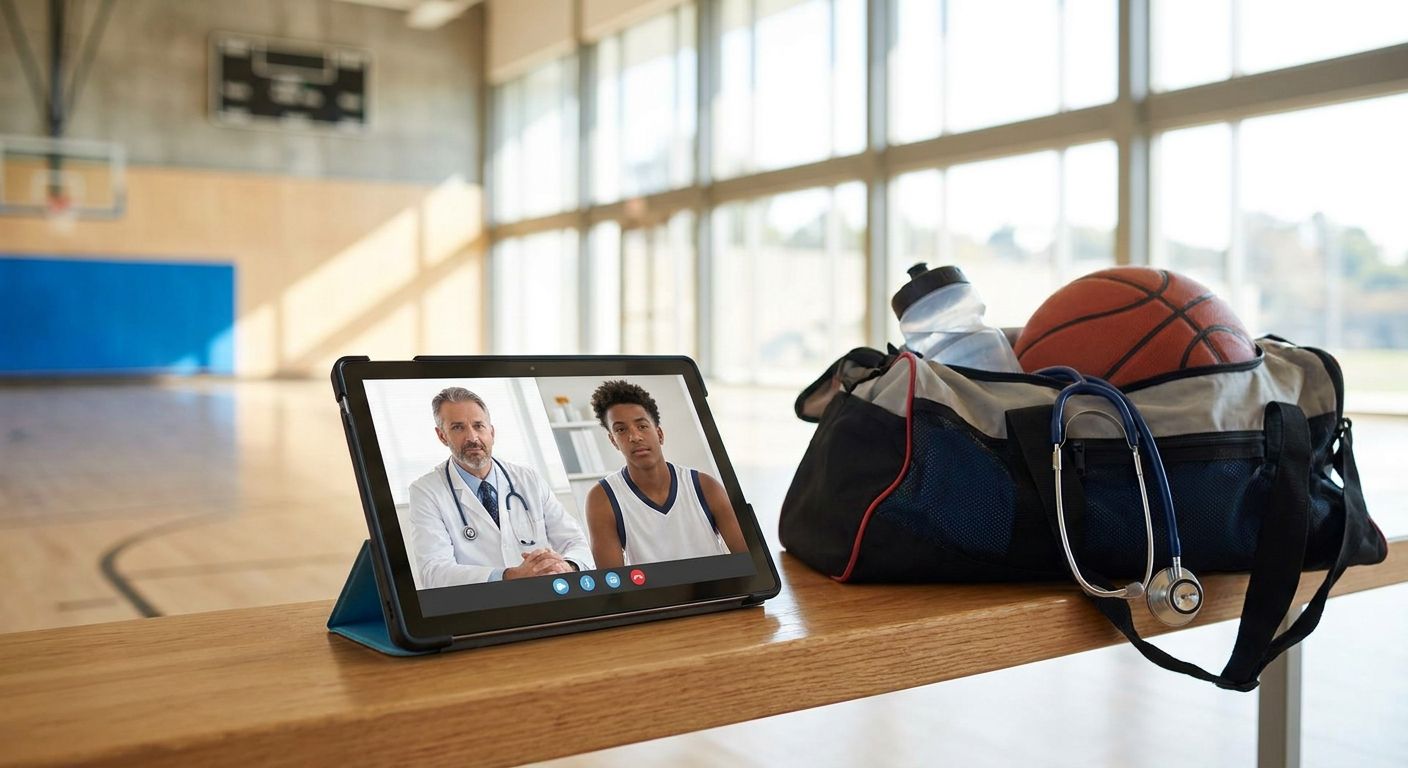
A school or sports physical is one of the few checkups where telehealth runs into a hard wall: most states require a hands-on cardiovascular and musculoskeletal exam that a camera cannot complete. This guide ranks the realistic virtual and in-person options for getting your athlete cleared in 2026, and shows exactly where telehealth for sports physicals actually helps.
- No telehealth platform legally finalizes a full school or sports physical alone in 2026 — states require an in-person exam component.
- NowCare wins for virtual sports injury assessment and follow-up when pain shows up mid-season, not for signing the PPE form itself.
- School-based health centers stay the lowest-cost route to a signed physical form for enrolled students.
- Your pediatrician's telehealth portal is the fastest way to handle intake paperwork before the in-person exam.
Why this matters
Parents search "best telehealth for sports physicals" every August and every January, right before tryout season, and most land on a page that oversells what a video visit can do. A preparticipation physical evaluation (PPE) — the form your athlete's coach or school demands — follows a standard built around a physical exam: heart and lung auscultation, blood pressure, vision screening, and a joint-by-joint musculoskeletal check. That standard traces back to the PPE Monograph, now in its 5th edition, used as the template by most state athletic associations.
Telehealth still has a real job in this process. It handles the history intake, the injury check that comes up mid-season, and the paperwork that speeds up the in-person visit. Knowing which piece belongs to which channel saves you a wasted appointment and a missed deadline.
Most state physical forms are valid for 12 months, so the exam you book now covers the whole season — which is exactly why getting the right visit type on the first try matters.
Best overall for the signed exam itself: your school-based health center or pediatrician, in person. Best telehealth option for an injury check or follow-up during the season: NowCare's virtual sports injury assessment. Best budget route: a school-based health center, when your district runs one. Best backup for a last-minute deadline: an in-person urgent care or retail clinic visit.
What makes the best telehealth for sports physicals
- Honesty about the in-person requirement — a platform that claims to "complete" your PPE by video alone is skipping a required exam component.
- Licensed clinician review on every intake, not an automated form.
- Fast turnaround before your season's tryout or paperwork deadline.
- A separate path for injuries that show up after the season starts, so a sprained ankle doesn't force a whole new physical.
- Clear cost expectations with no insurance surprises.
- State-form familiarity — the clinician knows what your PPE form actually requires.
At a glance
| Option | Best for | Standout feature | Key limitation |
|---|---|---|---|
| NowCare virtual sports injury assessment | Injury or pain during the season | Licensed clinician review same day | Can't sign the PPE exam form |
| Pediatrician's telehealth portal | Continuity + faster in-person slot | Existing medical history on file | Still requires an in-person visit |
| School-based health center | Free or low-cost signed physical | On-site, timed to your sports calendar | Only available in some districts |
| On-demand telehealth urgent care apps | Illness threatening the deadline | Same-day general access | Not built around the PPE form |
| Urgent care or retail clinic | Last-minute in-person completion | Walk-in, extended hours | No history with your athlete |
1. NowCare virtual sports injury assessment: best for injury checks during the season
NowCare connects your athlete with a licensed clinician by secure video for pain, swelling, or a new limp that shows up mid-season — a rolled ankle at practice, a nagging knee, a sore heel that won't quit. The clinician reviews symptoms, rules out red flags, and either issues a treatment plan or routes to in-person imaging or physical therapy. It sits inside the same sports injury assessment pathway NowCare uses for its Sports & Performance Foot Care pillar.
NowCare pros:
- Same-day video visit with a licensed clinician, no waiting room
- Ties directly into follow-up care and referral if imaging is needed
- Useful for the foot and ankle injuries that sideline athletes most often
NowCare cons:
- Does not replace the exam needed for a suspected fracture
- Cannot sign your school's PPE form
- Not a fit if your athlete needs the annual physical itself, not an injury check
Best for: the athlete who gets hurt three weeks into the season and needs a same-week opinion. Verdict: Buy — book this the day pain shows up, before it costs a week of practice.
2. Pediatrician's telehealth portal: best for continuity before an in-person exam
If your family already has a pediatrician, their telehealth portal can front-load parts of the intake — medical history, medication list, prior injury notes — so the in-person visit runs shorter. NowCare's own pre-employment physical exam intake works on the same logic for adult screenings: paperwork online, exam in person.
Pediatrician telehealth pros:
- Clinician already has your athlete's history
- Shrinks the in-person appointment
- No new patient paperwork
Pediatrician telehealth cons:
- Still requires the in-person exam to finish the PPE form
- Availability depends on your practice's telehealth hours
- Not every pediatric office offers a virtual pre-visit at all
Best for: families with an established doctor who want a faster in-office slot. Verdict: Hold — use it to shrink the visit, not replace it.
3. School-based health center: best for a free or low-cost signed physical
Where districts run one, a school-based health center is usually the cheapest legitimate route to a signed PPE form, staffed by clinicians who already know your state's exact paperwork.
School-based health center pros:
- Often free or covered by a school health fee
- Timed to line up with tryout and preseason schedules
- Familiar with your specific state's PPE form
School-based health center cons:
- Only exists in some districts
- Scheduling windows before tryouts are narrow
- No option if your school doesn't run one
Best for: budget-conscious families whose school offers the service. Verdict: Buy — the cheapest legitimate option when it's available.
4. On-demand telehealth urgent care apps: best for protecting the deadline from illness
General on-demand telehealth apps aren't built around the PPE form, but they're useful when a cold or stomach bug threatens to bump the appointment you already booked.
On-demand app pros:
- Fast, same-day access for unrelated illness
- Keeps the physical appointment itself on schedule
- Broad clinician availability
On-demand app cons:
- Not designed around sports-physical paperwork
- Still doesn't replace the in-person exam
- Clinician continuity varies visit to visit
Best for: keeping a physical deadline intact when illness gets in the way. Verdict: Hold — a good backup, not a physical-exam substitute.
5. Urgent care or retail clinic: best for a last-minute in-person completion
When tryouts are days away and neither the pediatrician nor the school center has an opening, an in-person urgent care or retail clinic visit finishes the exam fast.
Urgent care/retail clinic pros:
- Walk-in availability with extended hours
- Often same-day
- Completes the full in-person exam requirement
Urgent care/retail clinic cons:
- Clinician has no history with your athlete
- Can run more expensive without insurance
- Not a telehealth option at all
Best for: the family that's out of time and other routes fell through. Verdict: Wait — only after the other four options are ruled out.
How we ranked
Each option was measured against the same six criteria: honesty about the in-person exam requirement, licensed clinician review, turnaround speed before deadlines, whether it handles mid-season injuries separately, cost clarity, and familiarity with actual state PPE paperwork. Options that oversold what video alone can finish dropped in rank regardless of convenience.
“If your child's physical form asks for a heart and lung exam, no video call can complete that box — it needs a stethoscope in the room.”
Get a sports injury checked today
Licensed clinicians review foot, ankle, and joint pain by secure video visit.
Which telehealth option should you choose?
Start with your school-based health center if your district runs one — it's the cheapest signed physical you'll find in 2026. No school center available? Use your pediatrician's telehealth portal to speed up the in-person exam. Keep NowCare's virtual sports injury assessment in reserve for the moment an ankle or knee acts up once the season is underway — that's the one piece of this whole process telehealth actually finishes end to end.
FAQ
Can you get a sports physical entirely through telehealth in 2026?
No. Most state PPE forms require an in-person exam component — heart and lung auscultation, blood pressure, and a musculoskeletal check — that video alone cannot complete. Telehealth can handle history intake and mid-season injury checks, but the signed form still needs an in-person visit.
What's the difference between a telehealth sports physical and an in-person one?
A telehealth visit covers history, symptoms, and paperwork review. An in-person exam adds the hands-on pieces — auscultation, vision screening, and joint testing — that most state athletic associations require on the PPE form.
Is NowCare a substitute for a school physical?
No. NowCare's virtual sports injury assessment evaluates pain or injury during the season; it does not sign the state PPE form, which requires an in-person exam.
What should I do if my athlete gets injured mid-season?
Book a same-day virtual sports injury assessment through a licensed clinician rather than waiting for the next in-person opening. If imaging or physical therapy is needed, the clinician routes the referral from there.
Can a telehealth visit sign my child's PPE form?
Generally no. The PPE form requires an in-person cardiovascular and musculoskeletal exam in most states, so the signature has to come from that in-person visit.
How do I know if my state requires an in-person exam for sports physicals?
Check your state high school athletic association's PPE form directly — nearly all states base their form on the PPE Monograph, now in its 5th edition, which specifies an in-person exam.
What's the fastest way to get a signed physical form before tryouts?
Book a school-based health center slot first if your district has one. If not, call your pediatrician's office directly, since walk-in urgent care is usually the priciest and slowest fallback.
How long is a sports physical valid?
Most states set the PPE form's validity at 12 months, covering a full school year of athletics once signed.
One last thing
Most state PPE forms are built on the same national template — the PPE Monograph, 5th edition — which is exactly why the in-person exam requirement is nearly universal across all 50 states, not a quirk of any one school district. Plan around that fact instead of hunting for a platform that claims to skip it.


