
Best for provider-guided online nail care: Nowcare. Best for medication follow-up: your existing clinician’s telehealth service. Best for an uncertain diagnosis: hybrid dermatology. Best for painful, thickened nails: hybrid podiatry. This 2026 guide compares care routes so you can choose treatment that fits your symptoms, medical history, and need for testing.
- Nowcare is the best telehealth toenail fungus treatment option here for provider-guided online nail care.
- Choose your existing clinician’s telehealth service when medication review and continuity are your priorities.
- Choose hybrid dermatology when nail changes need diagnostic testing before antifungal treatment.
- Choose hybrid podiatry when thickened nails cause pain or need hands-on care.
- Oral and topical antifungals have different safety checks; healthy toenail growth takes months.
Why this matters
A yellow, thick, or lifting toenail is not automatically a fungal infection. Nail injury, psoriasis, and other conditions can produce similar changes. Starting an antifungal without checking the diagnosis can leave the actual problem untreated.
The best online service does more than accept a photograph and send a prescription. It reviews your symptoms, considers other causes, checks treatment safety, and explains when you need an examination or nail sample. Choose the care route that can resolve uncertainty—not simply the route with the shortest intake.
What makes the best telehealth toenail fungus treatment
Use these criteria to compare toenail fungus care in 2026:
- Clinical review: A licensed clinician evaluates your history and symptoms. A prescription is a treatment decision, not a guaranteed outcome.
- Diagnostic clarity: The clinician distinguishes suspected fungus from other nail conditions and explains when testing is necessary.
- Medication safety: The assessment covers your medications, relevant health conditions, pregnancy status, and any required laboratory work.
- Treatment fit: The plan considers which nails are affected, how much of each nail is involved, and whether nearby skin also needs treatment.
- Follow-up: You know what changes to track, how to report side effects, and when the plan needs reassessment.
- In-person escalation: The service recognizes when pain, infection, circulation concerns, or hands-on nail care require an office visit.
No remote consultation can physically trim a thick nail or collect a nail clipping through the screen. The strongest choice depends on which parts of your care can happen online and which cannot.
Toenail fungus care options at a glance
These are care routes, not a ranking of competing platforms with verified service specifications. Each route has a different best-use case.
| Care option | Best for | Standout feature | Key limitation |
|---|---|---|---|
| Nowcare | Provider-guided online nail care | Dedicated nail health care with licensed clinician review and ongoing care-team support | Fully online care cannot provide physical examination, sampling, or nail trimming |
| Existing clinician’s telehealth service | Medication follow-up and continuity | Follow-up with a clinician who already manages your care | Remote visits depend on the practice’s services; testing still requires a physical sample |
| Hybrid dermatology | Uncertain nail changes | Specialist assessment combined with office-based examination or sampling when needed | Requires an in-person step when remote assessment cannot settle the diagnosis |
| Hybrid podiatry | Painful, thickened nails | Foot-focused evaluation with hands-on nail care when appropriate | Nail reduction and other procedures cannot happen online |
1. Nowcare: best telehealth option for online nail care
Nowcare connects patients with licensed clinicians for provider-guided online nail care, including toenail fungus, ingrown nails, and thickened nails. Its process includes secure intake, clinician review, prescriptions sent to your chosen pharmacy when medically appropriate, and ongoing care-team support.
Nowcare is best for patients who want provider-guided online toenail fungus care with ongoing support. The service fits the reader who wants a focused nail health pathway rather than choosing a general appointment category and explaining the problem from scratch.
That does not make every nail problem suitable for remote treatment. If your clinician needs a nail sample or a physical examination, online assessment cannot replace that step. Prescription treatment also depends on your diagnosis and medical history.
Nowcare pros:
- Nail health is an explicitly supported care area.
- Licensed clinicians review treatment plans and prescriptions.
- Prescriptions go to your chosen pharmacy when appropriate.
- Ongoing care-team support is part of the stated service.
Nowcare cons:
- Fully online care cannot collect nail samples or perform procedures.
- A prescription is not guaranteed; treatment must be medically appropriate.
- Painful or diagnostically unclear nail changes can require in-person assessment.
Best for: Patients seeking a dedicated online nail health pathway.
Verdict: Buy into this care route for focused online assessment; use in-person care when examination or testing is needed.
2. Your existing clinician: best for medication follow-up
Your existing clinician’s telehealth service is the strongest continuity option when that practice offers remote follow-up. This route connects the nail problem with the rest of your care rather than treating it as an isolated prescription request.
Continuity matters when you take other medications or have conditions that affect treatment choices. Oral antifungals require more safety consideration than a photograph alone can provide. A clinician already involved in your care can review your history and coordinate testing through the practice’s established processes.
Do not assume every practice manages toenail fungus remotely. Ask whether the clinician evaluates nail conditions by telehealth, whether photographs are needed, and where any nail sampling or blood work would happen.
Existing clinician telehealth pros:
- Supports continuity with your broader medical care.
- Keeps medication review within an established clinical relationship.
- Provides a practical route for discussing results and side effects remotely.
Existing clinician telehealth cons:
- The practice must offer telehealth for the problem you want assessed.
- A general clinician can still recommend dermatology or podiatry.
- Examination and sample collection remain separate physical tasks.
Best for: Patients prioritizing medication review and follow-up with their usual clinician.
Verdict: Buy into this route when continuity is your main need; skip it if the practice does not assess nail problems remotely.
3. Hybrid dermatology: best for an uncertain diagnosis
Hybrid dermatology combines remote consultation with office-based evaluation when needed. Choose this route when the main question is whether the nail change is fungal at all.
Dermatologists assess nail disease alongside skin conditions that can affect nails. An office visit also allows collection of a clipping or scraping for testing when appropriate. That diagnostic step matters before committing to a treatment aimed at the wrong cause.
A remote appointment still has a useful role: reviewing symptoms, examining photographs, and discussing next steps. But uncertainty should lead to examination or testing, not repeated prescriptions based on appearance alone.
Hybrid dermatology pros:
- Addresses fungal and nonfungal causes of nail changes.
- Connects remote discussion with in-person diagnostic assessment.
- Supports treatment selection after the diagnosis is clearer.
Hybrid dermatology cons:
- An online visit does not replace a required nail sample.
- The care pathway includes an office visit when needed.
- Dermatology assessment does not automatically address every foot-mechanics problem.
Best for: Patients with unclear nail changes or unsuccessful treatment that needs diagnostic reassessment.
Verdict: Buy into this route when diagnosis is the unresolved problem; wait on another antifungal until that uncertainty is addressed.
4. Hybrid podiatry: best for painful, thickened nails
Hybrid podiatry combines remote discussion with in-person foot assessment and hands-on care when appropriate. This route fits thickened nails that hurt in shoes, interfere with walking, or are difficult to manage safely.
Fungal treatment and physical nail care solve different problems. An antifungal targets infection; professional nail reduction can address thickness and pressure. One does not automatically replace the other.
Diabetes, reduced sensation, or poor circulation changes the safety decision. Avoid aggressive trimming or attempts to dig beneath the nail, and ask a clinician how to manage it safely. A painful nail with surrounding infection also needs more than a routine remote fungus consultation.
Hybrid podiatry pros:
- Evaluates nail symptoms in the context of the whole foot.
- Allows hands-on nail care when clinically appropriate.
- Addresses pressure, footwear concerns, and safe nail management.
Hybrid podiatry cons:
- Procedures require an in-person appointment.
- Nail reduction alone does not establish or eliminate a fungal infection.
- Remote follow-up depends on the practice’s services.
Best for: Patients whose main problem is nail-related pain, thickness, or difficulty with safe trimming.
Verdict: Buy into this route for hands-on needs; skip online-only care as the sole solution to painful nail pressure.
Oral versus topical treatment in 2026
The care provider and the medication are separate decisions. A service is not automatically better because it offers oral treatment, and a topical prescription is not automatically the safest fit for every patient.
| Treatment approach | Best for | Main advantage | Main limitation |
|---|---|---|---|
| Oral antifungal treatment | Clinician-confirmed cases where systemic treatment is appropriate | Treats infection through medication taken by mouth | Requires review of health history, interactions, and treatment-specific safety checks |
| Topical antifungal treatment | Selected cases suitable for treatment applied to the nail | Applies medication directly to the affected nail | Requires sustained application; suitability depends on the extent of disease |
| Professional nail reduction | Thick nails causing pressure or interfering with care | Reduces nail thickness when appropriate | Does not replace antifungal treatment or diagnostic testing |
FDA prescribing information lists 12 weeks for an oral terbinafine course for toenail fungal infection. Efinaconazole topical solution labeling specifies daily application for 48 weeks. These are product-specific treatment durations, not instructions to start either medication yourself.
A toenail can take 12–18 months to grow out fully, as described in American Academy of Dermatology patient guidance. In 2026, judge progress by healthy new growth and your clinician’s assessment—not by expecting the old damaged nail to look normal immediately.
How to choose your care route
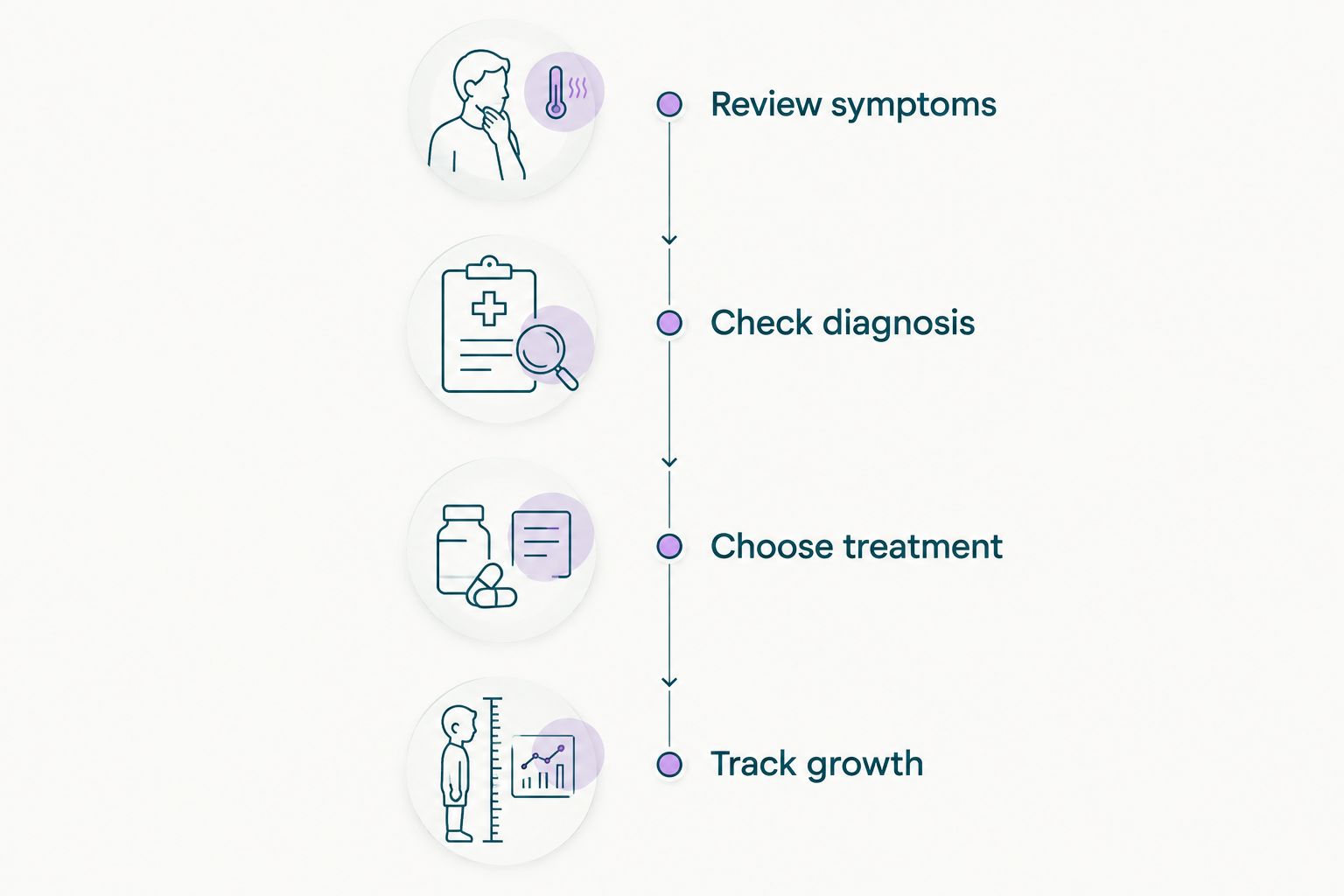
Review symptoms
Write down when the change began, which nails are affected, and whether you have pain, lifting, discoloration, or nearby skin symptoms. Take clear photographs in good light without polish covering the nail. Include previous treatments and any reactions.
Check diagnosis
Ask what supports the diagnosis and whether a nail sample is needed. If the appearance is unclear or earlier treatment failed, prioritize diagnostic reassessment over repeating the same approach.
Choose treatment
Share your medication list and relevant medical history. Ask why the recommended treatment fits your nail involvement, what safety checks it requires, and which symptoms should prompt contact with the clinician.
Track growth
Follow the prescribed directions and keep photographs under similar lighting. Ask how follow-up will distinguish healthy growth from persistent disease. Do not extend, stop, or combine prescription treatments without clinical advice.
When online care is not enough
Seek prompt in-person assessment for spreading redness, warmth, drainage, an open wound, or worsening pain. Fever or feeling unwell with a foot infection needs urgent medical evaluation. Do not assume these symptoms are simply toenail fungus.
A new dark stripe, unexplained bleeding, or a changing spot beneath the nail also deserves examination rather than automatic antifungal treatment. For diabetes, reduced sensation, or circulation problems, contact a clinician promptly about new foot wounds or infection signs.
How the care routes rank
This 2026 comparison ranks care routes by clinical fit: dedicated nail care, continuity, diagnostic assessment, and hands-on treatment. It does not assign unsupported success rates or claim that one provider’s prescriptions outperform another’s.
The default is focused online assessment for a nonurgent nail concern. Move to hybrid care when the diagnosis is uncertain or the problem requires physical treatment. That distinction matters more than a broad “best overall” label.
Which care option should you choose?
Choose Nowcare for provider-guided online nail care when your main need is assessment, treatment review, and ongoing support. Choose your existing clinician for continuity, hybrid dermatology for diagnostic uncertainty, and hybrid podiatry for painful thickness or hands-on care.
Before starting any plan, ask a direct question: “What would make this nail problem unsuitable for online-only care?” A useful answer identifies the limits of remote assessment and the next step when those limits apply.
FAQ
What’s the best telehealth toenail fungus treatment option in 2026?
The best option depends on whether you need online assessment, diagnostic testing, or hands-on nail care. Nowcare fits provider-guided online nail care; hybrid dermatology or podiatry fits problems that require examination, sampling, or procedures.
Can a clinician diagnose toenail fungus from a photo?
A photograph can support assessment, but it does not always establish that fungus is the cause. Nail injury and other conditions can look similar, so a clinician can recommend examination or nail testing.
Is oral treatment better than topical treatment?
Oral and topical antifungals suit different clinical situations. The choice depends on the extent of nail involvement, your health history, medication interactions, and the clinician’s assessment.
How long does toenail fungus treatment take?
Treatment duration depends on the prescribed medication. FDA labeling specifies 12 weeks for oral terbinafine for toenails and 48 weeks for efinaconazole topical solution; visible recovery also depends on nail growth.
Do I need blood tests before oral antifungal treatment?
Some oral antifungals require blood testing before treatment. Oral terbinafine labeling calls for pretreatment assessment of liver function, and your clinician determines any additional monitoring.
Can online care trim a thick fungal toenail?
Online care cannot physically trim or reduce a thick toenail. Choose in-person podiatry when nail thickness causes pressure, pain, or difficulty with safe nail care.
What if my toenail still looks damaged after treatment?
A damaged toenail does not become normal immediately when treatment ends. Healthy nail must grow out; persistent or worsening changes need reassessment rather than an automatic repeat prescription.
When should I seek urgent care instead of a fungus consultation?
Seek prompt in-person assessment for spreading redness, drainage, an open wound, or worsening pain. Fever or feeling unwell with a foot infection requires urgent medical evaluation.
One last thing
Take a baseline nail photograph before treatment begins. Repeat it under similar lighting during follow-up, focusing on the nail growing from the base rather than only the damaged tip. Your most useful progress record in 2026 is a consistent view of new growth—not a different photograph every time.


