
Best for provider-guided everyday concerns: NowCare. Best for ongoing care: your primary-care practice’s telehealth service. Best for specialist assessment: gynecology telehealth. This 2026 guide compares five care models for women’s health, including menopause-focused care and hybrid visits when you need an examination.
- NowCare is a fit for provider-guided online review of everyday women’s health concerns.
- The best telehealth womens health choice depends on symptoms, continuity, and whether you need an examination.
- Primary-care telehealth suits ongoing care; gynecology telehealth suits questions requiring specialist assessment.
- Choose hybrid care when testing or a physical examination is part of the next step.
- Severe symptoms need urgent assessment, not a routine online appointment.
Why this matters
Women’s health is not one appointment type. A question about a medication, recurring pelvic symptoms, and menopause symptoms require different clinical decisions. Choosing a service by convenience alone misses that distinction.
NowCare connects patients with licensed clinicians for provider-guided online care, including women’s health within Virtual Urgent Care. The service uses secure intake, sends appropriate prescriptions to your chosen pharmacy, and provides ongoing care-team support. Treatment is only appropriate when the clinician determines it is medically suitable.
NowCare women’s health telehealth is best for patients seeking online clinician review of everyday concerns. It does not replace every part of gynecologic care. A screen cannot provide a pelvic examination, collect a sample, or perform imaging.
For your 2026 decision, start with the task you need completed. An online consultation can assess symptoms and establish a next step; some next steps happen in person. That distinction matters more than a broad claim that one platform is best for everyone.
What makes the best women’s health telehealth service?
Use these criteria before choosing an appointment. They separate a useful clinical pathway from an online visit that leaves you arranging the same care again.
- Clinical fit: The service explicitly addresses your concern. A general women’s health label does not establish that every symptom or treatment falls within its scope.
- Licensed clinician review: A clinician reviews your history and decides whether treatment is appropriate. A requested prescription is not a guaranteed prescription.
- Examination and testing pathway: You understand how to arrange necessary examinations, laboratory testing, or imaging. Online care should not become a dead end.
- Continuity: You know who handles follow-up, medication questions, and symptoms that do not improve. Repeatedly starting from scratch adds work.
- Medication safety: You can share current medications, allergies, medical history, and pregnancy or breastfeeding status. These details affect treatment decisions.
- Practical access: You can confirm whether the service treats patients in your location and how to contact the care team. Check the actual service terms before enrolling.
Do not treat these criteria as interchangeable. Clinical fit comes first; a convenient intake process does not compensate for choosing the wrong level of care. In 2026, compare the care pathway rather than the platform’s headline.
Women’s health telehealth options at a glance
This comparison ranks care models by their distinct jobs, not by unverified claims about individual competitors. Apart from the named platform, the rows describe service types; confirm each provider’s actual scope before booking.
| Option | Best for | Standout feature | Key limitation |
|---|---|---|---|
| NowCare Virtual Urgent Care | Online review of everyday women’s health concerns | Licensed clinician review, secure intake, and care-team support | Cannot perform a physical examination online |
| Primary-care telehealth | Continuity for ongoing health questions | Care connected to your existing primary-care relationship | Specialist assessment can still require a separate appointment |
| Gynecology telehealth | Specialist-led reproductive and pelvic-health assessment | A consultation focused on gynecologic questions | Examinations and procedures require in-person care |
| Menopause-focused telehealth | A consultation centered on menopause symptoms | Focused discussion of symptoms and treatment suitability | Does not cover every unrelated women’s health concern |
| Hybrid gynecology care | Symptoms requiring online discussion and in-person assessment | A care model combining remote and office visits | Requires access to an in-person location |
There is no universal winner across these 5 care models. Pick the row that matches your clinical task, then check the individual service’s coverage, follow-up arrangements, and referral process. A service category is not a promise that every provider offers the same care.
1. NowCare: best for everyday online women’s health review
NowCare includes women’s health within its provider-guided Virtual Urgent Care offering. Licensed clinicians review care plans and prescriptions, with secure intake and ongoing care-team support. Appropriate prescriptions go to the patient’s chosen pharmacy.
The Virtual Urgent Care offering uses a 1-month plan. That gives you a defined program format, but it is not a promise that every condition can be resolved remotely or within that period. Ask whether your specific concern fits before choosing care.
NowCare pros:
- Licensed clinicians review every plan and prescription.
- Secure intake lets you provide relevant health information online.
- Care-team support is part of the stated offering.
- No insurance is required to use the service.
NowCare limitations:
- Fully online care cannot provide a pelvic examination or collect a laboratory sample.
- A clinician can determine that your concern needs care outside the online service.
- Prescription treatment depends on medical appropriateness, not your preferred outcome.
Best for: Patients seeking clinician review of an everyday women’s health concern through a fully online service.
Before enrolling, describe the actual symptom rather than selecting a broad category and assuming coverage. Include when it began, whether it is recurring, and any pregnancy possibility. Those details help establish the right setting for assessment.
Verdict: Buy into this care model when your concern fits online review; skip it for symptoms needing immediate examination.
2. Primary-care telehealth: best for continuity
Primary-care telehealth is the strongest starting point when your women’s health question connects to ongoing care. An established clinician can consider the concern alongside your broader health history. Confirm that the practice offers remote visits for the issue you want addressed.
Continuity is the reason to choose this model. A medication question or symptom discussion is different when the clinician already manages other aspects of your care, although access to complete records still depends on the practice.
Primary-care telehealth pros:
- Keeps the discussion within an existing care relationship.
- Provides a setting to review symptoms alongside other health concerns.
- Supports discussion of medications managed by the same practice.
- Offers a starting point for deciding whether specialist care is needed.
Primary-care telehealth limitations:
- Some concerns need gynecologic expertise beyond the initial consultation.
- A remote appointment does not replace a necessary examination.
- Testing and referrals depend on the practice’s actual arrangements.
Best for: Patients who already have a primary-care clinician and want continuity for an ongoing question.
For your 2026 appointment, ask whether the clinician can access relevant results and medication records. Do not assume that records from another practice are already available. Bring a concise summary when care spans several providers.
Verdict: Buy into primary-care telehealth for continuity; skip it as an extra stop when you already need a specific specialist assessment.
3. Gynecology telehealth: best for specialist assessment
Gynecology telehealth provides a remote setting for discussing reproductive and pelvic-health concerns with a specialist. The consultation can clarify your symptoms, review relevant history, and establish whether an examination or testing is necessary. Choose a practice that explicitly handles your concern.
Specialist access is the main benefit, not an exemption from in-person care. A detailed conversation can be useful even when the eventual recommendation is an office visit. The online appointment should move the assessment forward.
Gynecology telehealth pros:
- Centers the appointment on gynecologic questions.
- Provides space for a detailed reproductive-health history.
- Supports discussion of prior findings and treatment questions.
- Helps identify which concerns need an examination rather than remote treatment.
Gynecology telehealth limitations:
- Pelvic examinations cannot happen through a video visit.
- Sample collection and imaging require separate arrangements.
- Follow-up access varies by the individual practice.
Best for: Patients whose main need is specialist judgment about a reproductive or pelvic-health concern.
Ask what happens if the specialist recommends an examination. A useful answer identifies where you will go and who will review the findings. Simply telling you to find another provider leaves the pathway unfinished.
Verdict: Buy into gynecology telehealth for specialist discussion; hold off if the service cannot explain the next step after remote assessment.
4. Menopause-focused telehealth: best for menopause-centered care
Menopause-focused telehealth centers the appointment on symptoms during the menopause transition and after menopause. The clinical discussion can cover symptom patterns, health history, and treatment suitability. Select a service that explains its scope and how it handles concerns requiring further investigation.
Do not assume that every new symptom is caused by menopause. A focused service still needs to consider other explanations and identify when examination or testing is appropriate. A treatment decision requires an individual assessment.
Menopause-focused telehealth pros:
- Keeps the consultation centered on menopause-related questions.
- Provides a setting to discuss how symptoms affect daily life.
- Supports a focused review of treatment goals and medical history.
- Helps you prepare specific questions about benefits, risks, and follow-up.
Menopause-focused telehealth limitations:
- A narrow focus does not cover every unrelated health concern.
- Online discussion cannot investigate all causes of abnormal bleeding.
- Medication suitability and follow-up requirements differ between patients.
Best for: Patients seeking a consultation primarily about menopause symptoms and treatment decisions.
In 2026, judge this model by the quality of assessment and the clarity of follow-up, not a promise of a particular prescription. Ask how the clinician handles new bleeding, changing symptoms, or treatment side effects.
Verdict: Buy into menopause-focused care for a focused assessment; skip services that treat a requested medication as the starting assumption.
5. Hybrid gynecology care: best when an examination is needed
Hybrid gynecology care combines remote consultations with in-person appointments. It is the best-fitting model when an online conversation is useful but your assessment also requires an examination, sample collection, imaging, or a procedure. Confirm how the specific practice connects those visits.
The advantage is not that every appointment stays online. It is that remote and office care serve different parts of the same clinical task. Choose this model when physical assessment is central to getting an answer.
Hybrid gynecology care pros:
- Accommodates both conversation and physical examination.
- Provides an in-person route when remote assessment is insufficient.
- Lets you seek care suited to the actual diagnostic task.
- Avoids treating online access as the only acceptable format.
Hybrid gynecology care limitations:
- Requires travel when an office visit is necessary.
- Scheduling depends on both remote and in-person access.
- Shared records and coordinated follow-up must be confirmed, not assumed.
Best for: Patients whose symptoms or planned care require an in-person component.
Ask whether the same practice handles both parts and who communicates results. Hybrid care describes a format, not a guaranteed level of coordination. The practical details determine whether it fits your needs.
Verdict: Buy into hybrid care when examination is part of the answer; skip an online-only detour that cannot complete the needed assessment.
How these options are ranked
The ranking follows clinical fit, licensed review, examination access, continuity, medication safety, and practical access. Each option owns a different use case. This is a care-model comparison, not a claim that one provider has better clinical outcomes than another.
The named platform’s features reflect its stated offering. The other entries describe care categories rather than specific businesses, so their usefulness depends on the provider you select. No ranking position guarantees diagnosis, treatment, or a prescription.
Which women’s health telehealth option should you choose?
For an undecided reader, start with clinical fit rather than a platform name. Choose online everyday care for an appropriate routine concern, your existing practice for continuity, and specialist care when the question needs that expertise. Choose hybrid care when an examination is already part of the task.
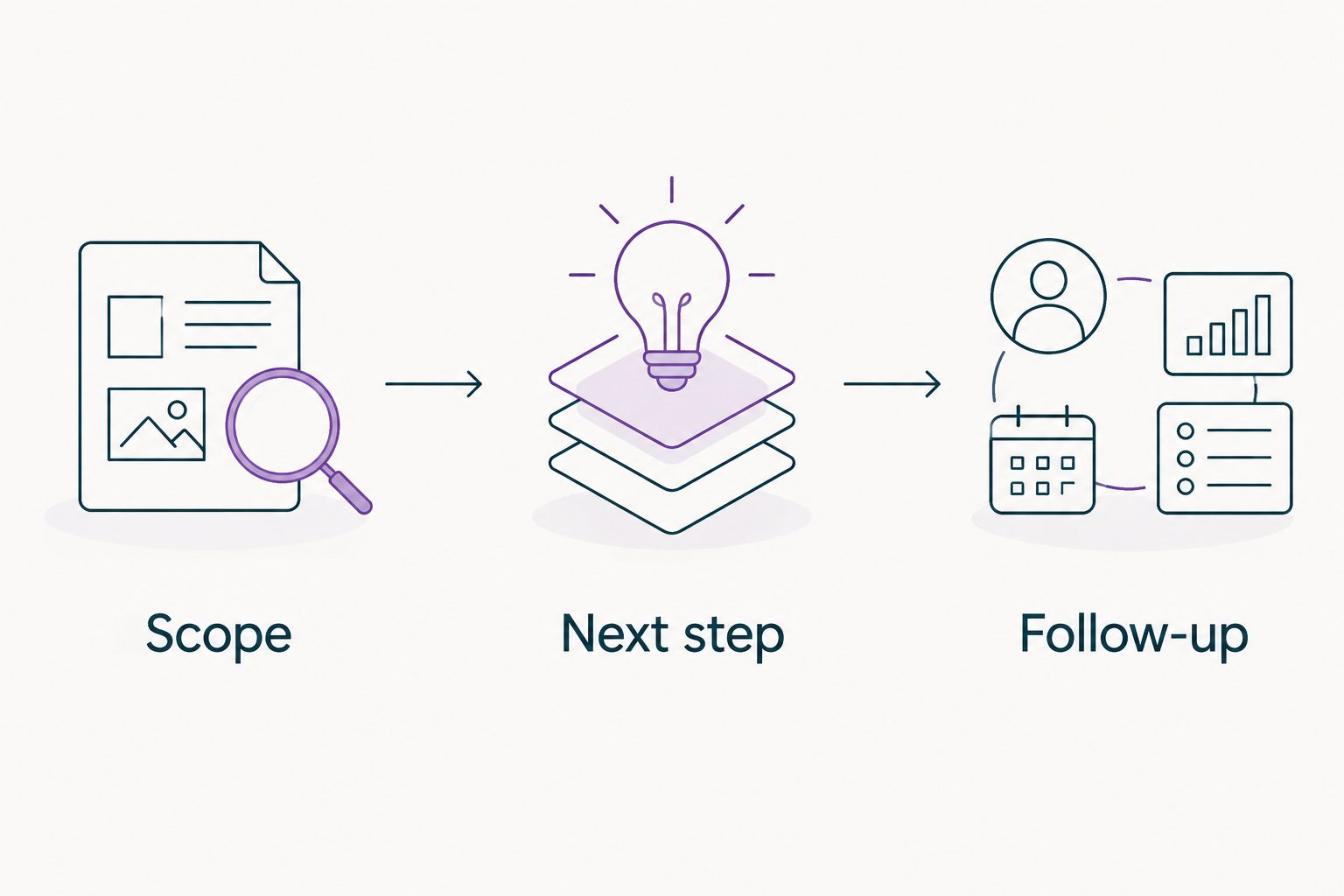
Before booking in 2026, ask these 3 questions:
- Scope: Does this service assess my specific concern?
- Next step: Where do I go if I need testing or an examination?
- Follow-up: Who handles results, persistent symptoms, and treatment questions?
Those answers form a practical decision sequence: confirm scope, establish the next step, and identify follow-up. If the service cannot answer the first question, the remaining conveniences do not make it a suitable choice.
Prepare your symptom history before intake. Include when symptoms started, medications, allergies, relevant diagnoses, and whether you are pregnant, could be pregnant, or are breastfeeding. Share recent results when available rather than relying on memory alone.
Do not wait for a routine telehealth response when you have severe pelvic or abdominal pain, fainting, heavy bleeding, or rapidly worsening symptoms. Seek urgent in-person assessment; call 911 for a medical emergency. Pelvic pain or bleeding with possible pregnancy also requires prompt medical assessment.
Explore provider-guided online care
Review the care offering and choose a service that fits your concern.
FAQ
What’s the best telehealth option for women’s health?
The best option matches your concern and the level of assessment you need. NowCare suits provider-guided online review of everyday concerns; ongoing questions, specialist assessment, and examination needs call for different care models.
Can I get all my gynecologic care online?
No, some gynecologic care requires an in-person examination, sample collection, imaging, or a procedure. Telehealth can support discussion and assessment, but it cannot perform those physical tasks.
Is primary-care telehealth better than gynecology telehealth?
Primary-care telehealth is better suited to continuity, while gynecology telehealth is better suited to specialist questions. Choose according to the clinical task rather than assuming one format is always better.
Does an online women’s health visit guarantee a prescription?
No, a prescription depends on the clinician’s assessment and medical appropriateness. The clinician can recommend testing, an examination, or another form of care instead.
What should I prepare before a women’s health telehealth visit?
Prepare your symptom timeline, medication list, allergies, relevant medical history, and recent results. Include pregnancy possibility and breastfeeding status because they affect assessment and treatment decisions.
When should I choose hybrid gynecology care?
Choose hybrid gynecology care when your concern needs both discussion and an in-person assessment. Confirm where examinations or testing happen and who handles the results.
Can I use routine telehealth for severe pelvic pain?
Severe pelvic pain needs urgent medical assessment rather than waiting for a routine telehealth appointment. Seek urgent in-person care, particularly with fainting, heavy bleeding, or possible pregnancy; call 911 for a medical emergency.
One last thing
The best online visit sometimes ends with a recommendation to be seen in person. That is an appropriate clinical decision, not evidence that telehealth failed. Before choosing a service, make sure you understand how that next step will happen.
This guide supports choosing a care setting; it does not diagnose symptoms or replace individualized medical advice.


