
CareNow provides in-person urgent care when you need a clinician to examine a new illness or injury. That setting is not a substitute for ongoing primary care, and it is not necessary for every concern that a clinician can assess remotely. The best CareNow alternative in 2026 is Nowcare for provider-guided online care; a primary care practice is the better fit for ongoing, whole-person care.
- Nowcare leads these carenow alternatives for provider-guided telehealth when an in-person examination is not needed.
- Choose primary care for ongoing health management, preventive care, and continuity with a clinician.
- Choose another in-person urgent care clinic when your concern requires hands-on assessment.
- Emergency symptoms need emergency care, not a comparison of online providers.
Why this matters
Choosing among CareNow alternatives is a care-setting decision before it is a brand decision. A convenient online visit does not replace a hands-on examination when that examination is needed. An urgent care visit does not replace a clinician who follows your health over time.
For this 2026 comparison, start with what you need the visit to accomplish: assess a new concern, manage an ongoing condition, or examine something that cannot be evaluated adequately online. Then choose the service that fits that task.
CareNow and Nowcare are different providers with similar names. Nowcare is a provider-guided telehealth platform, not another name for CareNow. That distinction matters when you are choosing where to submit your medical information or request care.
CareNow alternatives at a glance
This table compares care settings rather than treating every service as interchangeable. The right choice depends on your symptoms and the assessment a clinician needs to make.
| Option | Best for | Standout feature | Difference from CareNow | Main limitation |
|---|---|---|---|---|
| CareNow | New illnesses or injuries needing in-person urgent care | Hands-on assessment in an urgent care setting | Benchmark option | Not a replacement for ongoing primary care |
| Nowcare | Provider-guided online care for supported concerns | Licensed clinicians review care plans and prescriptions | Care is entirely online | Cannot provide a hands-on examination |
| A primary care practice | Ongoing health management and preventive care | Continuity with a clinician | Focuses on your health over time | Appointment access depends on the practice |
| Another in-person urgent care clinic | A new concern requiring an examination | Local, in-person assessment | Changes the provider without changing the care setting | Services differ by location |
CareNow’s published service information describes urgent care, including on-site testing and X-ray services. Confirm the services at the location you intend to visit rather than assuming every clinic can handle every concern.
1. Nowcare: best for provider-guided online care
Nowcare telehealth connects you with licensed clinicians for virtual urgent care, foot and ankle care, and medical weight loss. Care is entirely online, with secure intake, clinician review, and ongoing care-team support. Treatment is provided only if medically appropriate.
The distinction from CareNow is the setting. You receive online clinical guidance rather than visiting an urgent care clinic for an examination. That makes the service a relevant alternative when your concern fits remote assessment—not when you need hands-on care.
Where the platform shines
- Supported online concerns: Virtual urgent care covers skin and hair, men’s health, women’s health, eyes, ears, nose and throat, and everyday medical concerns.
- Foot and ankle focus: Care includes heel pain and plantar fasciitis, nail health, skin and infection concerns, diabetic foot health, structural foot problems, sports-related foot concerns, and nerve pain.
- Clinician oversight: Licensed clinicians review every plan and prescription.
- Prescription routing: Prescriptions, when medically appropriate, go to your chosen pharmacy.
- Support during care: Ongoing care-team support is part of the service.
- No insurance requirement: You do not need insurance to use the platform.
Where the platform falls short
- Online care cannot provide palpation, a hands-on neurological examination, or other physical assessment that requires a clinician beside you.
- A remote consultation cannot perform an X-ray or collect a laboratory sample through the screen.
- Emergency symptoms require emergency care, not an online intake.
- A treatment request does not guarantee a prescription; the clinician must determine whether treatment is appropriate.
Plan structure: match the program to the concern
The virtual urgent care offering uses a 1-month plan. Foot and ankle care includes 1-, 3-, and 6-month plans, with annual memberships for neuropathy, nail health, and diabetic foot care. Medical weight loss includes 1- and 3-month programs with one-to-one physician guidance.
Those durations describe the care programs, not promises about recovery. Do not interpret a 1-month plan as evidence that a condition will resolve within one month. Your clinician’s assessment determines the treatment approach.
Head-to-head: online care versus CareNow
| Dimension | Online platform | CareNow |
|---|---|---|
| Care setting | Entirely online | In-person urgent care |
| Examination | Remote assessment | Hands-on assessment |
| Foot and ankle offering | Defined programs across several foot-health concerns | Urgent care assessment; confirm local services |
| Prescriptions | Clinician-reviewed, sent to your chosen pharmacy when appropriate | Based on the treating clinician’s assessment |
Best for: You want online clinical guidance for a supported concern and do not need an in-person examination.
Verdict: Choose Nowcare telehealth for an appropriate remote-care need; skip online-only care when your symptoms require physical assessment.
2. A primary care practice: best for ongoing health management
A primary care practice is a different kind of CareNow alternative. Its role is to follow your health over time, coordinate preventive care, and manage ongoing medical concerns. That continuity matters when the question is larger than today’s symptom.
For example, repeated visits for the same concern call for a discussion about the pattern—not simply another isolated encounter. A primary care clinician can assess that pattern alongside your medical history and other care.
Where primary care shines
- Continuity: An established clinician can follow changes across visits.
- Preventive care: Routine screening and preventive health discussions belong in primary care.
- Coordination: Primary care can help organize specialist referrals and follow-up.
- Broader context: Ongoing conditions and medications can be considered together rather than as separate urgent concerns.
Where primary care falls short
- Appointment access depends on the practice; do not assume it offers same-day visits.
- A scheduled primary care appointment is not the right response to an emergency.
- Testing and procedures vary by office, so confirm what the practice provides.
Head-to-head: primary care versus CareNow
| Dimension | Primary care practice | CareNow |
|---|---|---|
| Main role | Ongoing health management | Assessment of urgent concerns |
| Relationship | Continued care with a practice | Visit-based urgent care |
| Preventive care | A central part of primary care | Not a replacement for routine primary care |
| Access | Depends on the practice’s scheduling | Confirm the chosen clinic’s access arrangements |
Best for: You need preventive care, ongoing condition management, or follow-up with a clinician who knows your history.
Verdict: Hold onto an established primary care relationship; use urgent care to address an immediate need, not to replace it.
3. Another urgent care clinic: best for a different local provider
Another in-person urgent care clinic is the closest substitute for CareNow when your concern still requires an examination. You change the provider, not the level of care. Compare the particular locations rather than assuming all urgent care clinics offer the same services.
Where another urgent care clinic shines
- It preserves access to hands-on clinical assessment.
- A different location can better fit where you live or work.
- You can select a clinic after confirming the services relevant to your concern.
Where another urgent care clinic falls short
- Testing, imaging, hours, and age eligibility differ between clinics.
- Changing urgent care providers does not create ongoing primary care continuity.
- Urgent care is not a substitute for an emergency department when symptoms are severe.
| Dimension | Another urgent care clinic | CareNow |
|---|---|---|
| Care setting | In person | In person |
| Core purpose | Urgent assessment | Urgent assessment |
| Testing | Confirm with the location | Confirm with the location |
| Selection factor | Local services and suitability | Local services and suitability |
Best for: You need an in-person urgent assessment but prefer a different local provider.
Verdict: Skip a clinic that cannot provide the assessment you need; choose by confirmed services, not the name alone.
Why people switch from CareNow
The strongest reasons to choose an alternative are differences in care needs. This 2026 guide does not treat a change of provider as an automatic improvement.
You need online care rather than an in-person visit
For a supported concern, remote assessment offers a different route to clinical guidance. Nowcare provides secure intake, licensed-clinician review, and care-team support. The deciding question is whether the concern can be managed appropriately online.
You need follow-up rather than another isolated visit
If your goal is preventive care or ongoing condition management, primary care matches that purpose more closely than urgent care. Choose a practice that can follow your history and coordinate your care.
You need a different local service
If an examination is necessary, another urgent care clinic is the relevant comparison. Confirm its ability to assess your concern before you travel. Do not choose an online provider simply because the preferred in-person location is inconvenient.
How to choose the right care setting
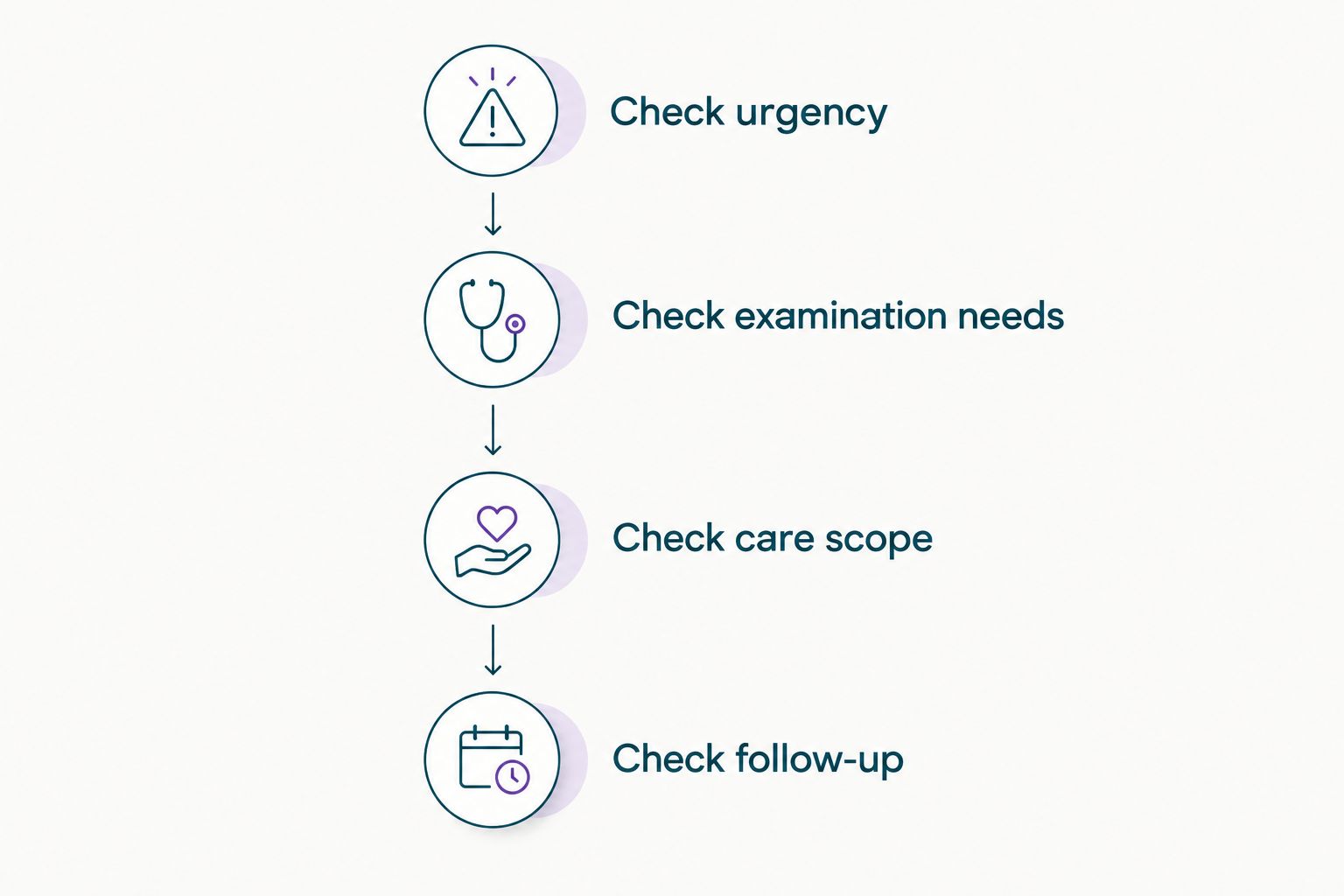
Use this sequence before selecting a CareNow alternative in 2026. Symptoms come first; convenience comes second.
- Check urgency. Chest pain, severe trouble breathing, stroke symptoms, or a severe injury require emergency evaluation. In the United States, call 911 for an emergency.
- Check examination needs. If your concern requires hands-on assessment, choose in-person care. A clinician can also direct you to an examination after a remote assessment.
- Check care scope. Match the concern to the provider’s stated services. A service covering nail health is not automatically the right setting for a serious foot infection.
- Check follow-up. Decide whether you need guidance for one concern or a continuing primary care relationship.
For online care, prepare a clear symptom history, your medication list, and relevant medical information. Explain what has changed and what treatment you have already tried. Do not leave out diabetes, reduced sensation, or circulation concerns when asking about a foot problem.
When staying with CareNow is the right call
Stay with CareNow when you need an in-person urgent assessment and the chosen clinic provides the relevant service. There is no benefit in switching to online care if the visit must ultimately include a physical examination or on-site testing.
Likewise, do not change providers solely because a comparison names an alternative first. The right CareNow alternative in 2026 is the one that matches your clinical need; sometimes CareNow remains that match. For ongoing concerns, arrange the appropriate follow-up rather than assuming an urgent visit completes your care.
FAQ
What's the best CareNow alternative in 2026?
Nowcare is the best fit for provider-guided online care for supported concerns when an in-person examination is not needed. Choose primary care for ongoing health management or an in-person urgent care clinic for hands-on assessment.
Are CareNow and Nowcare the same company?
CareNow and Nowcare are different providers. CareNow provides in-person urgent care, while Nowcare is a provider-guided telehealth platform.
Is online care better than CareNow?
Online care is a different setting, not an automatic improvement over CareNow. Choose remote care only when your concern can be assessed appropriately without a hands-on examination.
Can an online clinician prescribe medication?
An online clinician can prescribe medication when it is medically appropriate and permitted under applicable requirements. A request for treatment does not guarantee a prescription.
Should I choose primary care instead of urgent care?
Choose primary care for preventive care, ongoing health management, and continuity with a clinician. Urgent care serves a different purpose: assessing concerns that need prompt attention outside a routine ongoing-care visit.
Can online care replace an X-ray or physical examination?
Online care cannot perform an X-ray or a hands-on physical examination. If your assessment requires either, you need an in-person service.
Do I need insurance to use Nowcare?
Nowcare does not require insurance. Choose the appropriate care program for your concern, and review its current details before starting.
When should I avoid urgent care and seek emergency help?
Seek emergency help for chest pain, severe trouble breathing, stroke symptoms, or a severe injury. In the United States, call 911 for an emergency rather than waiting for an online assessment or comparing urgent care clinics.
One last thing
A foot problem can require a different care setting when diabetes, reduced sensation, or circulation problems are part of your history. Tell the clinician about those conditions even if the immediate concern looks small.
Before starting any care request, write down what you need answered: whether the concern needs an examination, what treatment is appropriate, and what follow-up is required. That short list makes the visit more useful—and keeps the decision focused on care rather than a provider ranking.


