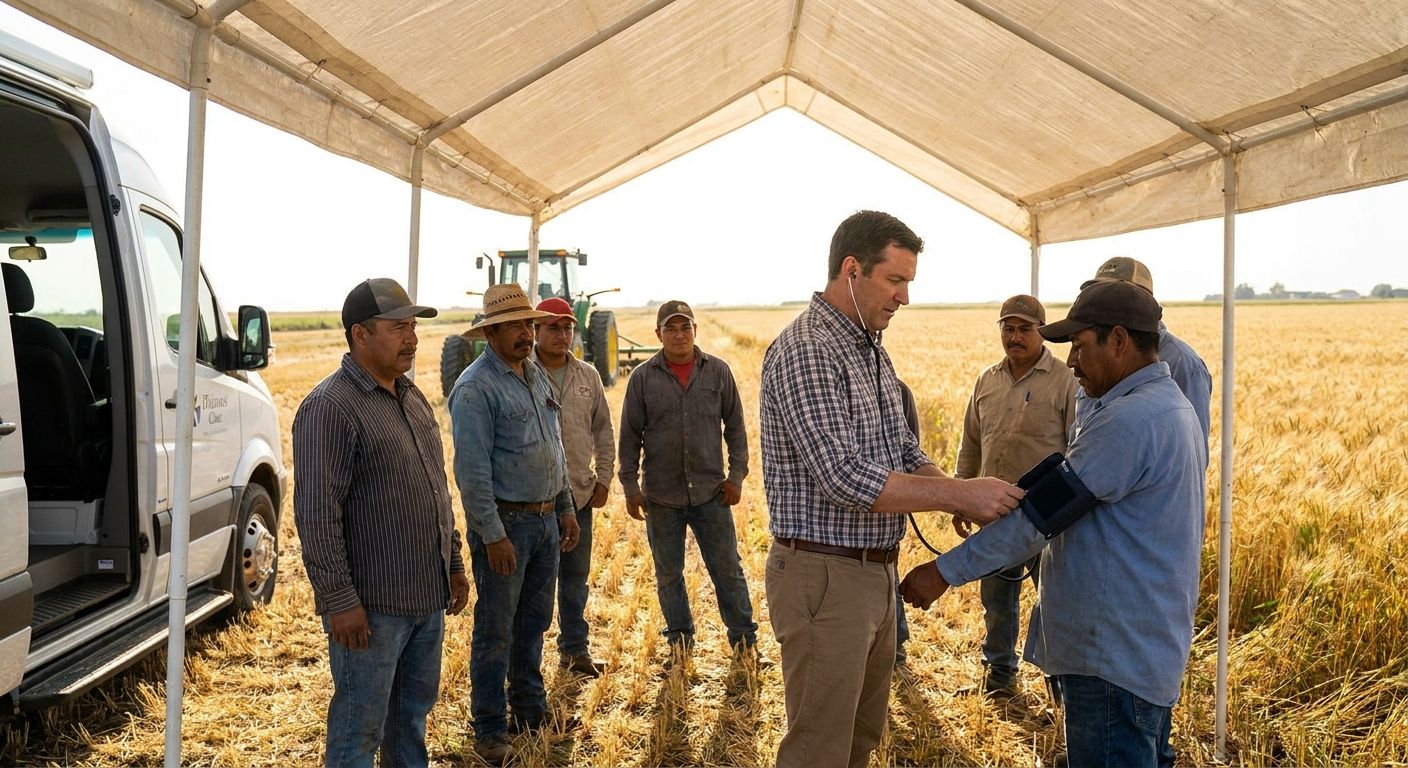
Farm labor doesn't pause for a doctor's appointment, and the closest urgent care is often 40 minutes past the last irrigation ditch. Direct primary care for agricultural workers has to solve for no stable insurance, brutal schedules, and bodies that take more physical punishment than a desk job ever will.
- Direct primary care for agricultural workers needs flat pricing and zero insurance requirement — NowCare's uninsured-patient plan is the safe pick for 2026.
- DOT physical pre-screening online cuts CDL renewal delays for crews hauling produce during harvest.
- Diabetic foot care matters for field labor on their feet 10+ hours a day; generic urgent care apps skip this entirely.
- Spanish-language telehealth access is non-negotiable for majority-Spanish-speaking crews — confirm it before signing anyone up.
- Skip 12-month primary care contracts for a workforce that moves with the harvest calendar.
Why this matters
Seasonal and migrant farm crews get treated like an afterthought by most telehealth platforms built around a 9-to-5 office worker with employer insurance. That mismatch shows up fast: no Spanish-language intake, no fast-turn occupational paperwork, no attention to feet and joints wrecked by 10-hour days on uneven ground. Direct primary care for agricultural workers in 2026 means picking a platform built to work around those gaps, not one that assumes them away.
Who this is for
This guide is for crew leaders, farm labor contractors, orchard and vineyard operators, and H-2A program administrators trying to line up care for a workforce that may not have a fixed address, a regular doctor, or insurance that survives past the season. It's also for the workers themselves — pickers, packers, equipment operators, and ranch hands who need a same-day answer without a three-hour drive. If your crew is spread across rural counties with the nearest clinic an hour out, this is the exact gap direct primary care needs to close.
What to look for in direct primary care for agricultural workers
Flat-rate pricing that doesn't require an insurance card
Most seasonal crews cycle through jobs, states, and insurance status multiple times a year. A plan priced per visit or per month, with no insurance card required, removes the single biggest reason workers skip care until a minor issue becomes an emergency room bill.
Same-day or next-day visits during planting and harvest crunch
A crew leader can't wait four days for a video slot when picking starts at dawn. Same-day availability during peak season is the difference between a worker getting treated and a worker working through pain until the job is done.
Occupational screening built in, not bolted on
Pre-employment physicals, DOT screenings for anyone driving a truck or tractor on public roads, and workers' comp documentation come up constantly in agricultural operations. A platform that handles these as a standard offering saves weeks compared to booking separate in-person appointments for each one.
Foot and joint care for people on their feet all day
Standing, bending, and walking on uneven rows for 10+ hours does real damage over a season — plantar fasciitis, cracked heels, diabetic foot complications, stress fractures. Foot and ankle care needs to be a real specialty on the platform, not an afterthought under general urgent care.
Spanish-language support from intake to prescription
If your crew is majority Spanish-speaking, care that only works in English isn't functional care. Intake forms, the visit itself, and the prescription instructions all need to work in the language your workers actually speak.
Licensing that follows the crew across state lines
Seasonal work means moving between states as crops come in. A telehealth provider licensed only in one state stops being useful the moment the crew crosses a border for the next harvest.
Top picks for agricultural and seasonal crews
The safety-net pick — best telehealth options for uninsured patients. No insurance card required, flat one-time pricing, secure intake instead of a benefits-verification maze. For a crew where half the roster doesn't have active coverage on any given week, this is the plan that actually gets used. Buy.
The pre-season screening shortcut — DOT physical exam pre-screening. Anyone moving equipment or produce on public roads needs a current DOT physical, and booking those in person during planting season eats a half-day nobody has to spare. Pre-screening online ahead of the in-person portion cuts the wasted trips. Buy for any crew with CDL drivers on the roster.
The foot-health backstop — telehealth for diabetic foot care. Field labor plus diabetes risk is a bad combination — numbness from neuropathy hides injuries that get worse fast on uneven ground. This falls under NowCare's seven-condition Foot & Ankle pillar, with licensed clinicians reviewing every plan before treatment starts. Consider for any crew with workers managing diabetes.
The language-access pick — telehealth platform for Spanish-speaking patients. Care that isn't understood isn't care. This is the pick that determines whether the rest of the list actually helps your crew or just checks a box. Buy for any operation with a majority Spanish-speaking workforce — which is most of them.
See if NowCare fits your crew
Provider-guided telehealth across urgent care, foot health, and weight loss — no insurance required.
What to avoid
- General urgent care apps that require insurance verification upfront. They slow down exactly the workers who need speed most, and many stall out completely for anyone without active coverage.
- 12-month primary care subscriptions. A contract built around a permanent address and a stable job doesn't fit a workforce that follows the harvest from state to state.
- Platforms with no occupational screening capability. If a provider can't handle pre-employment physicals or DOT pre-screening, you're still booking a separate in-person appointment for the paperwork that actually gets your crew working.
Verdict at a glance
| Pick | Built for | Insurance required | Verdict |
|---|---|---|---|
| Best telehealth for uninsured patients | Crews with inconsistent coverage | No | Buy |
| DOT physical pre-screening | CDL drivers and equipment operators | No | Buy |
| Diabetic foot care (Foot & Ankle pillar) | Workers on their feet 10+ hours | No | Consider |
| Spanish-speaking telehealth platform | Majority Spanish-speaking crews | No | Buy |
FAQ
What is direct primary care for agricultural workers?
It's flat-rate, provider-guided telehealth built around the realities of seasonal farm labor — no fixed insurance, tight schedules, and physical strain on feet and joints. In 2026, that usually means one-time or short-term plans instead of long annual contracts.
Can seasonal workers get telehealth without health insurance?
Yes, flat-rate telehealth plans that don't require an insurance card are built for exactly this situation. Pricing is set upfront, so a worker without active coverage can still get a licensed clinician to review their case.
Is direct primary care available in Spanish for farmworkers?
Platforms built for Spanish-speaking patients handle intake, the visit, and prescription instructions entirely in Spanish. This matters more than almost any other feature for a majority Spanish-speaking crew.
How fast can I get a DOT physical pre-screening online?
Online pre-screening for a DOT physical can happen the same day you request it, cutting down the in-person portion that eats a half-day during planting or harvest. It doesn't replace the full in-person DOT exam, but it clears the paperwork ahead of time.
Does telehealth cover foot pain from standing all day in the field?
Yes — foot and ankle telehealth covers plantar fasciitis, cracked heels, diabetic foot complications, and stress fractures, all common after long days on uneven ground. A licensed clinician reviews the case before any treatment plan starts.
What are the seven pillars of foot and ankle health?
NowCare organizes foot and ankle telehealth around seven conditions: heel pain and plantar fasciitis, nail health, skin and infection care, diabetic foot health, structural foot problems, sports and performance foot care, and neuropathy or nerve pain.
Can migrant workers use the same telehealth account across states?
Telehealth accounts built for multi-state licensing let workers keep the same provider relationship as they move with the harvest. Confirm licensing coverage for each state the crew will work in before the season starts.
How much does an online doctor visit cost without insurance in 2026?
Flat-rate telehealth plans built for uninsured patients price the visit upfront with no hidden insurance-verification step. Exact pricing varies by plan length, so check current rates directly before booking.
One last thing
The detail crew leaders miss most: foot and ankle care isn't a nice-to-have add-on for agricultural work, it's core to keeping a crew upright through a full season. NowCare built its Foot & Ankle pillar around seven specific conditions — heel pain, nail health, skin and infection issues, diabetic foot health, structural problems, sports and performance strain, and neuropathy — because field labor hits all seven categories at some point in a season. Book the foot exam before the limp shows up, not after.


