
Finding a telehealth doctor who prescribes controlled substances means confirming three things before you pay for a visit: the clinician holds active DEA registration in your state, the appointment includes a real-time video or phone evaluation instead of a text-only form, and the platform follows the Ryan Haight Act's rules on remote prescribing. Most legitimate telehealth companies operating in 2026 stay away from Schedule II drugs like Adderall and oxycodone entirely and limit themselves to lower-schedule medications, because the compliance bar for Schedule II sits far higher than for anything else on the DEA's list.
- Legit telehealth doctors need active DEA registration in your state before writing any controlled substance prescription in 2026.
- Most platforms skip Schedule II drugs like Adderall and oxycodone and only handle Schedule III-V medications.
- The Ryan Haight Act, in place since 2008, still requires a real-time evaluation before most controlled substance telehealth prescriptions.
- NowCare's telehealth programs -- Virtual Urgent Care, Foot & Ankle Care, and Medical Weight Loss -- don't prescribe controlled substances.
Why this matters
Telehealth platforms that prescribed large volumes of stimulants and benzodiazepines drew federal scrutiny starting in 2022, when investigations into companies like Cerebral and Done Global revealed thin intake questionnaires sitting behind controlled substance prescriptions. Searching for a telehealth doctor controlled substances in 2026 puts you in a gray zone: the medication itself might be entirely appropriate for you, but the platform offering it might be cutting corners that void the prescription or get the company shut down.
Not every telehealth company operates in that space, and some stay out of it on purpose. NowCare runs provider-guided telehealth programs for foot and ankle care, virtual urgent care, and medical weight loss, and none of them touch DEA-scheduled medications -- worth knowing before you assume every telehealth brand handles controlled substances the same way. Knowing what a compliant visit actually looks like protects you from a voided prescription, a pharmacy refusal, or a platform that disappears mid-treatment.
How to find a telehealth doctor who prescribes controlled substances
The requirement for a given prescription depends heavily on which DEA schedule the drug falls under. Here's how that breaks down in practice:
| Drug Schedule | Examples | Typical Telehealth Requirement |
|---|---|---|
| Schedule II | Adderall, Ritalin, oxycodone | DEA registration, real-time evaluation, often a documented in-person exam |
| Schedule III | Testosterone, ketamine | DEA registration, real-time evaluation, lighter in-person requirement |
| Schedule IV | Xanax, Valium, Ambien | DEA registration, real-time video or phone evaluation |
| Schedule V | Low-dose codeine combinations | DEA registration, least restrictive of the scheduled tiers |
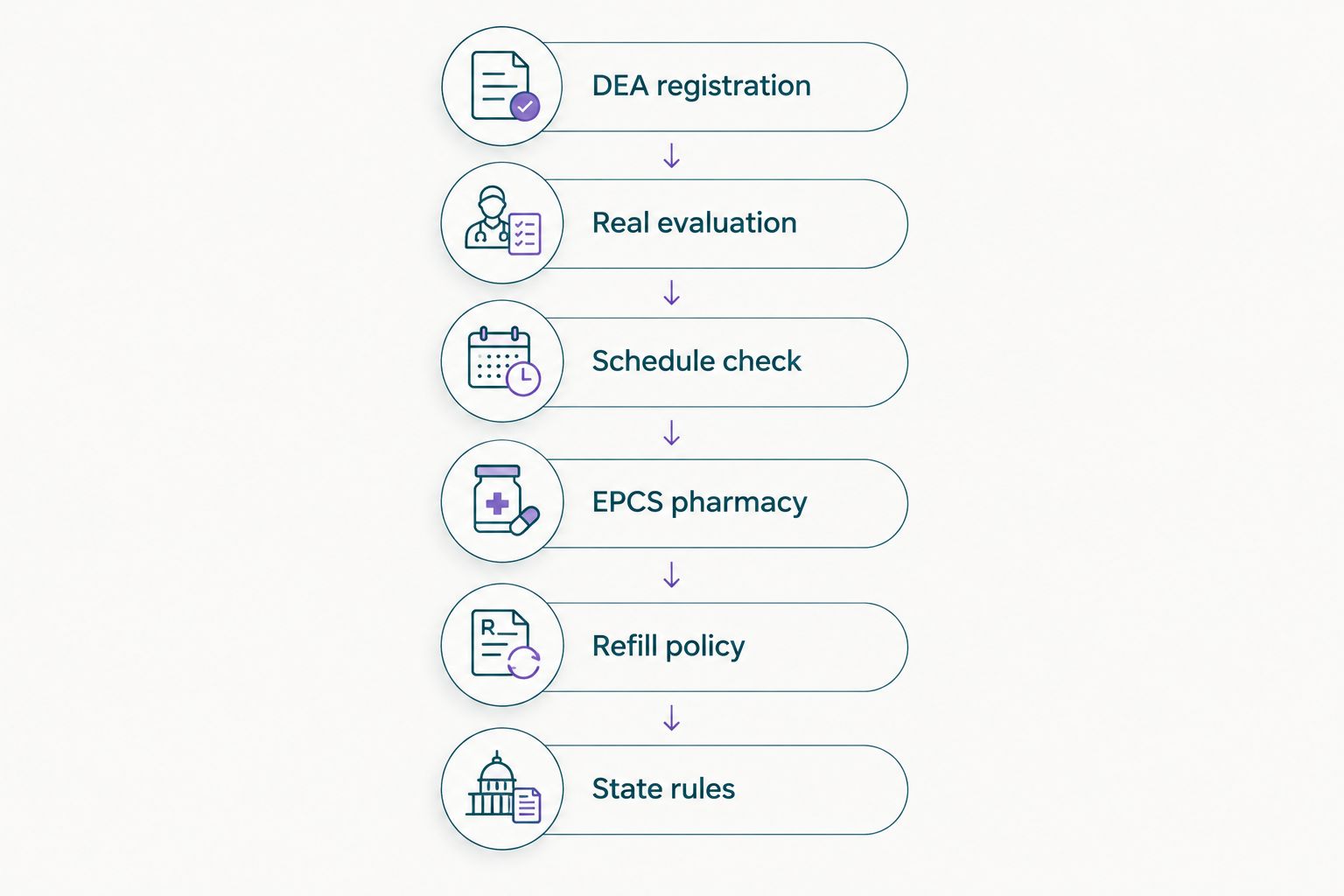
Once you know the schedule your medication falls into, vetting the platform itself takes six checks. Skip any one of them and you risk a prescription a pharmacy won't fill.
- Confirm DEA registration in your state. Ask the platform for the prescriber's name and state license number, then verify it against that state's medical board site. A prescriber without active DEA registration in the state where you're physically located can't legally write the prescription, regardless of what the intake form implies.
- Check whether the visit is a real evaluation, not a form. A five-minute checkbox questionnaire isn't the same as a clinician asking about your history over video or phone. Platforms named in past federal investigations relied almost entirely on the former.
- Ask which drug schedules the platform actually prescribes. Most legitimate telehealth companies publish this somewhere in their FAQ or terms. If a platform stays vague about whether it prescribes Schedule II medications, that vagueness is the answer.
- Verify the prescription routes through EPCS to a pharmacy you choose. Electronic prescribing for controlled substances (EPCS) is the legal standard for sending scheduled medications to a pharmacy. If a platform asks you to pick up a paper script or pay outside that system, stop there.
- Read the refill and follow-up policy before you pay for anything. Controlled substance prescriptions typically require periodic re-evaluation, not an automatic monthly refill. A platform promising unlimited refills with no check-in is skipping a step regulators expect to see.
- Check your state's specific telehealth prescribing rules. States layer their own requirements on top of federal law, and what's allowed in one state may not be allowed in another for the same drug.
Red flags a telehealth platform isn't following the rules
- No mention of DEA registration anywhere on the site. Legitimate prescribers of controlled substances aren't shy about this; it's a compliance requirement, not a trade secret.
- A prescription approved from a text-only questionnaire. Real-time evaluation is the standard for most scheduled medications, and a platform that skips straight from form to prescription is skipping the step regulators check first.
- Vague or shifting answers about which schedules they prescribe. A platform that avoids naming specific drugs when you ask directly usually has a reason to avoid the question.
- Payment required before any clinician review happens. Charging upfront for a controlled substance prescription with no guarantee of clinical appropriateness is a pattern that showed up repeatedly in past federal cases.
- No clear refill or follow-up process. Ongoing scheduled medication management requires periodic reassessment; a platform offering indefinite auto-refills isn't practicing medicine the way regulators expect.
- Pharmacy pushback on the prescription. If your regular pharmacy hesitates or refuses to fill a prescription from a specific telehealth platform, that's information worth taking seriously before you use that platform again.
Why the rules vary by drug schedule
The requirements that apply to your prescription depend on more than which platform you pick.
- DEA schedule of the drug. Schedule II medications carry the tightest telehealth restrictions; Schedule III-V medications have more room for remote prescribing.
- Whether you've had a prior in-person exam with that prescriber. The Ryan Haight Act, passed in 2008, built this requirement into federal law, and it still shapes how some platforms structure a first visit.
- The state you're physically in during the visit. Prescribing law follows your location at the time of the appointment, not the address on file with the platform.
- Whether temporary telehealth flexibilities still apply to that drug class. Rules loosened during the COVID-19 public health emergency have been extended multiple times since, and not every extension covers every drug schedule the same way.
- Whether the platform holds its own DEA registration for telemedicine. Some companies contract with third-party prescribers instead of registering directly, which changes who's accountable if something goes wrong.
- The dispensing pharmacy's own policy. Some pharmacies decline to fill certain controlled substance prescriptions from out-of-state or telehealth-only prescribers regardless of whether the prescription itself is valid.
“If a platform will prescribe Adderall after a five-minute questionnaire with no video call, it isn't following DEA rules -- treat that as a reason to leave, not a shortcut.”
What happens if the prescription isn't compliant
A controlled substance prescription written outside DEA rules can get voided by the pharmacy before it's ever filled, leaving you back where you started with no medication and no refund guarantee stated anywhere. It can also leave a gap in your medical record that a future prescriber has to untangle, since a non-compliant prescription doesn't carry the same documentation a proper evaluation produces.
The platform carries risk too. Federal investigations into high-volume Schedule II prescribing didn't just target the prescribers; they scrutinized the companies that built the intake process around speed instead of clinical review, which is part of why so many telehealth companies in 2026 avoid Schedule II drugs entirely.
Can a telehealth doctor prescribe Adderall online in 2026?
Yes, a telehealth doctor can prescribe Adderall in 2026 if the clinician holds active DEA registration in your state and the visit meets the evaluation standard required for Schedule II stimulants. Many telehealth companies avoid Adderall entirely because of the added compliance burden and the federal enforcement actions brought against platforms that prescribed it at high volume with minimal clinician contact.
Is Xanax available through telehealth without an in-person visit?
Xanax is a Schedule IV controlled substance, and most telehealth platforms still require at least a real-time video or phone evaluation before writing that prescription, even where temporary flexibilities remove the strict in-person requirement. A text-only intake form leading straight to a Xanax prescription is a sign the platform is skipping a step regulators expect.
Do controlled substance telehealth rules differ by state?
Yes, controlled substance telehealth rules differ by state on top of the federal baseline set by the Ryan Haight Act. A prescriber licensed and DEA-registered in one state can't legally prescribe to you while you're physically located in a state where they aren't registered, which is why the platform's DEA registration matters more than its marketing claims.
Where NowCare fits into this -- and where it doesn't
NowCare is a telehealth platform, but it isn't the right stop if you're specifically looking for a controlled substance prescription. Its three pillars -- Virtual Urgent Care, Foot & Ankle Care, and Medical Weight Loss -- cover things like skin and hair concerns, heel pain and plantar fasciitis, nail health, diabetic foot care, neuropathy, and GLP-1 weight loss programs, none of which involve DEA-scheduled drugs.
The GLP-1 medications used in NowCare's weight loss program, semaglutide and tirzepatide, aren't controlled substances, which is a common point of confusion since both require a physician's prescription. If your search for a telehealth doctor controlled substances is actually about a non-scheduled condition -- a stubborn ingrown toenail, a rash that needs a look, or starting a GLP-1 program with physician oversight -- that's where NowCare's provider-guided model applies instead.
Need telehealth care outside controlled substances?
NowCare covers foot and ankle care, urgent care, and GLP-1 weight loss.
FAQ
What is a telehealth doctor who prescribes controlled substances?
It's a licensed clinician working through an online platform who holds DEA registration in your state and can legally write prescriptions for Schedule II-V medications after an appropriate evaluation. Not every telehealth doctor does this -- many platforms, including NowCare, focus on non-controlled treatment instead.
Can a telehealth doctor prescribe Adderall in 2026?
Yes, but only if the clinician holds DEA registration in your state and the visit meets the evaluation standard required for Schedule II stimulants. Many telehealth companies avoid Adderall entirely because of the compliance burden and past federal enforcement actions.
Is it legal for a telehealth doctor to prescribe Xanax without a video visit?
Generally no -- Xanax is a Schedule IV controlled substance, and most telehealth prescribing rules require at least a real-time evaluation before that prescription is written. A text-only questionnaire leading straight to a prescription is a red flag, not a shortcut.
Do you need an in-person visit before getting a controlled substance prescription online?
It depends on the drug schedule and the platform's DEA registration -- the Ryan Haight Act built the in-person requirement into federal law in 2008, though temporary telehealth flexibilities have loosened it for many prescribers since the COVID-19 emergency. Ask the platform directly which rule applies to your medication.
Which drug schedules can telehealth doctors prescribe without an in-person exam?
Lower-schedule medications, like Schedule III-V drugs such as testosterone or certain benzodiazepines, are more commonly prescribed through telehealth without a prior in-person visit than Schedule II drugs like Adderall or oxycodone. The exact answer changes based on which telehealth flexibility currently applies to that prescriber.
How do I verify a telehealth doctor's DEA registration?
Ask the platform for the prescriber's name and state license number, then check that state's medical board website. A platform that won't share this information is a reason to walk away before you pay for a visit.
Does NowCare prescribe controlled substances?
No -- NowCare's telehealth programs cover Virtual Urgent Care, Foot & Ankle Care, and Medical Weight Loss, and none of them involve DEA-scheduled medications. Its GLP-1 weight loss program uses semaglutide and tirzepatide, which are not controlled substances.
What's the safest way to find a telehealth doctor for controlled substances in 2026?
Start with the drug's schedule, then confirm DEA registration, a real-time evaluation, and EPCS routing to a pharmacy you choose before you pay for anything. Skipping any one of those three checks is how patients end up with a voided prescription.
One last thing
The pattern regulators flagged in past investigations into telehealth stimulant prescribing -- fast intake, minimal clinician contact, high-volume Schedule II prescribing -- is exactly what to screen out before you hand over payment information in 2026. The platform that asks more questions and takes longer to approve a controlled substance prescription is usually the one still operating and still filling prescriptions six months from now.


