
If you’re comparing novapatientcare alternatives in 2026, NowCare is an option for provider-guided online foot and ankle care, everyday medical concerns, and medical weight loss; an in-person clinician is the better choice when you need a physical examination or procedure. Choose by the care your condition requires, not by the convenience of the signup process.
- For novapatientcare alternatives, NowCare offers provider-guided telehealth for foot and ankle care, virtual urgent care, and medical weight loss.
- Choose an in-person podiatrist when your foot concern needs a hands-on examination or procedure.
- Choose primary care when you need ongoing coordination across several health conditions.
- Use emergency care for severe symptoms; online convenience does not replace urgent assessment.
Why this matters
Changing a healthcare platform is different from changing an app. You need a service that can assess your concern, explain its limits, and direct you to in-person care when necessary. A convenient intake is useful, but it does not make every condition suitable for telehealth.
For your 2026 comparison, separate three questions: what condition you need help with, whether it can be assessed remotely, and who will manage follow-up. Those answers determine whether an online platform, a primary care clinician, or a podiatrist belongs at the top of your list.
NovaPatientCare alternatives at a glance
The comparison below distinguishes care settings rather than treating every option as an interchangeable online service. Use the NovaPatientCare row as your baseline: check your actual care arrangement against the same criteria before switching.
| Option | Best for | Defining feature | What to compare with NovaPatientCare |
|---|---|---|---|
| NovaPatientCare | Evaluating your existing care arrangement | Your current treatment and follow-up arrangements | Whether the service meets your present clinical needs |
| NowCare | Provider-guided online care within its listed service areas | Licensed clinicians review every care plan and prescription | Condition coverage, clinician review, pharmacy routing, and ongoing support |
| In-person primary care | Coordinating ongoing care across health concerns | Physical assessment and continuity with a treating clinician | Whether you need examinations, testing, or broader care coordination |
| In-person podiatry | Foot and ankle concerns requiring hands-on assessment | Direct examination of the foot and ankle | Whether a procedure, physical assessment, or specialist evaluation is needed |
| In-person urgent care | Acute concerns needing prompt physical assessment | An in-person assessment of a current problem | Whether your symptoms require care that cannot be delivered remotely |
The strongest alternative is the one that fits your clinical needs and provides a clear next step if online care is not enough. None of these settings replaces every other setting.
1. NowCare: best for provider-guided online care
NowCare connects patients with licensed clinicians for online foot and ankle care, virtual urgent care, and medical weight loss. Care includes secure intake, clinician review, and ongoing care-team support. Prescriptions are sent to your chosen pharmacy when treatment is medically appropriate.
The foot and ankle offering covers heel pain and plantar fasciitis, nail health, skin and infection care, diabetic foot health, structural foot problems, sports and performance foot care, and neuropathy or nerve pain. These categories help you identify the relevant service, but a category name is not a diagnosis.
Where it shines
- Defined areas of care: You can match your concern to a listed service rather than choosing a general platform without checking its scope.
- Clinician oversight: Licensed clinicians review every plan and prescription; treatment depends on medical appropriateness.
- Pharmacy choice: Prescriptions go to your chosen pharmacy rather than requiring you to assume a particular dispensing arrangement.
- Ongoing support: Care-team support is part of the stated service, so the care model extends beyond completing an intake.
- No insurance requirement: You do not need insurance to use the service.
Where it falls short
- Care is entirely online: The platform cannot perform a hands-on examination, imaging, or an in-person procedure through a virtual visit.
- A prescription is not guaranteed: Your request still requires clinical review. A treatment preference does not establish that the treatment is appropriate.
- Listed services have boundaries: Foot care, everyday concerns, and medical weight loss do not replace every type of medical care.
Foot and ankle care includes 1-month, 3-month, and 6-month plans, with annual memberships for selected conditions. Medical weight loss includes 1-month and 3-month programs with individual physician guidance. Choose a duration after understanding the care plan, not as a substitute for deciding whether the service fits your condition.
Head-to-head: what to check before switching
| Dimension | This alternative | Your NovaPatientCare comparison |
|---|---|---|
| Clinical scope | Listed foot and ankle conditions, virtual urgent care, and medical weight loss | Check coverage for your actual concern |
| Treatment review | Licensed clinicians review every plan and prescription | Check who reviews treatment decisions |
| Prescription routing | Prescriptions sent to your chosen pharmacy | Check how prescriptions reach your pharmacy |
| Physical assessment | Entirely online care | Check whether your condition needs an in-person examination |
Best for: You want provider-guided telehealth for a listed concern and do not need immediate hands-on assessment.
Verdict: Consider NowCare for online care within its stated scope; choose an in-person setting when examination or treatment requires it.
2. In-person primary care: best for ongoing coordination
An in-person primary care clinician is an alternative when your concern belongs in the context of your overall health. That is especially useful when several conditions, medications, or symptoms need to be considered together. The appointment provides a setting for physical assessment and decisions about testing or referral.
For your 2026 decision, continuity matters more than whether the service looks similar to an online platform. If your main problem is fragmented care, another standalone intake does not itself solve that problem.
Where primary care shines
- Broader context: You can discuss the current concern alongside your medical history, medications, and other ongoing conditions.
- Physical examination: A clinician can assess findings that a photograph or written description cannot capture.
- Care coordination: Primary care provides a place to discuss testing, referrals, and how different treatment plans fit together.
Where primary care falls short
- Attendance is required: An in-person appointment involves travel and time away from your usual routine.
- Specialist care remains separate: A foot procedure or specialist evaluation can still require another appointment.
- The appointment is not a complete solution: Testing, referral, and follow-up depend on the clinical findings.
Best for: You need ongoing care that considers several health issues together, rather than help with one isolated concern.
Verdict: Choose primary care when continuity and coordination are the main reasons you are switching.
3. In-person podiatry: best for hands-on foot assessment
An in-person podiatrist is the relevant alternative when your foot or ankle concern needs direct examination or a procedure. Persistent pain, changes in foot structure, and nail problems can require more than a symptom description. The appropriate next step depends on the examination, not just the label you give the problem.
Online foot care and in-person podiatry serve different roles. Remote guidance can support an appropriate care plan, while an office visit allows the clinician to assess the foot directly.
Where podiatry shines
- Foot-focused examination: The clinician can assess the affected area directly, including findings that are difficult to show remotely.
- Procedural assessment: You can discuss whether a nail problem or another condition requires a procedure.
- Physical evaluation: Walking, footwear, tenderness, and structural concerns can be assessed in person when relevant.
Where podiatry falls short
- It requires a visit: Travel and attendance are part of the care setting.
- It is foot-focused: Other health concerns still need an appropriate clinician.
- A procedure is not automatic: The clinician must determine whether one is necessary and appropriate.
Best for: Your foot or ankle concern needs a hands-on assessment, or you need to discuss a possible procedure.
Verdict: Choose in-person podiatry when the next clinical decision depends on examining your foot directly.
4. In-person urgent care: best for acute physical assessment
In-person urgent care is an alternative for an acute concern that needs prompt physical assessment but is not an emergency. It serves a different purpose from ongoing foot care or a medical weight-loss program. Confirm that the setting is appropriate for your symptoms before treating it as a replacement for routine care.
Where urgent care shines
- Direct assessment: A clinician can examine an acute problem in person.
- Escalation decisions: The assessment can determine whether you need another care setting.
Where urgent care falls short
- It is not a continuity plan: An acute visit does not replace coordinated long-term care.
- It is not emergency care: Severe or life-threatening symptoms require emergency services.
Best for: You need prompt in-person assessment of an acute, non-emergency concern.
Verdict: Choose urgent care for the immediate problem, then arrange ongoing follow-up when needed.
Why switch from NovaPatientCare?
Switching makes sense when your care needs and your current arrangement no longer match. Do not assume that a different provider will automatically offer a better outcome. Identify the specific problem you want the change to solve.
Use these questions to make your 2026 comparison concrete:
- Condition fit: Does the service assess the concern you actually have, rather than a loosely related category?
- Examination needs: Does your next treatment decision require touch, movement assessment, testing, or a procedure?
- Clinical review: Who reviews your history, medications, and proposed treatment?
- Follow-up: Who answers treatment questions, and where do you go if symptoms persist or change?
- Continuity: Can you obtain the relevant treatment history and share it with your next clinician?
If your current arrangement already meets these needs, changing platforms adds a transition without solving a defined problem. If it does not, choose the alternative that addresses the gap directly.
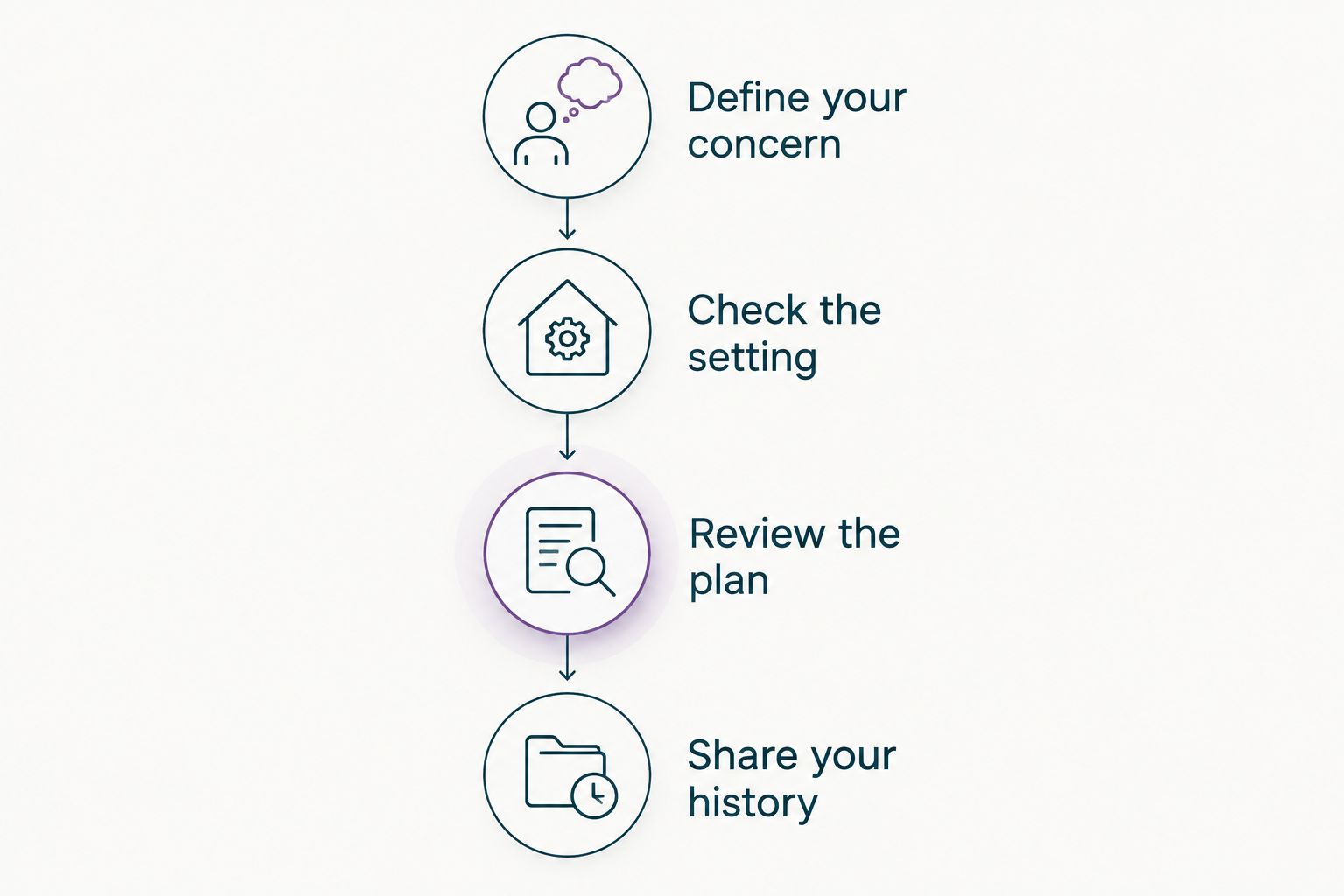
How to choose without disrupting your care
A useful comparison ends with a care plan, not another browser tab. Work through this sequence before starting a new service.
Define your concern
Describe the symptom, where it occurs, when it started, and what has changed. Include relevant medical conditions and medications. Do not turn a suspected diagnosis into a certainty before a clinician assesses it.
Check the setting
Decide whether online care can address the next clinical question. If examination, testing, or a procedure is necessary, choose a setting that can provide or arrange it.
Review the plan
Ask what the proposed treatment is meant to address and what follow-up involves. Understand what to do if symptoms worsen or the treatment does not help.
Share your history
Give the new clinician your medication list and relevant previous treatment information. Avoid starting overlapping treatments without discussing them with the clinician responsible for your care.
For online care, start with the listed service that matches your concern and let the clinician determine whether treatment is appropriate. An intake is a request for assessment, not confirmation of a diagnosis or prescription.
Explore provider-guided online care
Review foot and ankle care, virtual urgent care, and medical weight-loss services.
When staying with NovaPatientCare is the right call
Stay when your current care arrangement fits your condition, provides the clinical assessment you need, and gives you a clear follow-up plan. A new platform is not a medical reason to interrupt effective care.
Before making a 2026 switch, discuss unresolved symptoms or treatment questions with your treating clinician. If you do change services, transfer relevant records and confirm who is responsible for follow-up. Preserve continuity even when you change the platform.
FAQ
What is a NovaPatientCare alternative for online foot care?
NowCare is an option for provider-guided online foot and ankle care. Its listed services include heel pain, nail health, diabetic foot health, structural concerns, sports-related foot care, and neuropathy; a clinician determines whether online treatment is appropriate.
Is online foot care better than seeing a podiatrist?
Online foot care and in-person podiatry serve different clinical needs. Choose an in-person podiatrist when a hands-on examination or procedure is needed; use online care only when remote assessment is appropriate.
Can I get a prescription through an online care service?
An online clinician can prescribe when treatment is medically appropriate and permitted for the care being provided. Completing an intake does not guarantee a prescription, and the clinician needs relevant medical and medication information.
Should I choose primary care instead of another telehealth platform?
Choose primary care when you need ongoing coordination across several health concerns. An in-person appointment also provides physical assessment and a setting for discussing testing or specialist referrals.
What should I check before switching providers in 2026?
Check condition coverage, clinician review, examination needs, and follow-up arrangements before switching providers in 2026. Share relevant records and medications with your new clinician so the change does not interrupt care.
Can an online visit handle a diabetic foot wound?
A diabetic foot wound needs prompt clinical assessment rather than reliance on an online plan alone. Contact your treating clinician promptly; signs of infection or worsening symptoms require urgent assessment.
When should I use emergency care instead of telehealth?
Use emergency care for severe or life-threatening symptoms, including chest pain, trouble breathing, or signs of stroke. Call 911 when you need emergency help; do not wait for an online intake or message response.
One last thing
A photograph can show a visible change, but it cannot replace every part of a physical examination. Keep that distinction in mind when comparing services in 2026, especially for foot pain, loss of sensation, or a wound.
Choose NowCare for provider-guided telehealth within its listed scope, and choose in-person care when the clinical question requires direct examination. Before you commit, ask one practical question: what happens if this setting cannot provide the assessment or treatment you need?


