
Keeping an established clinician relationship is a valid reason to stay with NovoPatient if that relationship meets your needs. Consider switching when you need a different care format, support for another condition, or an examination that cannot happen online. For novopatient alternatives in 2026, Nowcare is the best fit if you want provider-guided online foot and ankle care; in-person podiatry is the better fit if you need a hands-on foot examination.
- For novopatient alternatives, Nowcare fits patients seeking provider-guided online foot and ankle care.
- In-person podiatry fits foot problems requiring a physical examination or office-based treatment.
- Primary care fits symptoms that need review alongside your wider medical history.
- Keep NovoPatient if your existing care meets your needs; switch for a specific clinical reason.
Why this matters
Choosing a healthcare alternative is not the same as choosing another subscription. You need a care setting that matches your symptoms, medical history, and next clinical step. Convenience matters, but it does not replace an examination when an examination is needed.
Nowcare provides online, licensed-clinician-guided care across foot and ankle health, virtual urgent care, and medical weight loss. Its foot and ankle offering includes heel pain, nail concerns, skin conditions, diabetic foot health, structural problems, sports-related concerns, and nerve pain.
Use this 2026 comparison to choose a care route, not to diagnose yourself. A switch should solve a concrete problem: the wrong appointment format, an unmet treatment need, or difficulty coordinating follow-up.
NovoPatient alternatives at a glance
The useful benchmark is whether your current care delivers the next step you need. These alternatives differ mainly in how a clinician can assess you and what happens after that assessment.
| Care option | Best for | Main advantage or decision point | Main limitation | When to consider it instead of NovoPatient |
|---|---|---|---|---|
| NovoPatient | Continuing an existing care arrangement that meets your needs | Assess your current clinician relationship and treatment plan | An existing relationship alone is not a reason to accept unmet needs | Stay when your current care remains appropriate |
| Nowcare | Provider-guided online foot and ankle care | Licensed clinicians, secure intake, and ongoing care-team support | Online care cannot provide a hands-on examination | You specifically want its online care format and condition coverage |
| In-person podiatry | Foot and ankle problems needing direct examination | Hands-on assessment and access to office-based care | Requires attending an appointment | Your next step needs a physical foot examination |
| In-person primary care | Symptoms connected to your wider health history | Review of foot concerns alongside other medical issues | Some conditions need referral to a specialist | You need broader assessment or coordination |
| In-person urgent care | New concerns needing prompt physical assessment | An examination without treating the issue as routine follow-up | Not a substitute for emergency care or ongoing specialist management | Your symptoms require prompt hands-on assessment |
Choose the care setting before choosing the provider. A convenient online intake is useful only when remote assessment is appropriate for the problem.
1. Nowcare: best for provider-guided online foot care
Nowcare is a telehealth platform connecting patients with licensed clinicians. Its online foot and ankle care covers the Seven Pillars of Foot & Ankle Health, including plantar fasciitis, nail health, diabetic foot concerns, and neuropathy or nerve pain. Treatment and prescriptions require clinician review and medical appropriateness.
For a 2026 shortlist, its clearest distinction is the combination of condition-focused online care and ongoing care-team support. You complete a secure intake, and prescriptions are sent to your chosen pharmacy when prescribed. No insurance is required.
Where the online service shines
- Condition-focused coverage: The foot and ankle offering includes heel pain, nail conditions, skin and infection concerns, structural problems, sports-related concerns, diabetic foot health, and nerve pain.
- Provider-guided decisions: Licensed clinicians review every treatment plan and prescription.
- Follow-up support: Ongoing care-team support is part of the stated offering.
- Different care durations: Foot and ankle plans include 1-month, 3-month, and 6-month options, with annual memberships for selected conditions.
Where the online service falls short
- No hands-on examination: A remote visit cannot directly assess every aspect of sensation, circulation, movement, or tenderness.
- No office-based procedures: Online care cannot perform nail procedures, wound treatment, or other physical interventions.
- No automatic prescription: An intake does not establish that a particular medicine is appropriate.
- Care duration is not a recovery promise: A longer plan does not guarantee that symptoms resolve within that period.
Best for: Patients seeking provider-guided online foot and ankle care who do not require an immediate hands-on assessment.
Before choosing a plan, identify the concern you want addressed. Heel pain after activity, a changing toenail, and reduced sensation are different clinical questions. Describe the symptom rather than selecting a diagnosis yourself.
The platform also offers a 1-month virtual urgent care plan and 1-month and 3-month medical weight loss programs. Choose those services for their stated purpose, not as substitutes for foot care or an examination that your symptoms require.
Verdict: Choose Nowcare for online foot care when a licensed clinician determines remote treatment is appropriate.
2. In-person podiatry: best for a hands-on foot examination
In-person podiatry is the strongest alternative when the missing piece is direct assessment of your feet or ankles. A podiatrist can examine the affected area, assess movement and tenderness, and determine whether further testing or an office-based intervention is needed.
This matters when a symptom cannot be adequately understood through your description alone. You should not keep repeating remote consultations if the next useful step is a physical examination.
Where in-person podiatry shines
- Direct assessment: The clinician can examine the location and pattern of your symptoms.
- Foot-focused care: The appointment concentrates on foot and ankle concerns.
- Procedure planning: The clinician can assess whether an office-based treatment or further referral is appropriate.
Where in-person podiatry falls short
- Travel is required: You need to attend the appointment physically.
- Services differ by practice: Confirm whether the practice evaluates your specific concern.
- Broader health issues need coordination: Foot care sometimes needs input from your primary care clinician or another specialist.
Best for: Foot and ankle symptoms requiring hands-on assessment, procedure evaluation, or direct follow-up.
For your 2026 comparison, ask what the first appointment includes and how follow-up works. Describe any wounds, loss of sensation, injury, or changes in walking when arranging care so the practice can assess the appropriate next step.
Verdict: Choose in-person podiatry when examination, not online convenience, is the priority.
3. In-person primary care: best for broader health review
Primary care is a useful alternative when your foot symptoms need to be considered alongside your overall health. Diabetes, medication use, changes in sensation, and other symptoms can affect the assessment and referral decision.
A primary care appointment gives you a route to broader evaluation without assuming that every foot complaint is an isolated foot problem. Bring your medication list and explain what changed.
Where primary care shines
- Whole-patient assessment: The clinician can review the concern alongside your medical history.
- Care coordination: Primary care can help connect relevant follow-up and specialist assessment.
- Continuity: An established clinician can review new symptoms against your existing health record.
Where primary care falls short
- Specialist referral can still be necessary: An initial assessment does not replace every podiatry service.
- Foot procedures are not universal: Confirm what the practice provides.
- An additional appointment can follow: Your assessment can lead to a separate specialist visit.
Best for: Foot symptoms accompanied by broader health questions or a need to coordinate ongoing care.
Verdict: Choose primary care when the foot concern belongs in a wider medical assessment.
4. In-person urgent care: best for prompt physical assessment
In-person urgent care is a different care route, not a long-term foot management program. It suits concerns that need prompt assessment when a routine appointment is not the right next step.
Where urgent care shines
- Physical assessment: A clinician can examine a new concern directly.
- Initial direction: The visit can establish whether you need treatment, follow-up, or another care setting.
Where urgent care falls short
- Limited continuity: A single assessment does not replace ongoing management.
- Variable facilities: Not every location provides the same testing or treatment.
- Emergency limits: Serious symptoms require emergency care rather than routine urgent care.
Best for: New symptoms needing prompt hands-on assessment without assuming an emergency department is unnecessary.
Verdict: Choose urgent care for an immediate assessment need, not as a replacement for planned follow-up.
How to choose the right care route
For a 2026 decision, start with the clinical task. You are choosing what needs to happen next, not simply which intake form is easiest to complete.
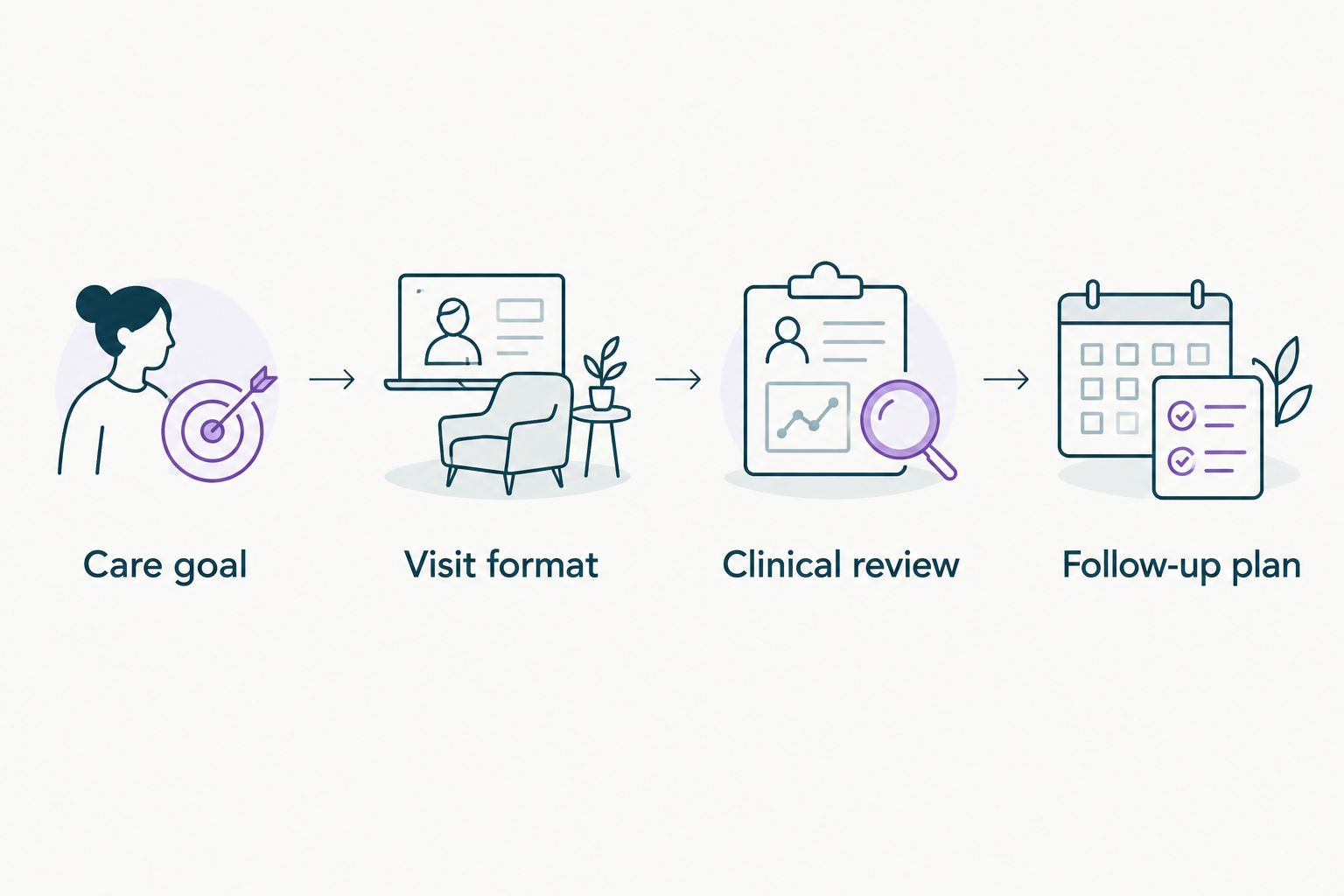
- Care goal: Write down the symptom you want assessed and what help you need.
- Visit format: Determine whether the concern needs a physical examination.
- Clinical review: Confirm that a licensed clinician assesses treatment suitability.
- Follow-up plan: Understand who handles persistent symptoms and changes in your condition.
This sequence prevents a common mismatch: selecting a convenient service before establishing whether it can deliver the needed assessment. It also gives you useful questions to ask without demanding a particular prescription.
Before a remote consultation, prepare your symptom history. Include when the problem began, what makes it better or worse, relevant medical conditions, current medicines, and previous treatment. Describe changes clearly rather than minimizing them to fit an online appointment.
For an in-person visit, bring the same information. Continuity depends on a useful handover, not on whether your next clinician works online or in an office.
Why people switch from NovoPatient
A useful reason to switch is a specific unmet care need. Dissatisfaction alone does not tell you which alternative will solve the problem; naming the missing step does.
Use these decision tests:
- You need a different format: Your next step is a physical examination rather than another remote review.
- You need different condition coverage: Confirm that the alternative actually evaluates the concern you have.
- You need clearer follow-up: Establish who responds when symptoms persist or treatment needs review.
- You need broader coordination: Choose a clinician who can consider relevant medical history and connect other care.
These are reasons to evaluate an alternative, not claims about NovoPatient's services. Compare your actual care experience against the next clinical task rather than assuming a different provider automatically means better treatment.
When staying with NovoPatient is the right call
Stay with NovoPatient when your current care meets your needs, the treatment remains appropriate, and you understand the follow-up plan. Changing providers adds little value if it does not solve a defined problem.
If you switch in 2026, preserve continuity. Request relevant records, share current medicines, and explain previous treatment responses to the next clinician. Do not stop prescribed treatment solely because you are comparing providers; discuss changes with the prescribing clinician.
FAQ
What's the best NovoPatient alternative for online foot care?
Nowcare is a suitable NovoPatient alternative for patients seeking provider-guided online foot and ankle care. Licensed clinicians review treatment plans and prescriptions, and remote care must be medically appropriate.
Is online foot care better than seeing a podiatrist in person?
Neither format is better for every foot problem. Online care offers remote assessment and support, while an in-person podiatrist can perform a hands-on examination and evaluate office-based treatment.
Can an online clinician prescribe treatment for a foot condition?
An online clinician can prescribe treatment when medically appropriate. Completing an intake does not guarantee a prescription, and some symptoms require in-person assessment.
Should I use primary care or podiatry for foot pain?
Choose primary care when foot pain needs review alongside your wider medical history; choose podiatry when you need focused foot and ankle assessment. Either clinician can determine whether another care setting is necessary.
Can telehealth replace an examination for a diabetic foot wound?
Telehealth cannot replace the hands-on assessment a diabetic foot wound can require. Contact a clinician promptly for direction rather than treating an online intake as sufficient wound assessment.
What should I bring when changing healthcare providers?
Bring your medication list, relevant records, symptom history, and details of previous treatment. Tell the new clinician about allergies, ongoing prescriptions, and changes in your condition.
Do I need to switch if my current care is working?
No, you do not need to switch when your current care remains appropriate and meets your needs. Compare alternatives only against a specific improvement you need, such as a different visit format or clearer follow-up.
One last thing
The best alternative is sometimes a different appointment format, not a different company. Before switching, ask whether your current clinician can arrange the examination, referral, or follow-up you need. That answer tells you whether to stay, change providers, or move from online care to an in-person assessment.


