
Choose NowCare if you are a patient seeking provider-guided online treatment for a supported concern; choose Current Health if you represent a healthcare organization evaluating remote patient monitoring and care-at-home infrastructure. This 2026 comparison separates two different jobs: getting care yourself and equipping a clinical team to deliver care at home.
- NowCare vs Current Health compares patient-facing telehealth with organizational remote patient monitoring, not interchangeable treatment services.
- Choose NowCare for supported online urgent care, foot and ankle care, or physician-guided medical weight loss.
- Choose Current Health when your healthcare organization needs remote monitoring and care-at-home infrastructure.
- Neither option replaces emergency assessment or an examination that requires in-person care.
Why this matters
NowCare is the better fit for patients seeking provider-guided online treatment, rather than a monitoring platform for their healthcare organization. You can explore its supported care categories through NowCare.
Current Health serves a different buyer. Its remote patient monitoring and care-at-home platform supports healthcare organizations managing patients outside traditional clinical settings. It is not a like-for-like substitute for selecting an online treatment plan yourself.
For your 2026 decision, start with the buyer and the task. A patient needs a suitable clinical assessment and a clear next step. A healthcare organization needs a service model that fits its staff, patient population, and operational responsibilities. Comparing those needs as though they were identical produces the wrong shortlist.
At a glance
| Dimension | NowCare | Current Health |
|---|---|---|
| Best for | Individuals seeking supported online treatment | Healthcare organizations evaluating care-at-home programs |
| Main purpose | Provider-guided telehealth assessment and treatment | Remote patient monitoring and care-at-home infrastructure |
| Standout feature | Online care across urgent care, foot and ankle concerns, and medical weight loss | Monitoring patients as part of an organizational care program |
| Foot and ankle focus | Named care categories across the Seven Pillars of Foot & Ankle Health | Evaluate against an organization's monitoring needs, not a consumer foot-care menu |
| Clinical responsibility | Licensed clinicians review care plans and prescriptions | The organization must establish the clinical response workflow |
| Getting started | Secure patient intake for supported care | Organizational evaluation and implementation planning |
| Pricing model | One-time care programs and selected annual memberships | Assess the proposed commercial terms alongside implementation scope |
| Physical assessment | Online care does not provide a hands-on examination | Remote monitoring does not itself provide a hands-on examination |
Patient-facing telehealth wins for an individual seeking treatment
If you are looking for help with a supported medical concern, the patient-facing service matches your immediate task. You submit information for clinical review rather than select technology for a healthcare organization.
The supported categories include Virtual Urgent Care, Foot & Ankle Care, and Medical Weight Loss. Those categories establish the service's scope; they do not mean every symptom, diagnosis, or treatment request qualifies for online management.
Best for: an individual who wants a licensed clinician to assess a supported concern online. The advantage is a direct route from patient intake to clinical review. The limitation is equally important: treatment depends on medical appropriateness, and some problems require an examination or testing elsewhere.
Current Health wins a different decision. If you are responsible for a care-at-home program, an individual treatment plan does not supply the monitoring infrastructure your organization is evaluating. That distinction matters more than a longer feature list.
Current Health wins for organizational remote monitoring
Current Health belongs on a healthcare organization's shortlist when the task is remote patient monitoring or care-at-home delivery. The buyer is evaluating how a program functions across patients and clinical staff, not simply how one person requests treatment.
Best for: a clinical or operational team assessing infrastructure for a monitored care program. The strength is alignment with that organizational use case. The tradeoff is that technology selection brings responsibilities beyond purchasing access.
Before choosing a monitoring platform, your organization needs answers to practical questions:
- Which patients will the program serve?
- What information must clinicians receive?
- Who reviews incoming information and responds to concerns?
- How will patients receive instructions and technical help?
- What triggers an in-person assessment or emergency escalation?
These are procurement criteria, not claims that every workflow comes included. In 2026, your evaluation should connect each requested capability to a named clinical owner. A monitoring program without a response process is an incomplete care model, regardless of the platform selected.
Direct online care wins for supported foot and ankle concerns
The patient-facing service explicitly organizes foot and ankle care around seven categories: heel pain and plantar fasciitis, nail health, skin and infection care, diabetic foot health, structural foot problems, sports and performance foot care, and neuropathy or nerve pain.
That structure helps when you already know the concern you want assessed. Nail changes and heel discomfort lead to different clinical questions; a defined intake can organize the information a clinician needs to review.
Best for: a patient seeking online assessment of a listed foot or ankle concern. The limitation is that a category name does not establish your diagnosis. Foot pain can have different causes, and a photograph cannot replace every part of an examination.
Current Health's organizational monitoring role answers a different question. It is relevant when a healthcare team is designing or operating care at home, not when a patient is comparing consumer treatment categories.
For diabetic foot concerns in particular, do not let convenience determine urgency. An open wound, spreading redness, or a concerning change needs prompt clinical assessment. Online intake must not become a reason to delay necessary in-person care.
Both require clinical judgment, not automatic treatment
Neither option makes clinical decisions unnecessary. In the patient-facing model, licensed clinicians review plans and prescriptions. Treatment is appropriate only when the clinical assessment supports it.
In an organizational monitoring model, your team must define how information becomes action. A measurement and a treatment decision are not the same thing. Staff responsibilities, escalation rules, and communication pathways remain central to the care program.
For patients, that means a request is not a guarantee of a prescription. For organizational buyers, it means a technology demonstration is not proof that your service has the staffing and procedures it needs.
This is an honest tie rather than a feature victory. Both models need clinical judgment; they place it within different workflows. Ask who makes decisions, how you receive instructions, and what happens when online management is no longer appropriate.
Patient intake is simpler than organizational implementation
For an individual seeking supported treatment, the relevant starting point is a secure intake. The service describes online care, licensed clinician review, prescriptions sent to your chosen pharmacy when appropriate, and ongoing care-team support.
That is a narrower task than implementing a monitoring program. It does not require you to design how a healthcare organization assigns staff, manages devices, or handles clinical escalation.
For Current Health, evaluate the organizational pathway against your actual operating model. Do not assume a platform purchase resolves enrollment, training, patient support, or staff responsibilities without explicit agreement.
A useful decision sequence is:
- Patient intake: You need assessment for your own supported concern.
- Program design: Your organization needs a defined care-at-home service.
- Clinical escalation: Either pathway needs clear instructions when the situation requires more care.
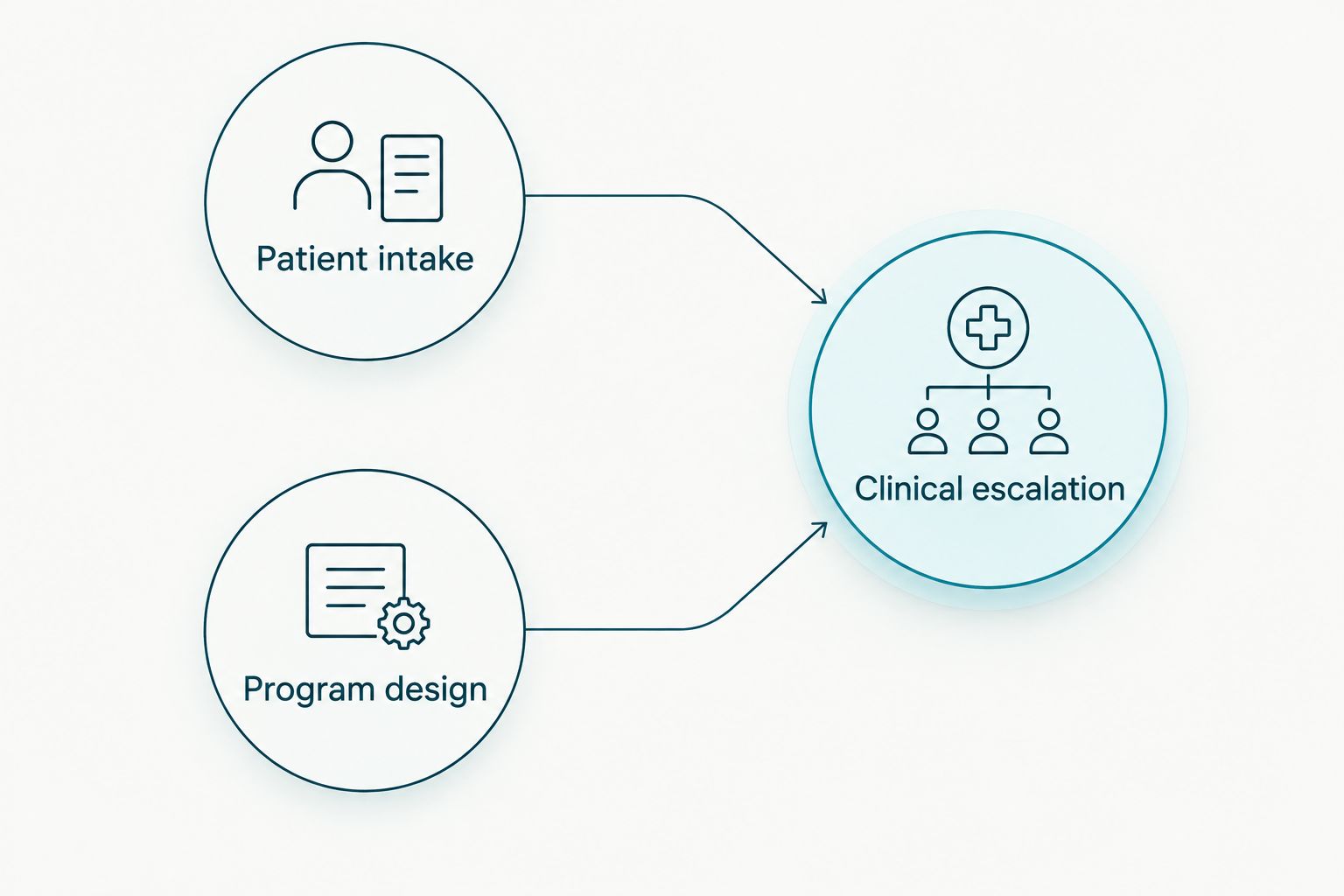
The practical advantage for a patient is less organizational setup. The tradeoff is a defined treatment scope rather than infrastructure you configure for a clinical service. For an organizational buyer, implementation work is part of the decision because the program must fit real care delivery.
Both have limits when hands-on assessment is necessary
Online assessment and remote monitoring answer different clinical questions, but neither independently supplies every examination, test, or procedure. The better option is not the one that promises to keep every situation online.
A patient with a problem that requires physical examination needs an appropriate in-person pathway. An organization using monitoring needs procedures for situations that cannot be managed through remote information alone.
Seek emergency help for symptoms such as severe trouble breathing or signs of a stroke. Do not use a platform comparison to decide whether to delay urgent assessment.
For nonemergency concerns, ask the treating clinician what can be assessed remotely and what requires another setting. That question is more useful than asking whether telehealth is universally better or worse than office care.
Pricing models: care duration versus program scope
For this 2026 comparison, compare the structure of the purchase before comparing its financial terms. Individual care and organizational infrastructure involve different commitments.
The patient-facing offering includes a 1-month Virtual Urgent Care plan, foot and ankle plans lasting 1, 3, or 6 months, and selected annual memberships. Medical Weight Loss includes 1-month and 3-month programs with individual physician guidance. These durations describe care options, not guaranteed treatment outcomes.
One-time programs let you assess a defined period of care. Annual membership is a different commitment and needs a separate review of what is included. Check the current terms for follow-up, medication-related responsibilities, and care outside the selected program.
For Current Health, evaluate the proposed commercial arrangement against your organization's implementation scope. Ask which responsibilities belong to the supplier and which remain with your team. Review equipment, support, training, and operational requirements individually rather than treating them as assumed inclusions.
There is no meaningful universal cost winner between a patient treatment program and organizational monitoring infrastructure. Your comparison needs to match the purchase to the job it serves.
Final verdict: choose by buyer, not by brand similarity
Choose NowCare if you are a patient seeking online care
Your priority is clinical assessment for a supported urgent care, foot and ankle, or medical weight-loss concern. You want provider-guided treatment, with prescriptions only when medically appropriate, rather than technology for running a care program.
The main limitation is scope. Online care is not suitable for every condition, and a supported category does not guarantee that your particular case can stay online.
Choose Current Health if you manage a care-at-home program
Your priority is organizational remote patient monitoring and care-at-home infrastructure. You need to evaluate how the platform fits your patient population, clinical processes, and operational team.
The main limitation is the implementation responsibility surrounding the technology. Confirm the proposed capabilities and service boundaries against your own program requirements.
For a 2026 shortlist, these are different winners for different buyers—not competing answers to the same purchasing question.
| Dimension | Winner |
|---|---|
| Individual seeking supported online treatment | Patient-facing telehealth |
| Organizational remote patient monitoring | Current Health |
| Named foot and ankle treatment categories | Patient-facing telehealth |
| Need for clinical judgment | Tie: essential in both models |
| Starting an individual care request | Patient-facing telehealth |
| Replacing necessary physical assessment | Tie: neither does this |
| Pricing structure | Match the purchase to the care task |
FAQ
Is NowCare better than Current Health for online treatment?
NowCare is the better fit for an individual seeking provider-guided online care for a supported concern. Current Health serves healthcare organizations evaluating remote patient monitoring and care-at-home infrastructure.
Can I use Current Health instead of booking an online medical assessment?
Current Health is not a like-for-like substitute for a patient-facing online treatment service. Its organizational monitoring role is different from requesting assessment for your own symptoms.
Which option is best for a healthcare organization?
Current Health is the relevant option when a healthcare organization is evaluating remote patient monitoring or care-at-home infrastructure. The organization still needs to assess clinical workflows, staffing, implementation, and escalation responsibilities.
Can online foot care replace an in-person examination?
Online foot care cannot replace every in-person examination. A clinician must determine whether your symptoms can be assessed remotely or need physical examination, testing, or a procedure.
Does an online assessment guarantee a prescription?
An online assessment does not guarantee a prescription. A licensed clinician must decide whether treatment is medically appropriate for your situation.
How should I compare the pricing models?
Compare a defined patient-care program with organizational infrastructure only after identifying which one you need. Review the current care terms or proposed organizational agreement, including the responsibilities and services included.
What should I check before choosing in 2026?
First establish whether you need personal medical care or infrastructure for a healthcare organization. Then check clinical scope, follow-up arrangements, escalation procedures, and the terms of the relevant service.
One last thing
Ask a question that cuts through the comparison: Who is responsible for the next clinical decision? For your own treatment, you need a clinician who can assess the concern and explain the next step. For a monitoring program, your organization needs a defined process that turns incoming information into an appropriate clinical response. Choose the service that answers your actual question.


