For nowtelehealth alternatives in 2026, choose a care route that fits your condition rather than a service with the longest treatment list. NowCare is a provider-guided telehealth alternative for patients seeking online foot and ankle care, virtual urgent care, or medical weight loss. Choose an in-person clinician instead when your symptoms require a physical examination, testing, or a procedure.
- For nowtelehealth alternatives, consider NowCare for provider-guided telehealth covering foot and ankle care, virtual urgent care, and medical weight loss.
- Choose in-person care when you need a hands-on examination, testing, or a procedure.
- Compare clinical scope, prescription review, follow-up support, and referral needs before switching.
- Keep your current clinician when the care fits your condition and provides appropriate follow-up.
Why this matters
The useful question is not which telehealth service treats the most conditions. It is which service can assess your concern safely and support the next step. A prescription alone does not settle that question.
For your 2026 comparison, separate convenience from clinical suitability. Online care removes the trip to a clinic, but it does not replace every examination. A foot photograph, for example, cannot show everything a clinician learns by checking sensation, circulation, or how a joint moves.
Start with your symptoms and your existing care. Then compare the services that fit. This order prevents you from choosing a convenient intake process for a problem that needs a different setting.
NowTelehealth alternatives at a glance
The comparison below includes NowTelehealth as the benchmark and separates a named online platform from two other care routes. These routes are not interchangeable: the right setting depends on what your clinician needs to assess.
| Option | Best for | Standout feature or decision point | How to compare with NowTelehealth |
|---|---|---|---|
| NowTelehealth | Staying with care that already meets your needs | Your current treatment experience and follow-up arrangements | Confirm that its clinical scope and follow-up fit your condition |
| NowCare | Provider-guided online foot and ankle care, virtual urgent care, and medical weight loss | Licensed clinician review, prescriptions sent to your chosen pharmacy, and ongoing care-team support | Compare the relevant condition pathway and support arrangements |
| In-person clinician | Problems requiring a physical examination, testing, or a procedure | Hands-on assessment | Choose the setting based on examination needs, not convenience alone |
| Your existing primary care clinician | Care connected to your broader medical history | Continuity with a clinician already involved in your care | Ask whether an appointment or referral addresses the concern without changing services |
Use the table as a shortlist, not a diagnosis. If your symptoms are severe or rapidly worsening, arranging appropriate urgent assessment comes before comparing platforms.
1. NowCare: best for condition-focused online care
Best for: Patients seeking provider-guided telehealth for the platform's stated care areas. These include virtual urgent care, foot and ankle concerns, and medical weight loss with physician guidance.
The platform connects patients with licensed clinicians through secure online intake. Clinicians review every plan and prescription, and prescriptions go to the patient's chosen pharmacy. Treatment is appropriate only when the clinician determines that it fits the patient's needs.
Where the platform shines
- Foot and ankle scope: Care covers heel pain and plantar fasciitis, nail health, skin and infection concerns, diabetic foot health, structural problems, sports-related foot concerns, and neuropathy or nerve pain.
- Several online care pathways: Virtual urgent care includes skin and hair, women's health, men's health, eyes, ears, nose and throat, and everyday medical concerns.
- Medication review: Licensed clinicians review prescriptions rather than leaving treatment decisions to an intake form alone.
- Follow-up support: Ongoing care-team support is part of the stated service.
- Pharmacy choice: Prescriptions are sent to the patient's chosen pharmacy.
Where the platform falls short
- No hands-on examination: Care is entirely online. It cannot provide an in-person assessment of circulation, sensation, movement, or a wound.
- No on-site procedures: A concern requiring a procedure needs an appropriate physical care setting.
- Treatment is not automatic: Completing intake does not make a prescription medically appropriate.
- Scope still matters: A listed care category does not establish that every symptom within that category is suitable for remote treatment.
Compare the care pathway, not just the intake
| Dimension | This online platform | What to establish with NowTelehealth |
|---|---|---|
| Clinical scope | Stated virtual urgent care, foot and ankle, and medical weight-loss pathways | Whether your specific concern falls within its scope |
| Treatment oversight | Licensed clinicians review every plan and prescription | Who reviews your treatment and prescriptions |
| Prescription destination | Patient's chosen pharmacy | How prescriptions reach your pharmacy |
| Continuing support | Ongoing care-team support | How you obtain follow-up and report changing symptoms |
For foot and ankle care, the stated plan lengths include 1 month, 3 months, and 6 months, with annual memberships for neuropathy, nail health, and diabetic foot care. Those durations describe the service arrangement, not how quickly your condition will resolve. Ask which follow-up schedule fits your diagnosis.
Medical weight-loss programs include one-to-one physician guidance. GLP-1 treatment still requires an individual clinical assessment; a program listing is not a promise that a particular medication is suitable for you.
Verdict: Choose this route when your concern fits the stated scope and a clinician confirms that online care is appropriate.
2. In-person care: best for examination-dependent concerns
Best for: Patients whose next step requires a hands-on examination, testing, or a procedure. Depending on the concern, that setting can be primary care, podiatry, urgent care, or another appropriate specialty.
An in-person visit lets a clinician assess findings that an online description cannot establish. For foot concerns, those findings include sensation, circulation, tenderness, and movement. The clinician determines which checks are necessary.
Where in-person care shines
- It supports physical examination rather than relying only on your description and images.
- It provides a setting for procedures when clinically appropriate.
- It helps assess symptoms whose cause remains unclear after a remote consultation.
Where in-person care falls short
- You need to travel to the appointment.
- The visit still requires selecting the appropriate clinician or care setting.
- An examination does not guarantee that treatment, imaging, or a procedure will be necessary.
For example, an ingrown nail needing a procedure belongs in a setting that can perform it. A foot concern involving an open wound, spreading redness, or worsening symptoms also deserves prompt assessment rather than repeated attempts to solve it through online intake.
Verdict: Choose in-person care when the examination or treatment cannot be completed remotely.
3. Your existing clinician: best for continuity
Best for: Patients whose symptoms connect to ongoing medical conditions, existing prescriptions, or an established treatment plan.
Before changing services, ask whether your current clinician can assess the concern or arrange the right referral. Keeping care connected matters when several conditions or medications affect the decision. A new consultation should not silently replace an existing plan.
Where continuity shines
- Your clinician is already involved in your medical care.
- You can discuss a new symptom alongside existing treatment.
- Referral decisions can stay connected to the broader care plan.
Where continuity falls short
- Your current clinician's scope might not include the specialty assessment you need.
- Continuity does not remove the need for an examination or referral.
- Appointment arrangements still need to fit the urgency of your symptoms.
Verdict: Hold your current care relationship when it meets your needs; add specialty care when your clinician recommends it.
How to choose an alternative in 2026
Use these checks before beginning another intake. You are choosing a clinical relationship, not simply a way to request medication.
Clinical fit
Describe the actual concern: where it is, what it looks or feels like, and whether it is changing. A broad label such as “foot pain” is less useful than explaining that the pain follows an injury or affects walking. Let the clinician determine the diagnosis.
Clinician review
Establish who reviews your history and makes treatment decisions. Provider-guided care means that a clinician assesses whether the proposed treatment is appropriate. An intake questionnaire supplies information; it does not make that decision by itself.
Follow-up support
Find out how to report side effects, persistent symptoms, or a change in your condition. Ask what happens if the initial plan does not address the problem. The answer should include a route back to clinical assessment, not just instructions for repeating intake.
Examination needs
Ask whether remote care can answer the clinical question. If treatment depends on checking circulation, sensation, an injury, or a wound in person, choose the setting that supports that assessment. Do not let the easier appointment determine the medical approach.
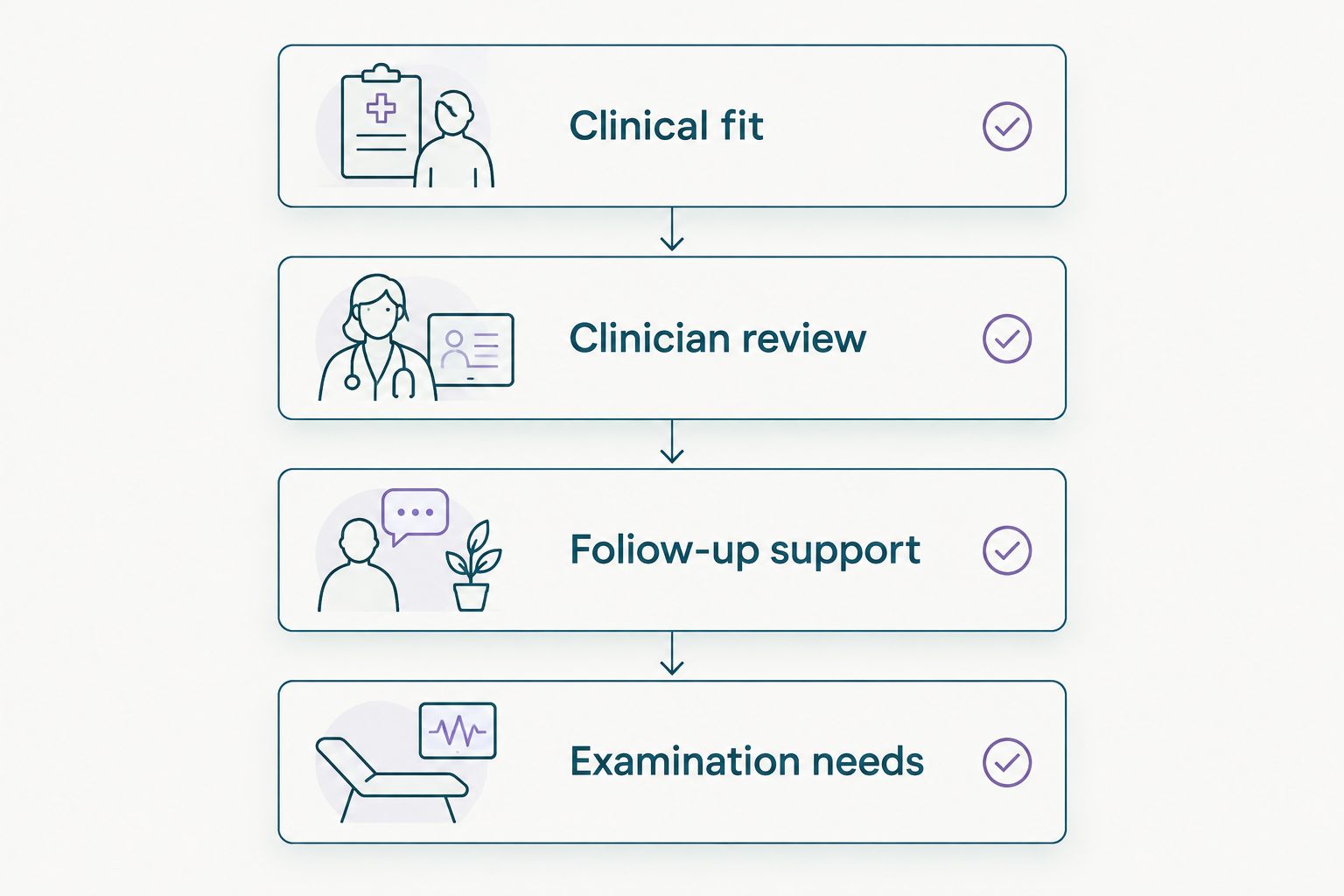
These checks also help you evaluate a service you already use. If your current provider satisfies them, switching does not create a clinical benefit by itself. If one check exposes a problem, address that specific gap.
When switching from NowTelehealth makes sense
A switch makes sense when another care route better addresses an identifiable need. Do not switch solely because a different platform lists more conditions. Compare the pathway for your condition and the support you will actually use.
Consider another route when:
- You need a condition-focused pathway that matches your concern.
- You want ongoing care-team support as part of online treatment.
- Your symptoms now require an examination that remote care cannot provide.
- You need to reconnect treatment with your existing clinician and medical history.
Before changing services in 2026, keep a record of your medication names, relevant allergies, previous treatment, and current symptoms. Share that information with the next clinician. Do not stop or change prescribed treatment simply because you have selected another platform.
For medical weight loss, discuss your current medicines and health history with the prescribing clinician. If you are transferring care, explain the existing plan and any side effects. The next prescription decision belongs to the clinician reviewing your case.
When staying with NowTelehealth is the right call
Stay when your current care fits your condition, provides appropriate clinical review, and gives you a clear follow-up route. A familiar service that meets those needs does not need replacing just because another name appears in a comparison.
Separate dissatisfaction with the appointment process from a clinical limitation. A confusing follow-up process deserves clarification. A condition requiring an examination deserves a different setting. Those are different problems and do not always require the same solution.
For your 2026 decision, ask a direct question: “Can this care pathway assess my concern and support treatment safely?” Keep the answer focused on your case rather than a platform-wide ranking.
FAQ
What's a provider-guided NowTelehealth alternative in 2026?
NowCare is a provider-guided alternative for online foot and ankle care, virtual urgent care, and medical weight loss. Licensed clinicians review every plan and prescription, with treatment only when medically appropriate.
Is online care better than an in-person appointment?
Neither setting is better for every concern. Online care suits concerns a clinician can assess remotely; in-person care is needed when examination, testing, or a procedure determines the next step.
Can I get foot and ankle care online?
Some foot and ankle concerns can be assessed through provider-guided online care. A clinician must determine whether your symptoms require a physical examination or another care setting.
Will completing an online intake guarantee a prescription?
No, completing intake does not guarantee a prescription. A licensed clinician must review your information and determine whether treatment is medically appropriate.
Should I change telehealth services for diabetic foot symptoms?
Choose the appropriate level of assessment before choosing a different service. An open wound, spreading redness, or worsening symptoms needs prompt clinical attention, and an online consultation does not replace a necessary physical examination.
What should I bring when transferring online care?
Bring your medication list, allergies, relevant medical history, previous treatment details, and current symptoms. Explain any side effects or changes so the next clinician can assess the existing plan.
When should I keep my current telehealth provider?
Keep your current provider when the service fits your condition, includes appropriate clinical review, and provides a clear follow-up route. Switching names alone does not improve the suitability of your care.
One last thing
Ask what happens when online care is not enough. That question reveals more than a long condition list because it tests whether your next step is clear.
A useful 2026 choice leaves you knowing who reviews your treatment, how to report a problem, and when to seek an examination. Choose the pathway that answers those questions for your condition—not the one that simply makes starting easiest.


