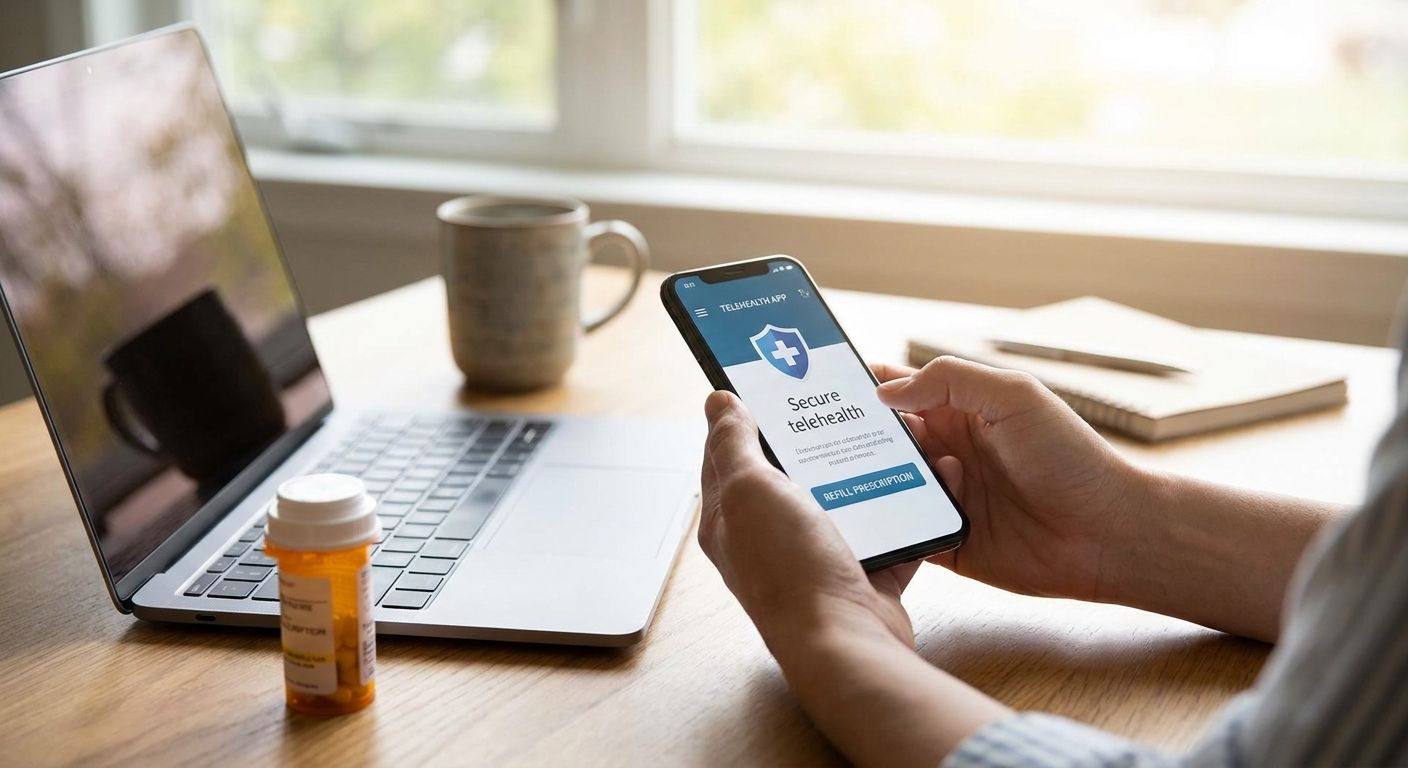
ADHD medication refill online is the process of renewing a stimulant prescription -- Adderall, Vyvanse, Ritalin, or Concerta -- through a video or asynchronous telehealth visit instead of driving to a psychiatrist's office. The goal is the same as any refill: keep treatment continuous. The process is not the same as refilling a blood pressure pill, because stimulants are Schedule II controlled substances and federal law treats every single fill as a brand-new prescription, not a routine renewal.
- Schedule II stimulants like Adderall and Vyvanse have no legal refills -- every fill needs a brand-new prescription, telehealth or in person.
- DEA telehealth flexibilities for controlled substances have been extended repeatedly since 2020, most recently through the end of 2025 -- confirm current status before you book.
- Request an ADHD medication refill online 5-7 business days before you run out; controlled substance e-scripts can sit in a pharmacy queue.
- Some states still require a periodic in-person visit even when telehealth covers routine follow-ups.
- Telehealth ADHD diagnosis and treatment visits connect you with a licensed clinician, but stimulant prescribing still depends on state rules and clinical judgment.
Why ADHD medication refill online matters for stimulant patients
Two separate problems collide for this group. First, the FDA announced a shortage of immediate-release mixed amphetamine salts (generic Adderall) in October 2022, and supply gaps for specific stimulant formulations have come and gone at the pharmacy level ever since. Second, the federal rules governing telehealth prescribing of controlled substances keep shifting: the 2008 Ryan Haight Act originally required an in-person evaluation before any controlled substance could be prescribed by telemedicine, that requirement was waived during the COVID-19 public health emergency, and DEA has extended the waiver multiple times since, most recently through December 31, 2025.
That means a refill approach that worked in 2025 is not guaranteed to work the same way in 2026 without a quick check. Telehealth ADHD diagnosis and treatment visits exist precisely because this population needs a documented evaluation on file, not just a request form, before a clinician will issue a stimulant prescription.
Patients managing ADHD stimulants online are also juggling insurance prior authorization, pharmacy-specific stock issues, and state licensing rules for the clinician -- three variables that don't apply to a routine antibiotic or statin refill.
Confirm your state's telehealth stimulant rules before you book
Rules vary by state and change year to year, so verify before you schedule anything.
- Check whether your state requires an in-person visit before or during ongoing stimulant treatment
- Confirm the clinician is licensed in the state where you're physically located during the visit
- Ask whether the clinician can e-prescribe Schedule II drugs directly, not just call in a request
- Check DEA's current telehealth flexibility status for controlled substances heading into 2026
- Ask your pharmacy whether it accepts telehealth-issued stimulant prescriptions at all
Pull your prescription history together
A clinician reviewing a stimulant refill needs specifics, not a vague "same as always."
- Name, dose, and formulation of your current stimulant (extended-release vs. immediate-release matters)
- Date and pharmacy of your last fill
- Diagnosing clinician's name and approximate date of your original ADHD evaluation
- Insurance ID and any prior authorization already on file
- Photo ID matching the name on your existing prescription
Book the evaluation, not just a refill request
Most legitimate stimulant prescribing starts with a real visit, not a checkbox.
- Look for a visit type labeled evaluation or follow-up, not a one-click refill form
- Expect questions about symptom control, side effects, sleep, appetite, and blood pressure
- Bring notes on missed doses or dosage changes since your last visit
- Confirm whether the visit is live video or an asynchronous questionnaire -- controlled substances typically require synchronous video
A visit like how to get an ADHD diagnosis through telehealth walks through what that evaluation actually covers, which matters if you're new to a clinician and need your history reviewed before any prescription gets written.
Time the refill request to avoid a gap
Schedule II timing mistakes are the single most common reason patients run out.
- Request 5-7 business days before your current supply runs out
- Add extra lead time if your pharmacy has flagged shortages on your specific formulation
- Remember Schedule II prescriptions can't be phoned in or faxed as a "refill" -- the clinician issues a brand-new script every time
- Ask the clinician's office how far in advance they'll write next month's prescription
Check pricing and prior authorization before the visit
A denied prior authorization the week you need medication is worse than a denial two weeks out.
- Confirm whether the telehealth visit itself bills to insurance or runs cash-pay
- Ask if prior authorization applies to your specific stimulant and dose
- Compare savings cards against your insurance copay for the medication itself
- Ask if a formulation switch (brand to generic, or immediate-release to extended-release) would clear a prior-auth hold faster
Have a backup plan for shortages and denials
Stimulant shortages hit specific doses and manufacturers, not the whole drug class at once.
- Ask your clinician about clinically appropriate alternative formulations if your usual stimulant is out of stock
- Call two or three nearby pharmacies before the visit so the e-script routes somewhere with actual stock
- Know your state's rules on transferring a Schedule II prescription between pharmacies -- many states restrict or forbid it entirely
- Keep a short buffer supply if your prescribing history and pharmacy relationship allow it
“Schedule II stimulants have no refills under federal law -- every fill is a brand-new prescription, telehealth or in person.”
Comparing your options for an ADHD stimulant refill
| Option | Best for | Handles Schedule II stimulants | Key limitation |
|---|---|---|---|
| In-person psychiatrist | Complex dose titration or comorbid diagnoses | Yes, full authority | Long new-patient wait times in most markets |
| Telehealth ADHD evaluation and follow-up | Adults with an existing diagnosis needing ongoing management | Yes, where state and DEA rules allow | May still require a periodic in-person visit depending on your state |
| Mental health medication management telehealth | Patients managing ADHD alongside anxiety or depression | Varies by platform and clinician license | Not all platforms prescribe stimulants; some limit to non-controlled medications |
| Primary care telehealth follow-up | Patients whose PCP already manages a stable long-term regimen | Yes, if the PCP is comfortable prescribing controlled substances | Many primary care telehealth visits refer ADHD care out to a specialist |
Verdict: telehealth works for stimulant refills in 2026 only when the clinician is licensed in your state, documents an evaluation, and confirms your pharmacy will accept the e-script -- skip any of those three and the refill stalls.
Common mistakes patients make refilling ADHD stimulants online
- Waiting until the bottle is empty, then discovering the e-script sits in a pharmacy queue for days
- Assuming any telehealth platform that treats ADHD can legally prescribe a Schedule II stimulant
- Skipping the state's in-person visit requirement and getting stuck mid-cycle without care
- Trying to transfer a stimulant prescription between pharmacies when the state doesn't allow it
- Asking for "the same refill" without answering the symptom-review questions, which slows down a clinician who needs documented current symptoms before writing a new script
Start an ADHD telehealth evaluation
Connect with a licensed clinician for ADHD diagnosis and treatment review.
FAQ
Can you get an ADHD medication refill online in 2026?
Yes, for many patients, as long as the clinician is licensed in your state and follows current DEA telehealth rules for controlled substances. State-specific in-person requirements and pharmacy acceptance of e-scripts still vary.
Is it legal to refill Adderall through telehealth?
It's legal in most states when the prescribing clinician holds the required license and documents a real evaluation. Because Adderall is Schedule II, there's no such thing as a routine phone-in refill -- each fill needs a fresh prescription.
How often do you need a new prescription for a stimulant?
Typically every month, since Schedule II stimulants carry no authorized refills under federal law. Your clinician writes a new prescription at each visit rather than approving a refill on an existing one.
How far in advance should you request an ADHD refill online?
Request it 5-7 business days before your current supply runs out. Controlled substance e-scripts can take longer to process at the pharmacy than a standard prescription.
Do all telehealth platforms prescribe ADHD stimulants?
No. Some telehealth platforms limit prescribing to non-controlled medications and refer ADHD stimulant care elsewhere. Confirm a platform actually handles Schedule II prescribing before you book.
What happens if your pharmacy is out of your stimulant dose?
Ask your clinician about a clinically appropriate alternative formulation and call a few nearby pharmacies before your visit so the e-script routes somewhere with stock on hand.
Does telehealth ADHD treatment require an annual in-person visit?
In some states, yes, even when routine follow-ups happen by video. Check your state's specific rule before assuming telehealth alone covers you indefinitely.
Can an Adderall prescription be transferred between pharmacies?
Often not. Many states restrict or forbid transferring Schedule II prescriptions between pharmacies, so confirm which pharmacy will fill it before the script is sent.
One last thing
The 2008 Ryan Haight Act promised a "special registration" pathway that would let telehealth clinicians prescribe controlled substances without ever requiring an in-person visit. As of 2026, DEA still hasn't finalized it -- nearly two decades later. That gap is exactly why the rules for an ADHD medication refill online keep shifting on temporary extensions instead of settling into a permanent policy, and why it's worth a five-minute check before every refill cycle rather than assuming last year's process still applies.


