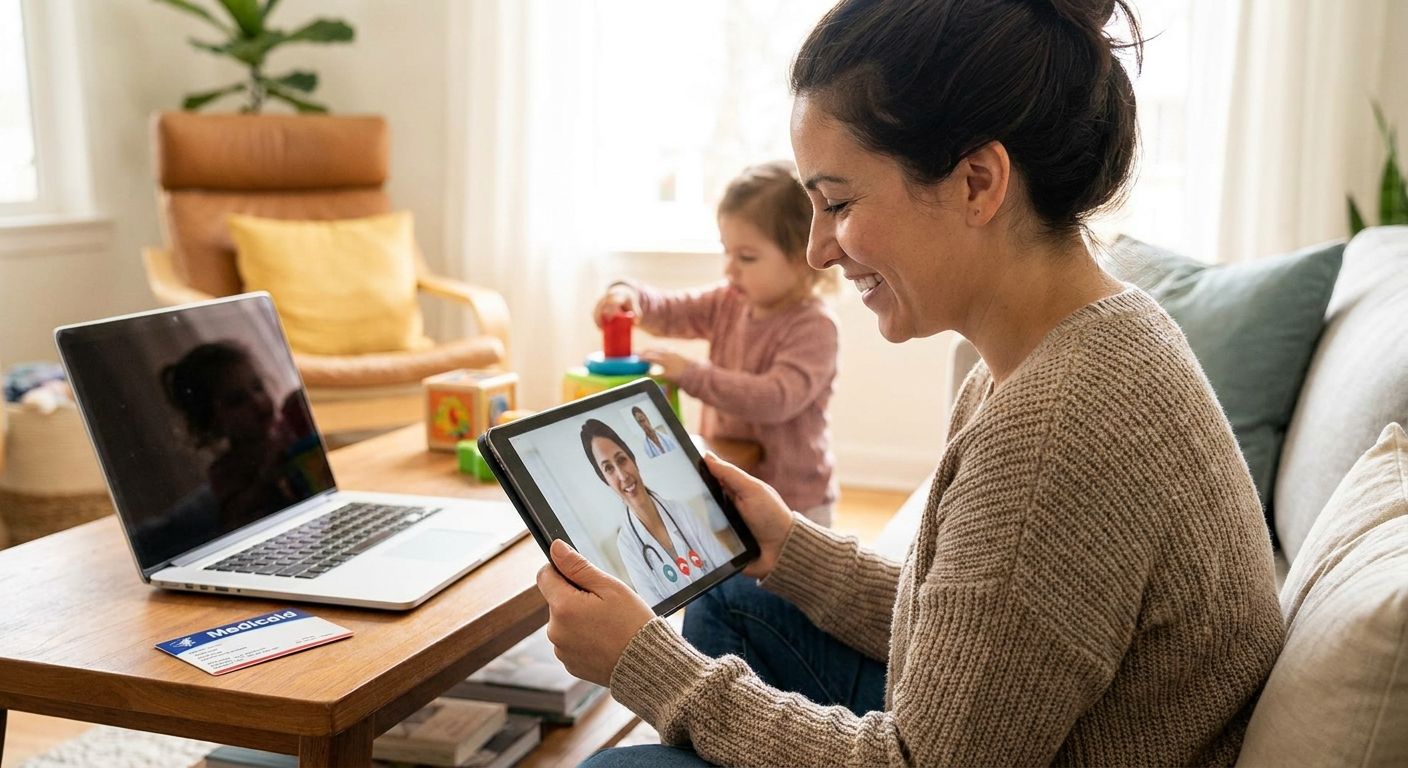
Medicaid covers online primary care in most states in 2026, but coverage runs through your Medicaid managed care plan or state fee-for-service program, not through general telehealth apps you find on Google.
- Online primary care medicaid access runs through your MCO or state Medicaid plan, not general telehealth apps.
- Coverage rules for virtual primary care vary by state and managed care plan in 2026.
- NowCare offers flat-rate, self-pay telehealth for urgent care, foot and ankle issues, and GLP-1 weight loss — it does not bill Medicaid.
- Verdict: use your Medicaid MCO's telehealth line for covered primary care; use a self-pay platform like NowCare to close gaps outside that network.
Why this matters
Medicaid enrollees run into two problems that other patients rarely hit: fewer primary care doctors accept Medicaid in the first place, and the ones who do often have longer waits for a virtual slot. That gap is exactly why "online primary care Medicaid" shows up as a search query in the first place — people want a faster path to a licensed clinician without losing their coverage.
The fix isn't picking any telehealth app. It's understanding which parts of your care are billed to Medicaid and which parts you might need to handle separately. NowCare is one example of the second category: a flat-rate, self-pay telehealth option for urgent care, foot and ankle conditions, and GLP-1 weight-loss programs, not a Medicaid-billed primary care service. Knowing that distinction up front saves you a denied claim or a surprise bill later.
Why online primary care matters for Medicaid patients
Medicaid patients search for telehealth options for reasons that are different from a commercially insured patient's reasons. Transportation, work schedules that don't allow a weekday clinic visit, and a shortage of Medicaid-accepting PCPs in many counties all push enrollees toward virtual care as the realistic first option, not a backup plan.
That also means the stakes of picking the wrong platform are higher. A visit with a clinician outside your MCO's network, or on a platform that doesn't bill Medicaid at all, can leave you paying out of pocket for something that should have been covered. The steps below sort out what's covered, what isn't, and where a self-pay option fits.
Confirm your Medicaid managed care plan's telehealth network
Most Medicaid enrollees are in a managed care organization (MCO), not traditional fee-for-service Medicaid, and the MCO controls which telehealth providers count as "in-network."
- Call the member services number on the back of your Medicaid card and ask specifically about virtual primary care
- Check the MCO's online provider directory and filter for telehealth or virtual visit options
- Ask whether a PCP referral is required before a virtual specialist visit
- Confirm whether the visit counts toward your annual wellness exam requirement
- Ask if there's a copay for telehealth visits under your specific plan
Check your state's Medicaid telehealth policy for 2026
State Medicaid programs set their own rules for what counts as a reimbursable telehealth visit, and those rules have shifted since the pandemic-era flexibilities expired in some states.
- Look up whether audio-only visits are still reimbursed in your state in 2026
- Check if there are originating-site restrictions (some states still require you to be at a clinic, not home)
- Confirm which specialties (behavioral health, chronic disease management, primary care) are covered virtually
- Verify that the clinician is licensed in the state where you're physically located during the visit
- Ask your MCO or state Medicaid office directly if a rule sounds unclear online
Look for a Federally Qualified Health Center with virtual visits
Federally Qualified Health Centers (FQHCs) are built to serve Medicaid and uninsured populations, and most now offer some form of virtual primary care.
- FQHCs bill Medicaid directly, so there's usually no separate charge for enrollees
- Many offer sliding-scale fees if you lose Medicaid eligibility mid-year
- Ask if they offer video primary care visits, not just phone triage
- Some FQHCs now support remote monitoring for chronic conditions like hypertension or diabetes
- Community health workers at FQHCs can help with the paperwork side of staying enrolled
Gather what you need before the visit
A rushed Medicaid telehealth visit wastes the clinician's time and yours. A few minutes of prep changes the outcome.
- Your Medicaid ID card and MCO member ID number
- A current list of medications, including dose and frequency
- Recent lab results if you have them, even a photo of a paper printout
- A short written list of active conditions or new symptoms
- A device with a working camera and microphone, and a quiet spot to talk
Book the visit through the right channel
Where you book determines whether Medicaid pays for it. Booking through the wrong door is the single most common reason a claim gets denied.
- Use your MCO's nurse line or member portal to schedule, not a third-party search result
- Check if your state runs a Medicaid telehealth directory separate from MCO listings
- Call 211 or your local health department if you're not sure which MCO covers you
- Ask the FQHC's virtual front desk directly if scheduling online isn't clear
- Confirm the appointment time zone and platform link before the visit day
Use a self-pay platform for gaps your Medicaid plan doesn't cover
Some needs fall outside what your MCO's telehealth network handles well, or the wait is longer than the problem can wait for. This is where a flat-rate, self-pay platform earns its place alongside Medicaid coverage, not instead of it.
- Same-day urgent care visits when your MCO's next available slot is weeks out
- Foot and ankle issues like heel pain, ingrown toenails, or diabetic foot concerns that your PCP may not manage directly
- GLP-1 weight-loss programs with physician oversight, when weight management isn't part of your Medicaid benefit
- A prescription refill when your assigned PCP is unavailable and the medication can't wait
- Ongoing care-team support for a condition your Medicaid plan doesn't actively manage day-to-day
NowCare fits this category: licensed clinicians, secure intake, prescriptions sent to your chosen pharmacy, and one-time flat pricing with no insurance required. It's not a Medicaid replacement for your primary care visits — it's a same-day option for the specific things listed above. If your MCO's queue is backed up for a sinus infection or you need a prescription refill without an office visit, that's the use case, not a full PCP swap.
Need care faster than your queue allows
Flat-rate telehealth visits with licensed clinicians, no insurance required.
Manage ongoing conditions between visits
A single covered visit doesn't fix a chronic condition. Medicaid patients with diabetes, hypertension, or asthma need a repeatable system, not a one-off appointment.
- Schedule follow-ups according to your MCO's care plan, not just when symptoms flare
- Have prescriptions sent to one consistent pharmacy to avoid refill gaps
- Track labs and vitals between visits if your MCO app or FQHC portal supports it
- Ask your PCP to file a specialist referral early if a condition isn't improving
- Use secure messaging with your care team instead of waiting for the next scheduled visit
Comparing your options as a Medicaid patient
| Option | Best for | Cost model | Key limitation |
|---|---|---|---|
| Medicaid MCO telehealth line | Routine primary care covered under your plan | Billed directly to Medicaid | Limited to clinicians contracted with your specific MCO |
| FQHC virtual visits | Comprehensive care, sliding-scale needs | Billed to Medicaid or adjusted by income | Appointment slots are often booked out for weeks |
| State Medicaid fee-for-service telehealth | Rural enrollees without an MCO plan | Billed to Medicaid directly | Fewer specialists participate in fee-for-service networks |
| NowCare (self-pay telehealth) | Same-day urgent care, foot and ankle issues, GLP-1 weight loss outside Medicaid's scope | Flat one-time price, not billed to Medicaid | Cost isn't covered by Medicaid |
Verdict: for anything Medicaid actively covers, book through your MCO or an FQHC — that's the option with no separate cost. For same-day needs Medicaid doesn't handle well, a flat-rate platform like NowCare closes the gap without derailing your Medicaid coverage elsewhere.
Common mistakes Medicaid patients make
- Assuming any telehealth app takes Medicaid. Most direct-pay platforms, including NowCare, don't bill Medicaid — check before you book if cost matters.
- Skipping prior authorization for specialist telehealth referrals, which is a common reason MCOs deny a claim after the fact.
- Not confirming state licensing. A clinician licensed only in a different state generally can't legally treat you under Medicaid telehealth rules tied to your location.
- Sitting in an MCO queue for something time-sensitive, like a UTI or sinus infection, when a same-day self-pay visit resolves it faster.
- Missing chronic-condition follow-ups because reminders live in a portal the patient never checks.
FAQ
Does Medicaid cover online primary care in 2026?
Yes, in most states Medicaid covers virtual primary care visits booked through your managed care plan or a Federally Qualified Health Center. Rules on audio-only visits and originating-site requirements still vary by state in 2026.
Is NowCare covered by Medicaid?
No, NowCare is a flat-rate, self-pay telehealth platform and does not bill Medicaid. It works as a same-day option for urgent care, foot and ankle issues, and GLP-1 weight-loss programs outside what your Medicaid plan covers.
What if my Medicaid plan doesn't offer virtual primary care?
Check whether a Federally Qualified Health Center in your area offers video visits, since most FQHCs bill Medicaid directly and serve as a virtual primary care option even when your MCO's own telehealth line is limited.
How do I find a Medicaid-approved telehealth provider?
Start with your MCO's member portal or provider directory and filter for telehealth, or call the member services number on your Medicaid card. Booking outside that network risks a denied claim.
What's the difference between Medicaid telehealth and a self-pay platform like NowCare?
Medicaid telehealth is billed to your state Medicaid plan through an in-network clinician, while a self-pay platform charges a flat one-time price with no insurance billed at all. Use Medicaid for covered primary care and a self-pay option for same-day needs outside that coverage.
Can Medicaid patients get prescriptions through telehealth?
Yes, a licensed clinician can prescribe during a covered Medicaid telehealth visit or through a self-pay platform, with the prescription sent to your chosen pharmacy either way.
Do Medicaid telehealth visits cost anything?
Most Medicaid managed care plans charge no separate cost for a covered telehealth visit, though this depends on your specific state and MCO copay rules.
What happens if I need care Medicaid doesn't cover, like foot pain or weight-loss medication?
You'll need a self-pay option since Medicaid only covers services within your plan's defined benefits. Flat-rate telehealth platforms handle these visits without touching your Medicaid coverage elsewhere.
One last thing
The biggest planning mistake Medicaid patients make isn't picking the wrong platform — it's treating "telehealth" as one category when it's actually two separate systems with different billing rules. Sort your need into "Medicaid should cover this" or "this is faster to self-pay" before you book, and you'll skip the denied-claim conversation entirely.


