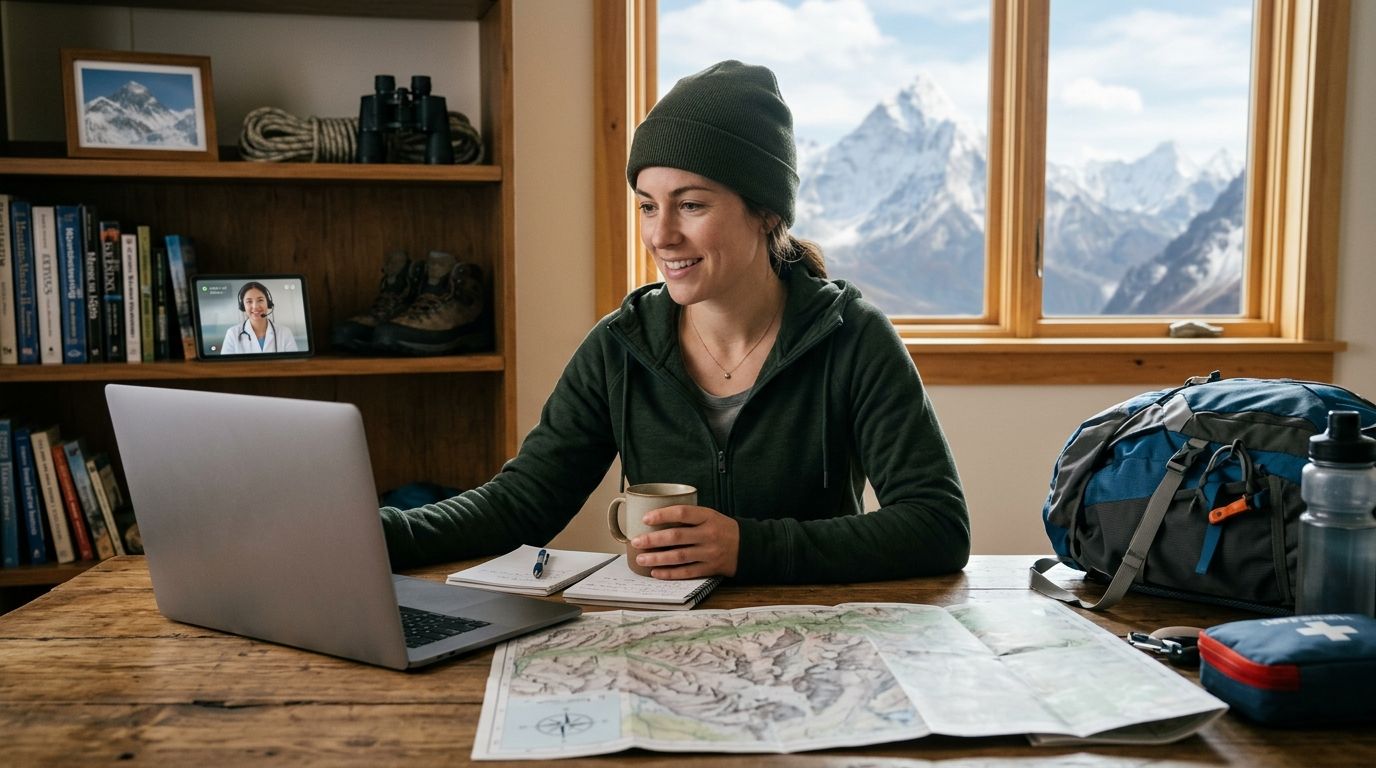
Mountain trip travelers use telehealth for altitude sickness to get a pre-departure risk review, a symptom-scoring plan, and a licensed clinician's input on medication questions before they ever leave home. Unlike a routine sick-visit, this consult runs on a hard deadline — your flight date — and it has to end with a written plan you can actually follow once you're above cell signal.
- Telehealth for altitude sickness works best as pre-trip prep, not as emergency care once you're above 10,000 feet.
- NowCare's Virtual Urgent Care covers everyday medical concerns and fits a pre-departure risk review, not on-mountain rescue.
- The Wilderness Medical Society's ascent rule caps sleeping-altitude gain at 1,000-1,600 feet a day above 8,000 feet — that beats any pill for cutting risk.
- Score symptoms daily with the Lake Louise system; a rising score means stop ascending, not push through.
- Book a virtual or in-person visit 4-6 weeks before departure if you want a prescription option on the table.
Why telehealth for altitude sickness matters for mountain trip travelers
Most people don't think about altitude until the packing list is already open. That leaves days, not weeks, to get a clinician's input, and local travel clinics book out further than most trip timelines allow. A virtual visit through NowCare removes the scheduling bottleneck — a licensed clinician reviews your itinerary and health history without you driving anywhere or losing a workday.
The tradeoff is real. Telehealth can't run a physical exam, take a pulse-ox reading, or manage a rescue while you're on the mountain. It works as prep, not as the safety net once you're ascending. Treat it as one part of the plan, not the whole plan.
Know your risk before you book the flight
Altitude sickness risk depends more on how fast you climb and where you sleep than on how fit you are. Before anything else, map the trip against these factors:
- Starting elevation of your home airport versus your destination
- Sleeping altitude each night, not just the highest point you'll hike that day
- Any prior episode of acute mountain sickness (AMS), even a mild one
- Age, pregnancy status, and conditions like heart or lung disease
- Whether the itinerary includes a rapid ascent (flying directly into a high-altitude city)
Build your ascent and acclimatization schedule
The Wilderness Medical Society's long-standing guideline: above 8,000 feet, limit sleeping-altitude gain to 1,000-1,600 feet (roughly 300-500 meters) per day, with a rest day built in for every 3,000 feet gained. This single rule prevents more altitude sickness than any medication.
- Plan an acclimatization day at 8,000-10,000 feet before pushing higher
- Avoid flying directly into a high-altitude city and hiking the next morning
- Add a buffer day if your itinerary jumps more than 1,600 feet in sleeping altitude overnight
- Skip alcohol and sleep medication the first 48 hours at altitude — both blunt your breathing response
- Hydrate consistently; altitude increases fluid loss through faster breathing
Score your symptoms daily with a simple checklist
The Lake Louise AMS scoring system rates headache, GI upset, fatigue, dizziness, and sleep disturbance from 0 (none) to 3 (severe). Use it every evening at altitude, not just when you feel bad.
- Headache: 0 (none) to 3 (incapacitating)
- Gastrointestinal symptoms: 0 (none) to 3 (severe nausea/vomiting)
- Fatigue or weakness: 0 to 3
- Dizziness or lightheadedness: 0 to 3
- Difficulty sleeping: 0 to 3
A total score of 3 or higher with a headache generally signals mild AMS — stop ascending and reassess. A rising score, not a single bad night, is the actionable signal.
Talk to a clinician before you fly
The manual route: schedule an in-person visit with your primary care doctor or a travel medicine clinic weeks ahead. The faster route, if your timeline is tighter, is a virtual visit — this is where a platform like NowCare's Virtual Urgent Care fits, since it's built for everyday medical concerns and pre-trip questions rather than requiring an office visit.
- Share your full itinerary, including sleeping altitudes each night
- Disclose any medications you're already taking, especially heart or blood pressure drugs
- Ask directly whether a preventive option makes sense for your trip and health history
- Confirm the clinician can send a prescription to a pharmacy near you before departure, if one is appropriate
- Ask what symptoms would mean you need in-person emergency care instead
Get a pre-trip virtual visit
Talk to a licensed clinician about your itinerary before you fly.
Pack a fast-relief kit based on that conversation
What goes in the kit depends on what your clinician actually recommends, but most mountain-trip kits share a base layer:
- Written copy of your acclimatization schedule and Lake Louise scoring sheet
- Any prescribed or over-the-counter medication discussed during your visit
- A basic pulse oximeter if your trip goes above 10,000 feet
- Extra water and electrolyte packets
- A printed list of red-flag symptoms and the nearest descent route
Set a hard turnaround rule with your group before you climb
Summit-day decisions get made badly in the moment. Set the rule on day one, in writing, while everyone's clear-headed.
- Agree on a Lake Louise score that triggers automatic descent, no debate
- Assign a buddy to check scores with you each evening
- Pre-identify the descent route from every camp, not just the summit
- Save an emergency contact and the nearest medical facility's location before you lose signal
- Agree that no one summits alone once symptoms appear in anyone in the group
Know the red flags that mean descend now
High-altitude cerebral edema (HACE) and high-altitude pulmonary edema (HAPE) are medical emergencies, not "bad AMS." Confusion, loss of coordination (ataxia), shortness of breath at rest, or a persistent cough with pink-tinged sputum mean immediate descent and emergency care — no telehealth visit, virtual or otherwise, substitutes for that.
Comparing your options before a mountain trip
| Option | Best for | Key limitation |
|---|---|---|
| NowCare Virtual Urgent Care | Fast pre-departure risk review and general medical questions | Not built for on-mountain emergencies or physical exams |
| In-person travel medicine clinic | Travelers with 4+ weeks lead time and complex medical history | Booking windows often exceed short trip timelines |
| Standard primary care telehealth | Patients who already have an established doctor relationship | May not specialize in altitude or travel medicine |
| Wilderness medicine specialist | High-altitude trekking (14,000+ feet) or expedition-length trips | Fewer providers; harder to book on short notice |
“The single best predictor of severe altitude sickness is going up too fast — not your fitness level.”
Common mistakes mountain trip travelers make
- Waiting until departure week to book any kind of medical visit, virtual or in-person, leaving no time for a prescription to arrive
- Confusing day-hike altitude with sleeping altitude — a summit day above 12,000 feet is fine if you sleep back down at 9,000
- Treating fitness as protection — a marathon runner and a first-time hiker face similar AMS risk at the same ascent rate
- Ignoring a rising Lake Louise score because "the group already planned the summit push"
- Skipping the red-flag briefing and assuming everyone already knows the difference between AMS and HACE/HAPE
FAQ
What is telehealth for altitude sickness good for before a trip?
It's best used for a pre-departure risk review — going over your itinerary, health history, and medication questions with a licensed clinician before you fly. It is not a substitute for on-mountain emergency care.
Can a virtual visit prescribe medication for altitude sickness?
A licensed clinician can discuss options like acetazolamide during a virtual visit and issue a prescription when it's medically appropriate, sent to a pharmacy near you. Not every telehealth platform runs altitude-specific protocols, so confirm scope before booking.
How soon before a mountain trip should you book a telehealth visit?
Book 4-6 weeks out if you want a prescription option on the table, since pharmacy fulfillment and any follow-up take time. A visit days before departure still helps with a risk review, just with fewer options.
What is the Lake Louise score and how do you use it?
It's a self-scoring checklist for headache, GI symptoms, fatigue, dizziness, and sleep trouble, each rated 0-3. Score yourself every evening at altitude; a rising total with headache signals it's time to stop ascending.
Is telehealth enough if you're headed above 14,000 feet?
A virtual visit still helps with pre-trip planning, but expeditions above 14,000 feet benefit from an in-person consult with a wilderness medicine specialist who can go deeper on high-altitude-specific risk factors.
What are the warning signs that mean you need to descend immediately?
Confusion, loss of coordination, shortness of breath at rest, or a cough with pink-tinged sputum point to HACE or HAPE, both medical emergencies. Descend immediately and get in-person emergency care.
Does being physically fit lower your risk of altitude sickness?
No. Ascent rate and sleeping altitude predict AMS risk far more reliably than fitness level, and well-conditioned hikers get AMS as often as anyone else.
How does NowCare's Virtual Urgent Care fit into altitude sickness prep?
NowCare's Virtual Urgent Care connects you with a licensed clinician for everyday medical concerns, which covers a pre-departure risk review ahead of a mountain trip. It's not built for on-mountain emergencies — if HACE or HAPE symptoms appear, descend and seek in-person emergency care.
One last thing
Fitness level tells you almost nothing about your altitude sickness risk — genetic and individual variation in how your body responds to lower oxygen matters more than how many miles you can run at sea level. The traveler who trained hardest can still be the first one with a Lake Louise score of 6 on night two, while someone who barely trained sails through. Plan for altitude, not for fitness, and the 2026 trip goes a lot smoother.


