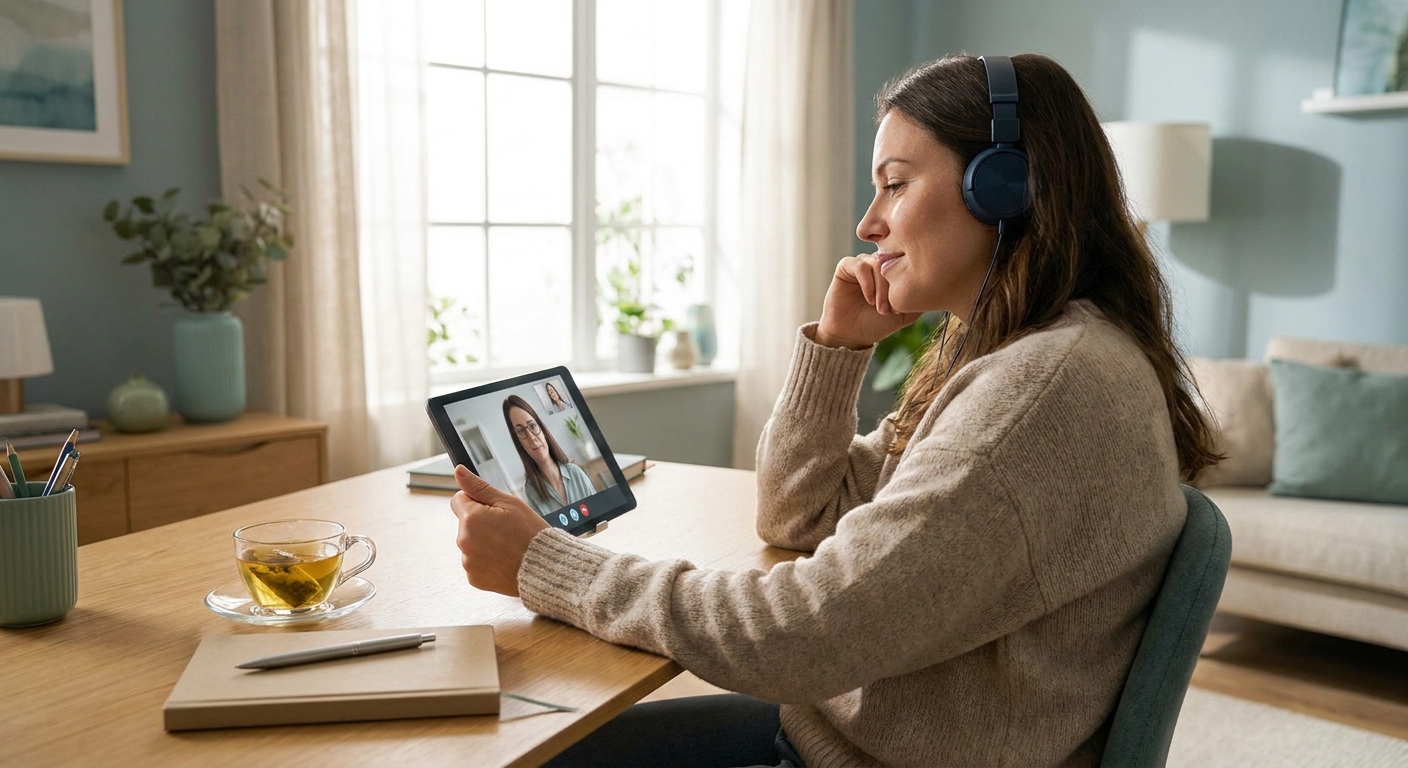
Telehealth for anxiety and stress management now covers everything from licensed therapy platforms to employer EAP portals to primary-care-based programs — and most of it looks the same from the outside. This guide breaks down what actually separates clinically sound telehealth anxiety stress management from a wellness app in a lab coat, and where a provider-guided telehealth platform like NowCare fits into the broader picture of prescriptions, primary care, and chronic condition management you might already be managing online.
- Telehealth anxiety stress management only works if the platform verifies your clinician's state license before session one — non-negotiable in 2026.
- Skip async-only chat apps for moderate to severe anxiety; no path to medication management stalls real treatment.
- Pick telehealth built around chronic condition management when stress is tangled with a physical diagnosis, not a standalone anxiety app.
- Remote workers do best with evening and weekend booking slots, not 9-to-5-only calendars — Buy that flexibility.
- Confirm insurance coverage before the intake call; out-of-network sessions add up fast without it.
Why this matters
Anxiety and chronic stress rarely show up alone. They ride along with sleep loss, high blood pressure, weight gain, and chronic pain — the same conditions people already manage through NowCare and other telehealth platforms built around ongoing, clinician-guided care. That overlap is exactly why the type of telehealth you choose for anxiety and stress management matters more than the marketing copy on the landing page.
A 20-minute video intake with a licensed clinician is not the same product as a wellness chatbot with a subscription fee. In 2026, regulators and insurers are drawing sharper lines between the two, and patients who skip the licensing check often end up paying twice — once for an app that can't prescribe anything, and again for the visit that actually treats the problem.
Who telehealth anxiety and stress management is for
This guide is for adults juggling a job, a household, or a chronic health condition who want confidential, clinician-backed support for anxiety or everyday stress without waiting three weeks for an in-person opening. It's for remote workers whose schedules don't fit a 9-to-5 therapy slot, for people already managing a chronic condition through telehealth who don't want a fifth disconnected app, and for anyone deciding whether an EAP benefit, an insurance-covered platform, or a primary-care-based program fits their situation best in 2026.
What to look for in telehealth for anxiety and stress management
Licensed clinician verification in your state
A platform that can't tell you, in writing, which state your clinician is licensed in cannot legally treat you across state lines. This matters more than it sounds — many wellness apps use unlicensed coaches for the first several sessions and only route you to a licensed provider once symptoms escalate. Ask for the license number before you book, not after.
Session format that matches your actual schedule
Video, live chat, and asynchronous messaging are three different products with three different response times. A 24-48 hour message turnaround works for mild stress management; it does not work if you're in an acute anxiety spike at 11pm on a Tuesday. Match the format to how bad your worst week actually gets, not your average one.
A real path to medication management
Talk therapy alone helps a lot of people, but moderate to severe anxiety often needs a clinician who can also manage an SSRI, SNRI, or short-term anxiolytic. If the platform's answer to "can you prescribe?" is a referral to a different app, that's a structural gap, not a minor inconvenience.
Integration with the rest of your health care
Stress that's driven by a chronic condition — diabetes, hypertension, chronic pain — responds better to a telehealth setup that treats the whole picture instead of isolating the anxiety symptom. Online primary care for chronic condition management is built around exactly that kind of continuity, and it's worth checking before you sign up for a fourth separate app.
Transparent cost and insurance handling
Confirm coverage before the first call, not after the invoice arrives. Out-of-network anxiety telehealth adds up fast, and platforms that bury their cash-pay rate until checkout are a red flag worth walking away from.
“If a telehealth platform can't tell you who's licensed in your state, it can't treat you — full stop.”
Top picks by scenario
The chronic-condition pick
When anxiety is riding shotgun with a diagnosed chronic condition, online primary care for chronic condition management treats the stress and the underlying condition in the same visit instead of splitting you across two apps. The one spec that matters here: continuity of clinician, not a new provider every session. Verdict: Buy if stress and a chronic diagnosis are showing up together.
The medication-continuity pick
Anxiety medications only work if refills don't lapse. A setup built around online prescription refill for maintenance medications keeps an SSRI or anxiolytic on schedule without a fresh in-person visit every 90 days. Verdict: Consider it as the backbone of a longer-term plan, not a crisis-day fix.
The remote-workforce pick
A 2pm therapy slot doesn't work for someone on back-to-back calls until 6. Telehealth platform for remote workers solves the scheduling mismatch that causes most remote employees to skip stress-related care entirely in 2026. Verdict: Buy if your calendar, not your motivation, is the barrier.
The access pick
For patients outside a metro area, the telehealth options built for rural access solve a different problem: distance, not scheduling. The tradeoff is usually a longer intake process and fewer same-week openings. Verdict: Consider, and set expectations on wait times before you commit.
What to avoid
- Subscription wellness apps marketed as "treatment" — journaling prompts and breathing exercises aren't a substitute for a licensed clinician, no matter how the app is priced.
- Async-only chat services for moderate to severe anxiety — a 48-hour reply window is fine for stress management, dangerous for someone in crisis.
- Any platform that won't confirm licensing before the first session — this is the single fastest disqualifier, and it should be non-negotiable in 2026.
Verdict comparison
| Pick | Licensing shown upfront | Medication path | Best for | Verdict |
|---|---|---|---|---|
| Chronic-condition primary care | Yes | Yes | Anxiety tied to a physical diagnosis | Buy |
| Prescription refill for maintenance meds | Yes | Yes | Long-term medication continuity | Consider |
| Remote-worker telehealth | Yes | Varies | Scheduling-driven stress | Buy |
| Rural-access telehealth | Yes | Varies | Distance-driven access gaps | Consider |
FAQ
Is telehealth as effective as in-person care for anxiety and stress management?
Telehealth works as well as in-person visits for mild to moderate anxiety when the clinician is licensed and the session includes a real medication review, not just a chat script. Severe or crisis-level symptoms still need a platform with fast escalation options.
How much does telehealth for anxiety cost in 2026?
Cost depends entirely on insurance coverage and whether the platform is in-network, so confirm coverage before booking rather than assuming a flat rate. Cash-pay sessions run higher than insurance-covered visits across most platforms.
Can a telehealth provider prescribe anxiety medication?
Yes, if the platform employs licensed clinicians with prescribing authority in your state — not every wellness app does. Ask for the license verification before your first session, not after.
What's the difference between telehealth therapy and a mental wellness app?
Telehealth therapy connects you with a licensed clinician who can diagnose and prescribe; a wellness app offers self-guided exercises with no clinical oversight. Both have a place, but only one qualifies as treatment.
Is async messaging enough for stress management, or do I need live video?
Async messaging works for mild, ongoing stress management where a 24-48 hour reply window is tolerable. Live video is the safer choice if symptoms spike quickly or you need same-day support.
Does telehealth for anxiety work for people managing a chronic condition too?
It works better when the same telehealth setup handles both, since stress and chronic conditions like hypertension or diabetes often drive each other. A fragmented approach across separate apps tends to lose continuity.
How do I check if a telehealth clinician is actually licensed?
Ask the platform directly for the clinician's license number and state before booking, and cross-check it against your state's medical or counseling board website. A platform that hesitates on this question is a red flag.
One last thing
Chronic pain and anxiety feed each other more than most people realize — plantar fasciitis, diabetic neuropathy, and heel pain all disrupt sleep, and disrupted sleep is one of the strongest predictors of daytime anxiety. NowCare's provider-guided model across its Seven Pillars of Foot & Ankle Health framework was built on the same principle that applies here: treating the physical root often lowers the baseline stress load more than a standalone anxiety app ever will. Before adding a fifth telehealth subscription in 2026, check whether an untreated physical condition is the thing actually driving the stress.


