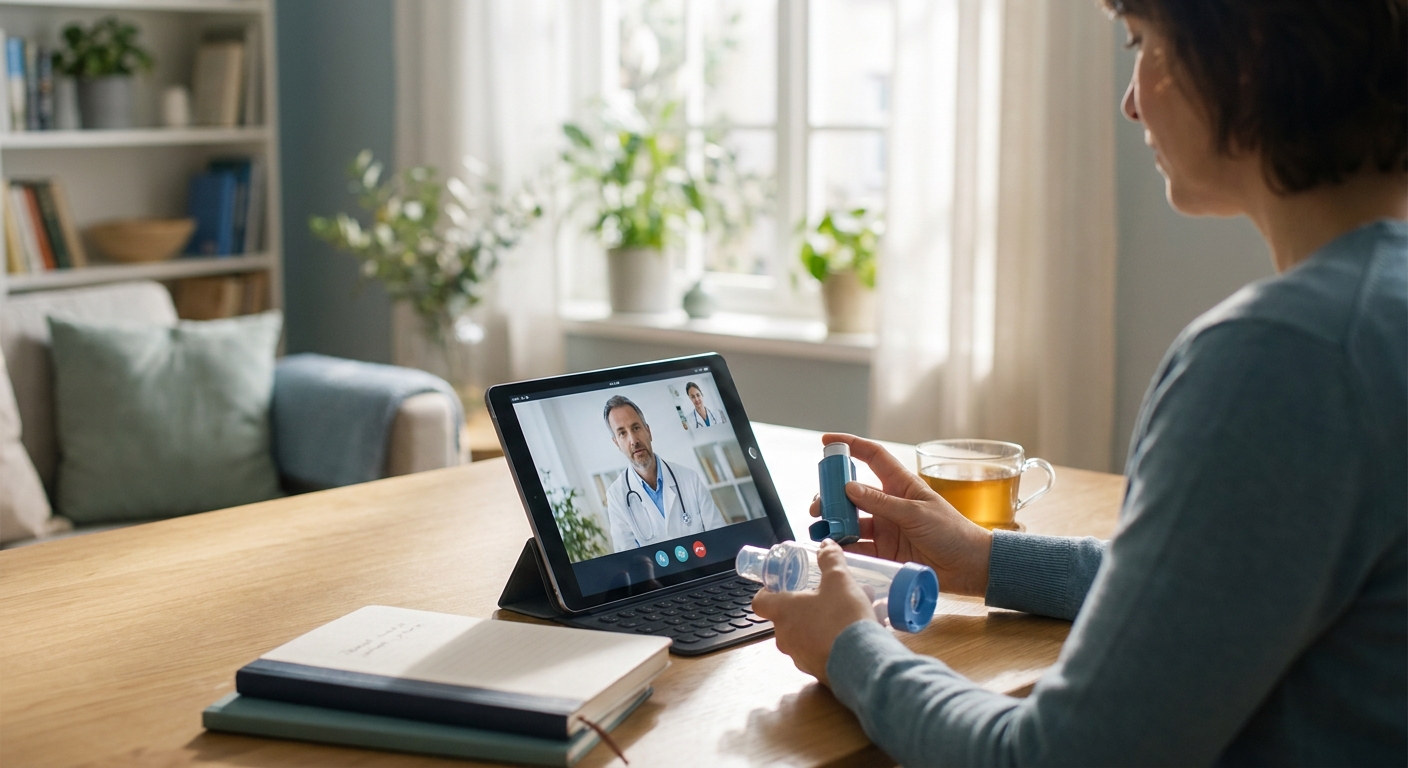
Telehealth for asthma management works when the platform does more than triage a bad breathing day — it needs to refill your inhaler, track your control over time, and get a clinician on video before a flare-up turns into an ER trip.
- Telehealth asthma management works best when a platform pairs same-day triage with ongoing chronic condition follow-up.
- Maintenance inhaler refills without an office visit save the most time and prevent lapsed control. Buy that model.
- Urgent-care-only apps handle a bad flare-up but drop the ball on long-term management. Skip platforms with no primary care track.
- Rural and remote asthma patients need video visits with real prescribing authority, not a symptom checker. Verify licensing state by state.
- Kids and seniors with asthma need different telehealth setups — family-plan support and Medicare-compatible platforms aren't interchangeable.
Why this matters
Asthma is a condition you manage for decades, not weeks. Most visits aren't for a new diagnosis — they're for a refill, a step-up in medication, or a check on whether your control is slipping. A telehealth setup built around one-off urgent care visits misses that pattern entirely.
CDC data has long put asthma prevalence in the US at roughly 1 in 13 people, and childhood asthma runs close to 1 in 12 kids. That volume is why online primary care for chronic condition management exists as its own category separate from a same-day sick visit — asthma patients need both, at different moments, from the same account.
In 2026, the platforms that actually work for asthma combine three things: a clinician who can prescribe and adjust controller medication, a fast lane for flare-ups, and a refill process that doesn't require a new appointment every 30 days.
Who this is for
This guide is for people with an existing asthma diagnosis — adults on a controller inhaler, parents managing a child's asthma action plan, or anyone whose current care setup means driving to urgent care every time a refill runs out. It's not for someone with new, undiagnosed wheezing that needs spirometry and an in-person workup first.
What to look for in telehealth for asthma management
Continuity, not just a single visit
A one-time video call that ends with a printout is not asthma management — it's a symptom check. Look for a platform that keeps the same clinician or care team across visits so your medication history and trigger patterns actually get tracked over 2026.
Prescription refill support without a re-exam
Maintenance inhalers (the daily controller kind) need refilling roughly every 30 days. A platform that requires a full video visit every single refill wastes your time and your clinician's. Refill-only workflows for stable, well-controlled asthma cut that down to a quick request-and-approve cycle.
Fast access when a flare-up hits
Separate from routine management, you need same-day access when symptoms spike — a viral trigger, a smoke exposure day, a missed dose that snowballs. If the platform's queue runs 3-5 days out, it's not built for asthma.
Licensing that actually covers where you live
Telehealth clinicians can only prescribe in states where they're licensed. If you live somewhere with fewer specialists nearby, confirm the platform can legally treat your zip code before you book anything.
Support for the whole household
Asthma often runs in families, and a parent managing a child's inhaler needs a different intake flow than an adult managing their own. Platforms without pediatric asthma pathways will bounce a child's case to an in-person referral fast.
Compatibility with Medicare or existing insurance
Older adults with asthma, often layered with COPD, need a platform that works with Medicare billing rather than cash-pay-only models that add cost every single month.
Top picks for asthma-specific telehealth setups
1. The control pick: chronic condition management track This is built for the asthma patient who's stable but needs regular oversight — medication adjustments, symptom logging, and a clinician who sees the full picture instead of one bad week. Monthly check-ins beat urgent, disconnected visits for keeping control scores steady across a 12-month asthma calendar. Online primary care for chronic condition management fits this exactly. Buy if you're on a daily controller and want one care team tracking it.
2. The refill shortcut: maintenance medication refills Most asthma flare-ups tied to non-adherence trace back to a lapsed refill, not a failed medication. A platform built to turn refill requests around in 24-48 hours without a new office visit keeps controller therapy uninterrupted. Online prescription refill for maintenance medications is the model to use here. Buy if your inhaler dose has been stable for 6+ months.
3. The access play: rural telehealth Asthma patients outside metro areas often drive 60 miles or more to see a pulmonologist, and that gap gets worse every year specialist shortages persist. A platform built specifically for distance and connectivity gaps solves the access problem before the medication problem. Telehealth platform for rural patients addresses that gap directly. Consider it if the nearest in-person respiratory specialist is more than 30 minutes away.
4. The Medicare-compatible pick: senior asthma care Asthma in adults over 65 frequently overlaps with COPD, and billing complexity is the biggest reason seniors skip telehealth altogether. A platform built around Medicare compatibility removes that friction instead of adding a cash-pay surcharge on top of an existing plan. Telehealth platform for seniors on Medicare is built for that exact billing structure. Consider it if you're managing asthma alongside another chronic respiratory condition.
5. The pediatric pick: family primary care Childhood asthma needs an intake process built for a parent managing a minor's action plan, not an adult-only symptom flow. Family-oriented primary care telehealth handles school notes, action plan updates, and refills for a child's inhaler in one account instead of three separate logins. Best online primary care services for families covers that setup. Buy if you're the one managing a child's asthma medication schedule.
What to avoid
- Symptom-checker apps with no prescribing authority. They'll tell you what an asthma flare-up looks like, then send you to urgent care anyway — no medication change, no refill, no value beyond what a search engine already gave you.
- Urgent-care-only platforms with no follow-up. A single video visit that resolves a flare-up but doesn't reassess your controller regimen leaves you back at square one in 8-10 weeks.
- Platforms that skip a real intake history. Asthma severity and trigger patterns matter for prescribing decisions — a 90-second chat box that jumps straight to a prescription request is a red flag, not a shortcut.
Verdict comparison
| Service model | Continuity | Refill speed | Flare-up response | Best fit |
|---|---|---|---|---|
| Chronic condition management | Strong | Standard | Moderate | Stable adults on daily controller |
| Maintenance refill service | Moderate | Fast (24-48 hrs) | Weak | Patients with stable dosing |
| Rural telehealth platform | Moderate | Standard | Strong | Patients 30+ minutes from a specialist |
| Medicare-compatible platform | Strong | Standard | Moderate | Seniors 65+ with overlapping conditions |
| Family primary care | Strong | Standard | Strong | Parents managing pediatric asthma |
FAQ
What's the best telehealth option for asthma management in 2026?
The best setup pairs a chronic condition management track with fast refill access for maintenance inhalers, rather than a single urgent-care visit. Look for continuity across visits so your controller dose gets adjusted based on real history, not a one-time snapshot.
Can a telehealth visit replace an in-person pulmonologist appointment?
Telehealth handles routine management, refills, and flare-up triage, but new or worsening asthma with abnormal breathing tests usually still needs in-person spirometry. Use telehealth for ongoing control, not a first diagnosis of severe or unstable asthma.
How much does telehealth asthma management cost without insurance?
Cash-pay pricing varies by platform and visit type, so check current pricing directly on the provider's site before booking. Refill-only visits generally cost less than a full evaluation visit.
Is telehealth asthma management covered by Medicare in 2026?
Many telehealth platforms now bill through Medicare for chronic condition visits, but coverage depends on the specific platform and visit type. Confirm Medicare compatibility before scheduling, especially for seniors managing asthma alongside COPD.
Can you get an asthma inhaler prescription refilled online?
Yes, most telehealth platforms offer refill-only requests for stable, previously prescribed controller medications without a new full visit. Turnaround typically runs 24-48 hours once a clinician reviews the request.
Does telehealth work for children with asthma?
Yes, but only on platforms built with a pediatric intake pathway, since a child's asthma action plan and dosing differ from an adult's. Family-oriented primary care telehealth handles school documentation and refills in one account.
What happens if you have an asthma attack during a telehealth visit?
A telehealth clinician will direct you to emergency services immediately if symptoms indicate a severe attack, since video visits can't administer oxygen or nebulizer treatment. Telehealth is built for management and mild-to-moderate flare-ups, not acute respiratory emergencies.
Do rural patients have access to asthma specialists through telehealth?
Rural-focused telehealth platforms connect patients to licensed clinicians who can prescribe controller medication without the 60-mile drive many rural patients face to reach an in-person respiratory specialist. Licensing still needs to match your state of residence.
One last thing
Most asthma-related ER visits trace back to a lapsed maintenance inhaler, not a new trigger — the medication ran out, a refill got delayed, and control slipped over a couple of weeks before the attack. The single highest-leverage move for 2026 isn't finding a fancier platform, it's picking one that turns refill requests around in under 48 hours so your controller therapy never has a gap.


