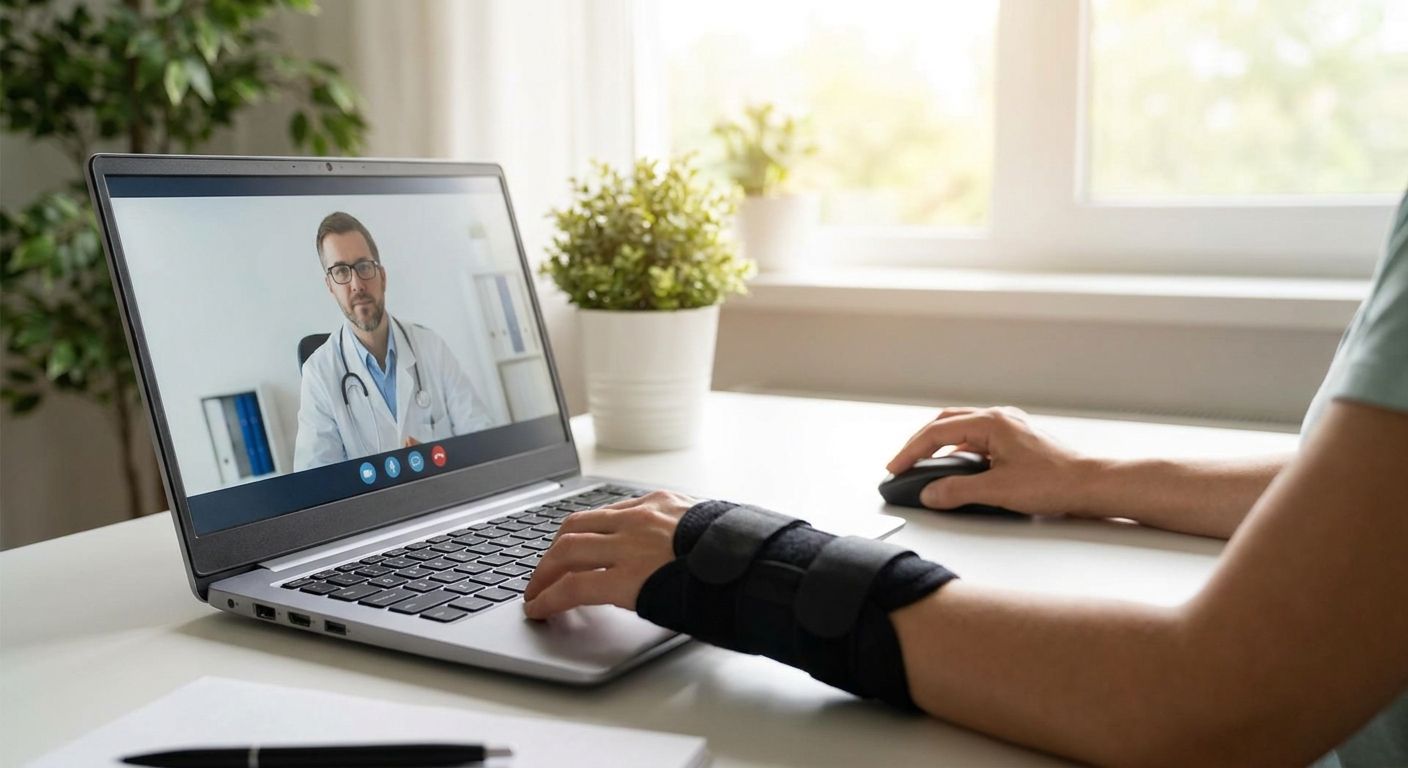
Numbness in your thumb and first two fingers that wakes you up at 3 a.m. is usually the first sign someone searches for telehealth for carpal tunnel — and the honest answer is that online care can start the workup, but it can't finish it alone.
- Telehealth for carpal tunnel works well for early symptom triage, splinting guidance, and PT referrals — book it for stage-one numbness and tingling.
- NowCare's provider-guided visits route confirmed or worsening cases to physical therapy or a hand specialist rather than guessing at treatment.
- No telehealth platform can run a nerve conduction study or perform carpal tunnel release surgery — those require an in-person specialist.
- Workers' comp documentation and remote-worker ergonomic reviews are two of the more overlooked telehealth for carpal tunnel use cases in 2026.
Why This Matters
Carpal tunnel syndrome is a median nerve problem, not a skin rash you can photograph and diagnose in ninety seconds. The nerve runs under a ligament in the wrist and compresses symptoms into the thumb, index, middle, and half of the ring finger — that's the textbook distribution clinicians check for on every visit.
What telehealth changes in 2026 is the front door, not the back end. A licensed clinician can review your symptom pattern, rule out lookalikes like cervical radiculopathy, start conservative treatment, and — critically — decide fast whether you need imaging, nerve testing, or a referral instead of six more weeks of guessing. That triage speed is the entire value of NowCare's provider-guided model.
Who Telehealth for Carpal Tunnel Works For
This path fits people with early-to-moderate symptoms: nighttime tingling, occasional hand weakness when gripping a coffee cup, or a new desk job with eight hours of typing a day. It also fits anyone who wants a referral to physical therapy without sitting in an urgent care waiting room first.
It does not fit someone with visible muscle wasting at the base of the thumb, sudden complete numbness, or symptoms after a wrist fracture — those need same-day in-person evaluation, not a video visit.
What to Look for in Telehealth for Carpal Tunnel
Symptom-based intake that flags red flags
A good intake form asks about thenar muscle weakness, symptom duration, and whether numbness is constant versus intermittent. If a platform's questionnaire only asks "rate your pain 1-10," it's not built for a nerve condition — it's built for a headache.
A licensed clinician reviewing the case, not a script
Carpal tunnel mimics ulnar nerve entrapment, cervical disc issues, and even early diabetic neuropathy. The visit only has value if a licensed clinician is reading the actual history, not a chatbot matching keywords to a treatment template.
A real referral pathway, not a dead end
Conservative care — night splinting, activity modification, sometimes a short course of anti-inflammatories — is the standard first-line approach. When that doesn't resolve things, the platform needs an actual next step: physical therapy or a hand specialist, not a message to "follow up with your doctor."
Honesty about what telehealth can't do
Nerve conduction studies and EMG testing confirm the diagnosis and severity — no telehealth platform performs those remotely. Surgical release, when it's needed, also requires an in-person surgeon. A platform that implies otherwise is overselling.
Documentation that holds up for work or workers' comp
If your carpal tunnel symptoms started on the job — think warehouse scanning, assembly line work, or a keyboard-heavy role — you need a visit note that actually documents onset, task correlation, and clinician assessment, not a generic "seen via telehealth" line.
Fit for how you actually work
Remote and hybrid employees need scheduling flexibility more than in-office workers do. A platform offering evening or weekend video visits matters more here than it does for a routine physical.
The Four Care Pathways at NowCare
Pathway 1: Physical Therapy Referral — the safe first step
The hook: this is where most early-stage carpal tunnel cases should start. NowCare's physical therapy referral pathway connects a symptom review with a direct referral when conservative treatment — splinting, ergonomic changes, activity modification — is the appropriate next move.
One spec that matters: NowCare's Virtual Urgent Care is sold as a flat-rate 1-month plan, so a single visit and any needed follow-up during that window sit under one price rather than per-visit billing. Verdict: Buy for anyone with new or mild tingling who hasn't tried conservative care yet.
Pathway 2: Chronic Pain Management — the persistent-case pick
The hook: for carpal tunnel that's been grinding on for months with flare-ups and plateaus, NowCare's chronic pain management visit type is built around ongoing symptom tracking rather than a single one-off consult.
This pathway matters because carpal tunnel that's outlasted a few weeks of splinting needs a clinician watching trend lines — is grip strength declining, is numbness becoming constant — not a fresh diagnosis every time you log in. Verdict: Consider if your symptoms have persisted past the point where splinting alone is working.
Pathway 3: Workers' Comp Evaluation — the occupational-injury pick
The hook: repetitive-motion carpal tunnel tied to a specific job task needs a different kind of paperwork trail than a personal case does. This visit type exists specifically to document onset, task correlation, and clinician findings in a format employers and claims adjusters expect. Verdict: Consider if your symptoms are job-linked and you'll need documentation for a claim.
Pathway 4: Remote Worker Telehealth — the hybrid-schedule pick
The hook: if your carpal tunnel symptoms trace back to eight-plus hours at a laptop and you can't take a weekday off for a clinic visit, a plan built around remote-worker scheduling — evenings, weekends, faster turnaround — solves the access problem more than the medical one. Verdict: Consider if scheduling flexibility is your actual bottleneck, not diagnostic complexity.
Start with a provider-guided visit
Get symptom review, conservative treatment guidance, or a PT referral without an in-person wait.
What to Avoid
- Platforms that diagnose carpal tunnel from a photo or a five-question quiz. Nerve conditions need a history and a hands-on or video-guided physical exam component — a static form isn't enough.
- Any service that promises to "treat" carpal tunnel without mentioning referral options. If conservative care fails, the honest answer is a referral, not a longer prescription list.
- Platforms silent on surgical limits. If a service doesn't mention that release surgery happens in person, it's setting expectations it can't meet.
Verdict Comparison
| Pathway | Best For | Documents Occupational Injury? | Refers to Specialist? | Verdict |
|---|---|---|---|---|
| Physical Therapy Referral | New or mild symptoms | No | Yes | Buy |
| Chronic Pain Management | Persistent, months-long cases | No | Yes | Consider |
| Workers' Comp Evaluation | Job-linked repetitive strain | Yes | Yes | Consider |
| Remote Worker Telehealth | Scheduling-constrained hybrid workers | No | Yes | Consider |
“Telehealth can start the workup for carpal tunnel; it can't run the nerve conduction study that confirms it.”
FAQ
Can telehealth diagnose carpal tunnel syndrome?
Telehealth can screen symptoms, review history, and start conservative treatment in 2026, but it can't run the nerve conduction study or EMG that confirms carpal tunnel syndrome and its severity. A licensed clinician on a video visit can decide whether that testing is the right next step.
Is telehealth for carpal tunnel better than an in-person doctor?
Telehealth for carpal tunnel is faster to access for early symptom review and conservative care guidance, but in-person visits remain necessary for nerve conduction testing or surgical evaluation. Most patients benefit from starting online and escalating in person only if needed.
How much does an online carpal tunnel consultation cost?
Pricing varies by platform and visit type; NowCare's Virtual Urgent Care is sold as a flat-rate 1-month plan rather than per-visit billing. Check current pricing directly on the platform before booking.
Can a telehealth visit get me a wrist splint?
Yes, a clinician can recommend and guide you on a night splint as first-line conservative treatment for mild-to-moderate carpal tunnel syndrome. Splinting is typically the starting point before any other intervention is considered.
Does telehealth work for workers' comp carpal tunnel claims?
Telehealth visits can document symptom onset, task correlation, and clinician assessment in a format usable for workers' comp claims. The visit note quality matters more than the delivery method for claims purposes.
What are the first symptoms of carpal tunnel syndrome?
The earliest symptoms are usually nighttime tingling or numbness in the thumb, index, and middle fingers, sometimes with morning stiffness. Grip weakness and dropping objects tend to appear later as the condition progresses.
Can telehealth refer me to a hand specialist?
Yes, when conservative treatment isn't resolving symptoms, a telehealth clinician can refer you to physical therapy or a hand specialist for further evaluation. This referral step is what separates a functional telehealth for carpal tunnel visit from one that just prescribes and stops.
Is carpal tunnel surgery available through telehealth?
No, carpal tunnel release surgery requires an in-person surgeon and cannot be performed or scheduled purely through a telehealth visit. Telehealth's role stops at triage, conservative treatment, and referral.
One Last Thing
The detail most people miss: carpal tunnel symptoms that show up only at night, before any daytime hand weakness, are the version most likely to respond to a night splint alone — no medication, no referral, no surgery conversation needed yet. Catching it at that stage through a quick telehealth for carpal tunnel visit is the cheapest and fastest outcome available in 2026, and it's the exact reason symptom-based intake matters more than a flashy app.


