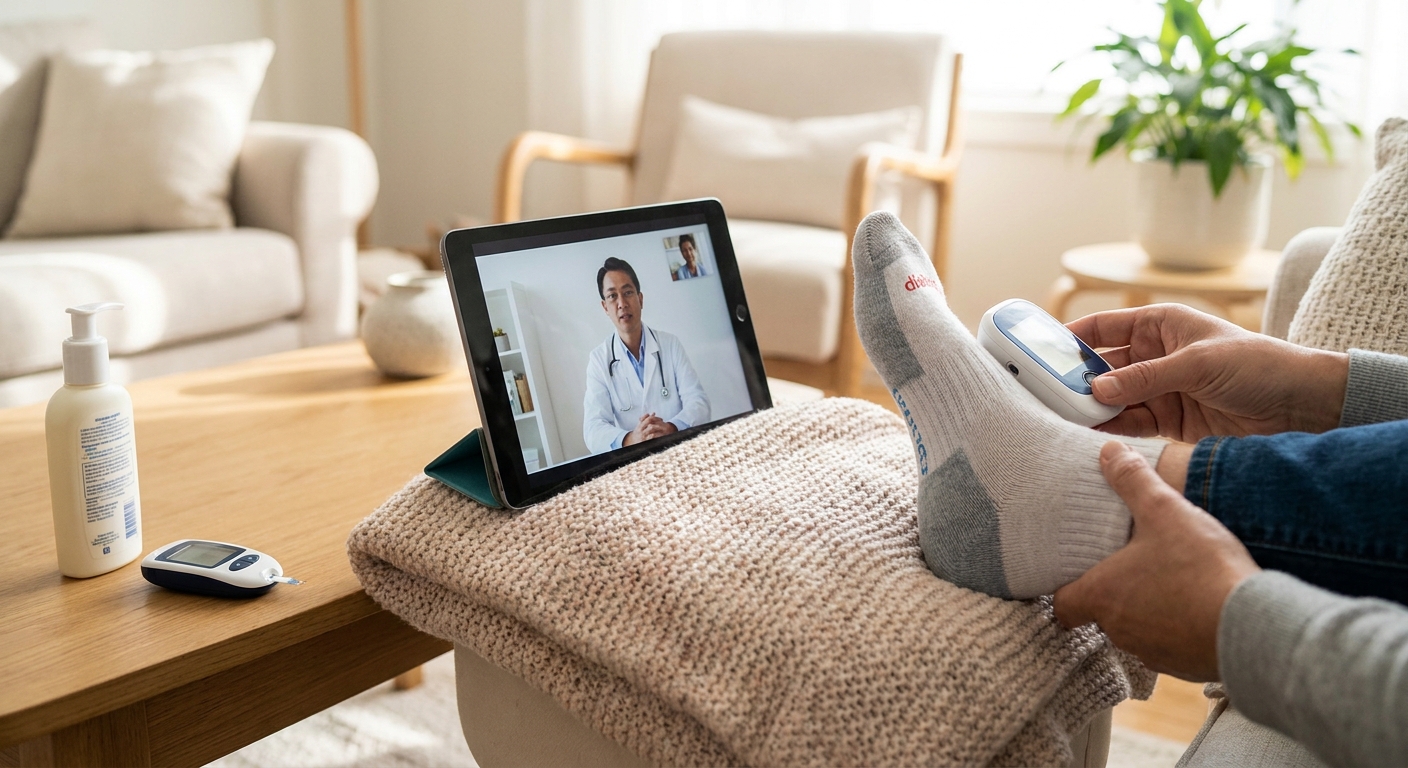
Diabetic foot complications send more people to the hospital than almost any other diabetes-related issue, and most of those cases start with something small — a cracked heel, a numb toe, a nail that got a little too thick. Telehealth for diabetic foot care puts a licensed clinician in front of that small problem before it becomes an emergency room problem.
- Diabetic foot care telehealth works for early-stage nail, skin, and nerve issues — NowCare routes true wounds and infections to in-person care.
- NowCare's diabetic foot pathway runs on 1, 3, or 6-month provider-guided plans across its Seven Pillars of Foot & Ankle Health framework.
- Toenail fungus treatment and ingrown toenail care are the two highest-volume telehealth visits for diabetic patients in 2026.
- Skip video-only urgent care for numbness or tingling — that's a neuropathy conversation, not a five-minute triage call.
- Daily self-checks plus a quarterly virtual podiatry review is the realistic maintenance rhythm for 2026.
Why this matters
Diabetes changes how your feet behave. Reduced circulation slows healing. Nerve damage means you might not feel a cut until it's already infected. A callus that would be a nuisance for anyone else can turn into an ulcer for a diabetic patient within weeks.
That's why the same telehealth model that works for a sinus infection doesn't automatically work for a diabetic foot. The visit needs a clinician who's actually looking for the diabetic-specific red flags — skin color changes, temperature differences, nail thickening, numbness patterns — not just asking "does it hurt." NowCare built its diabetes management program around that distinction, pairing general diabetes oversight with a dedicated foot and ankle track.
Heading into 2026, more diabetic patients are choosing virtual first-line care simply because it catches problems earlier — a video visit is easier to book on a Tuesday afternoon than a podiatry appointment three weeks out.
Who this is for
This guide is for anyone managing type 1 or type 2 diabetes who wants a faster, provider-guided way to catch foot problems before they become urgent — commuters who can't take a half-day off for a podiatry visit, rural patients without a local podiatrist, and anyone already juggling multiple diabetes-related appointments who wants one more handled online instead of in a waiting room.
It's also for caregivers managing foot checks for an aging parent with diabetes, where a monthly video review replaces guesswork about whether that toe looks "normal."
What to look for in diabetic foot care telehealth
Provider licensure and diabetic-specific training
A general telehealth doctor can look at a rash. Diabetic foot issues need someone trained to recognize neuropathy, poor circulation, and early ulcer risk — ask whether the clinician reviewing your case has podiatry or diabetic wound experience before you commit to a plan.
Photo and video intake quality
Diabetic foot assessment depends on seeing skin color, nail texture, and swelling clearly. A platform that only asks for a text description of symptoms can't catch what a clear photo intake can.
Clear escalation path to in-person care
Some diabetic foot problems — open wounds, spreading redness, fever — need a same-day in-person visit, not a video call. A telehealth platform for diabetic foot care must tell you when it can't help, not just when it can.
Prescription and pharmacy routing
Antifungal medication, topical antibiotics, and nerve pain prescriptions need to reach a pharmacy fast. Confirm the platform sends prescriptions directly to your chosen pharmacy rather than making you print anything.
Plan structure that matches a chronic condition
Diabetic foot issues rarely resolve in one visit. Look for 1, 3, or 6-month plan options instead of a single pay-per-visit model — chronic nail fungus and neuropathy both need follow-up, not a one-and-done call.
Ongoing care team, not a new clinician every time
Continuity matters when a condition is being tracked over months. A care team that remembers your last visit catches slow changes that a fresh clinician might miss.
The NowCare pathways for diabetic foot telehealth
Diabetes management program — the foundation pick. This is where diabetic foot care telehealth should start: a licensed clinician reviewing your overall diabetes control alongside foot-specific risk factors. Plans run 1, 3, or 6 months with ongoing care-team support. Buy — this is the anchor visit before any nail, skin, or nerve issue gets treated on its own.
Toenail fungus treatment — the highest-volume pick. Fungal nails are one of the most common diabetic foot complaints because thickened, discolored nails are harder to trim safely at home. NowCare's nail health track also covers annual membership options for patients who need repeat monitoring. Buy for anyone with visible nail thickening or discoloration.
Ingrown toenail care — the prevention pick. An ingrown nail is a minor annoyance for most people and a real infection risk for a diabetic patient with reduced circulation. Online triage plus a clear escalation rule for in-person removal makes this a smart first call rather than a DIY trim. Consider — book it the moment a nail edge looks irritated, don't wait for pain.
Foot pain relief — the structural pick. Bunions, flat feet, and hammertoes change how weight lands on the foot, which matters more for diabetic patients already at risk for pressure sores. A virtual podiatry review can flag structural issues worth escalating to orthotics or in-person imaging. Consider if you've noticed new pain patterns or shoe fit changes in the last few months.
Neuropathy and nerve pain review — the watch pick. Numbness, tingling, or burning in the feet is the symptom diabetic patients most often ignore, and it's the one most worth a provider conversation. It's not a same-day fix, but a virtual review sets the direction for pain management and monitoring. Consider — don't self-diagnose nerve symptoms with over-the-counter creams alone.
Start your diabetic foot care visit
Get matched with a licensed clinician for provider-guided diabetic foot care in 2026.
What to avoid
- General urgent care video visits for foot symptoms. A five-minute triage call built for colds and rashes isn't set up to catch diabetic-specific risk factors like circulation changes or early ulcer signs.
- Nail salon pedicures for thickened or fungal nails. Salon tools aren't sterile-guaranteed, and a small nick during a pedicure is a real infection risk for diabetic feet — get a licensed opinion first.
- Waiting on numbness or tingling. Neuropathy symptoms tend to get written off as "just tired feet." The earlier a provider reviews it, the more monitoring options stay on the table.
Verdict comparison
| Pathway | Best for | Plan length | Verdict |
|---|---|---|---|
| Diabetes management program | Overall diabetic foot risk | 1, 3, or 6 months | Buy |
| Toenail fungus treatment | Thickened, discolored nails | 1, 3, 6 months + annual | Buy |
| Ingrown toenail care | Nail edge irritation | Single visit or plan | Consider |
| Foot pain relief | Structural changes, shoe fit issues | 1, 3, or 6 months | Consider |
| Neuropathy and nerve pain review | Numbness, tingling, burning | 1, 3, or 6 months | Consider |
FAQ
What is diabetic foot care telehealth?
Diabetic foot care telehealth connects a diabetic patient with a licensed clinician online to review foot skin, nails, and nerve symptoms without an in-person podiatry visit. It works well for early-stage nail, skin, and structural issues but routes open wounds or infections to in-person care.
Can telehealth treat a diabetic foot ulcer?
No — an open ulcer needs in-person wound care, not a video visit. Telehealth is built for catching risk factors before an ulcer forms, and a provider-guided platform should tell you to seek in-person care if a wound is already open.
Is telehealth good for diabetic nerve pain in the feet?
Yes, as a starting point. A clinician can review symptoms, discuss monitoring, and guide next steps for neuropathy, though ongoing nerve pain often needs a longer plan rather than a single visit.
How often should a diabetic patient get a virtual foot check?
A quarterly virtual review paired with daily self-checks at home is a realistic rhythm for most diabetic patients in 2026. Anyone with active nail or skin issues should book more frequently until resolved.
Does diabetic foot telehealth replace an in-person podiatrist?
It replaces many routine visits but not all of them. Structural issues needing imaging, open wounds, or surgical evaluation still require in-person care; telehealth handles the earlier-stage monitoring and treatment.
What's the difference between diabetic foot telehealth and regular urgent care?
Regular urgent care is built for acute, general symptoms. Diabetic foot telehealth is built around the specific risk factors of diabetes — circulation, nerve damage, and slow healing — that a general triage call isn't designed to catch.
Can I get toenail fungus medication through telehealth if I'm diabetic?
Yes, a licensed clinician can prescribe antifungal treatment after a photo and history review, sent directly to your chosen pharmacy. Diabetic patients should mention their diabetes status during intake so the clinician accounts for slower healing.
Is diabetic foot telehealth covered without insurance?
NowCare's foot and ankle plans run on transparent one-time pricing with no insurance required, sold as 1, 3, or 6-month plans depending on the condition.
One last thing
The single habit that changes outcomes most isn't the telehealth visit itself — it's the daily 60-second foot check that catches a problem while it's still small enough for a video call to fix. Diabetic patients who pair that daily habit with a quarterly virtual podiatry review through a program like NowCare's tend to catch nail and skin issues weeks before they'd notice them on symptoms alone.


