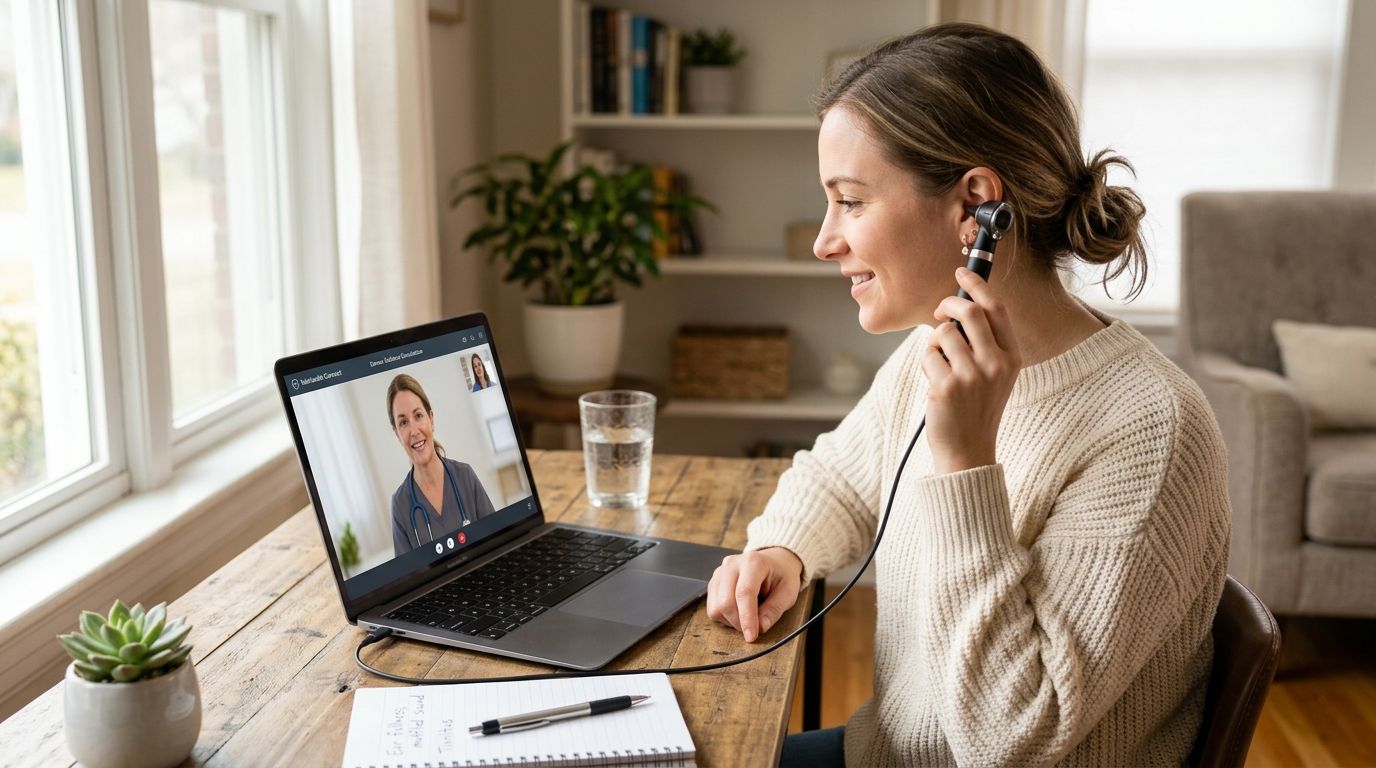
Earwax buildup telehealth visits get you a licensed clinician who reviews your symptoms, checks whether wax is actually the cause of hearing changes or ear fullness, and decides whether you need in-person removal or a home care plan. Virtual visits cannot pull earwax out directly because that step needs an otoscope and usually a curette, irrigation, or suction tool in person. The catch most people miss going in: if the clinician can't see far enough into your canal on video, you still end up with an in-person referral, so telehealth works best as the first triage step, not the last one.
- Earwax buildup telehealth visits handle symptom evaluation and referral, not direct removal, in 2026.
- NowCare's Virtual Urgent Care pillar covers ENT concerns including suspected earwax impaction.
- Removal itself needs an in-person otoscope exam; a clinician can't extract wax remotely.
- Over-the-counter softening drops handle mild buildup; ear candles and cotton swabs carry real injury risk.
- Sudden hearing loss, ear pain with fever, or drainage need in-person evaluation the same day.
Why this matters
Earwax buildup is one of the most common preventable causes of temporary hearing loss, and it sends a steady stream of people to urgent care and ERs for something a short video visit can often sort out first. According to the American Academy of Otolaryngology-Head and Neck Surgery's clinical guideline on cerumen impaction, roughly 1 in 10 children, 1 in 20 adults, and more than 1 in 3 older adults have impacted earwax at any given time. A telehealth visit tells you fast whether you're dealing with simple wax buildup, an ear infection, or something that needs same-day in-person care — and that answer changes what you do next.
Getting that answer through NowCare means a licensed clinician looks at your symptoms, asks about ear pain, drainage, hearing loss, and tinnitus, and either walks you through safe at-home softening steps or routes you to in-person removal. That's the actual value in 2026: skipping the guesswork before you show up somewhere for a procedure you may not even need.
Can a telehealth visit treat earwax buildup?
A telehealth visit can evaluate whether your symptoms match earwax buildup, rule out infection or a perforated eardrum based on what you describe, and recommend softening drops. It cannot physically extract wax, because that requires direct visualization through an otoscope and a hands-on tool the clinician can't operate through a screen.
| Situation | Telehealth can help | Needs in-person care |
|---|---|---|
| Mild fullness, muffled hearing, no pain | Yes — symptom review, softening drop guidance | No |
| Wax visible at canal opening, no pain | Yes — guidance on safe removal | Sometimes, if softening doesn't clear it |
| Ear pain, drainage, or fever | Initial triage only | Yes — same-day in-person exam |
| Sudden hearing loss or one-sided deafness | Initial triage only | Yes — urgent in-person evaluation |
| Suspected perforated eardrum | Initial triage only | Yes — same-day ENT or urgent care |
Verdict: a telehealth visit is the right first move for mild-to-moderate earwax buildup with no pain or drainage, and the wrong move if you have pain, fever, or sudden hearing loss — those go straight to in-person care.
How to get earwax removal guidance through telehealth
- Book a virtual urgent care visit and describe your symptoms in detail — when the fullness started, whether you use earbuds or hearing aids, and whether you've tried anything already.
- Answer screening questions about pain, fever, drainage, and hearing changes so the clinician can rule out infection first.
- Get a home care plan if it's mild buildup — usually an over-the-counter softening drop used for 3 to 5 days before you try gentle rinsing.
- Get a referral if the clinician suspects impaction that needs manual removal, a perforated eardrum, or an infection that needs an in-person look.
- Follow up if softening drops don't clear the fullness within about a week — that's the signal to stop trying home methods and get it removed in person.
Talk to a provider about ear symptoms
Get a same-visit evaluation for ear fullness, pain, or hearing changes.
Why earwax buildup happens
Earwax is protective — it's not dirt, and clearing it out aggressively is usually what causes the problem in the first place. A few patterns show up again and again in people who end up needing removal:
- Cotton swab use pushes wax deeper into the canal instead of removing it, packing it against the eardrum.
- Hearing aids and earbuds worn daily block the canal's natural self-cleaning motion and trap wax against the device.
- Narrow or curved ear canals, which some people are simply born with, make natural wax migration harder.
- Age-related changes make earwax drier and more likely to become impacted, which lines up with the higher rate seen in older adults.
- Excess ear hair, more common with age, physically catches and holds wax in place.
- Frequent swimming or showering without drying ears well can soften wax in a way that leads to buildup rather than clearing it.
What are the signs of earwax buildup?
Earwax buildup usually shows up as a feeling of fullness or muffled hearing in one or both ears, sometimes with mild itching or a faint ringing sound. If those symptoms come with pain, drainage, or fever, that's not simple wax anymore — that combination points toward infection and needs an in-person exam.
Is it safe to remove earwax at home with cotton swabs or ear candles?
Cotton swabs and ear candles are not safe methods for removing earwax buildup, and both carry real risk of canal injury or eardrum perforation. Over-the-counter softening drops used for a few days, followed by gentle warm water rinsing, are the method most clinicians recommend for mild buildup at home in 2026.
When does earwax buildup need urgent in-person care?
Earwax buildup needs urgent in-person care when it comes with sudden or one-sided hearing loss, ear pain with fever, drainage, or dizziness. Those symptoms suggest infection, a perforated eardrum, or something beyond simple impaction, and a telehealth visit alone won't be enough to manage it.
Related ear symptoms follow similar logic. Fullness after swimming that comes with pain points more toward swimmer's ear than plain wax buildup, and persistent drainage or fever is more consistent with an ear infection than impaction alone — both are worth ruling out during the same visit.
FAQ
Can a doctor remove earwax through a video visit?
No, a doctor cannot remove earwax through a video visit because extraction requires an otoscope and a hands-on tool used in person. Telehealth can evaluate your symptoms and refer you for removal if home softening doesn't work.
How much earwax buildup is considered impacted?
Earwax is considered impacted when it fully blocks the ear canal and causes hearing loss, fullness, or discomfort rather than sitting as a normal, non-bothersome amount. A clinician confirms impaction by direct visualization, which telehealth can't do remotely.
Do earwax removal drops actually work?
Over-the-counter softening drops work for mild-to-moderate buildup when used consistently for 3 to 5 days before gentle rinsing. They are less effective on hard, deeply impacted wax, which usually needs in-person irrigation or manual removal.
Is earwax buildup a sign of an ear infection?
Earwax buildup by itself is not a sign of infection, but pain, drainage, or fever alongside fullness usually means something more than wax is going on. That combination needs an in-person exam rather than home softening.
Can hearing aids cause earwax buildup?
Yes, hearing aids and earbuds worn daily block the ear canal's natural wax-clearing motion and trap wax against the device. Regular check-ins with a clinician can catch buildup before it affects hearing aid function.
What happens during a telehealth visit for earwax buildup?
A telehealth visit for earwax buildup involves a clinician asking about your symptoms, ear history, and any pain or drainage, then recommending softening drops or an in-person referral. The visit sorts out whether wax is the actual cause before you go anywhere in person.
Why does earwax buildup happen more in older adults?
Earwax becomes drier and harder to clear naturally with age, which is part of why more than 1 in 3 older adults have impacted cerumen at any given time. Reduced manual dexterity and hearing aid use also play a role.
One last thing
The instinct to clean ears more when they feel full is exactly backwards — earwax is protective, and the people who dig at it most with swabs or picks are usually the ones who end up impacted. If softening drops haven't cleared fullness within about a week in 2026, stop trying to manage it yourself and get it looked at, because pushing further at that point tends to pack wax tighter rather than clear it.


