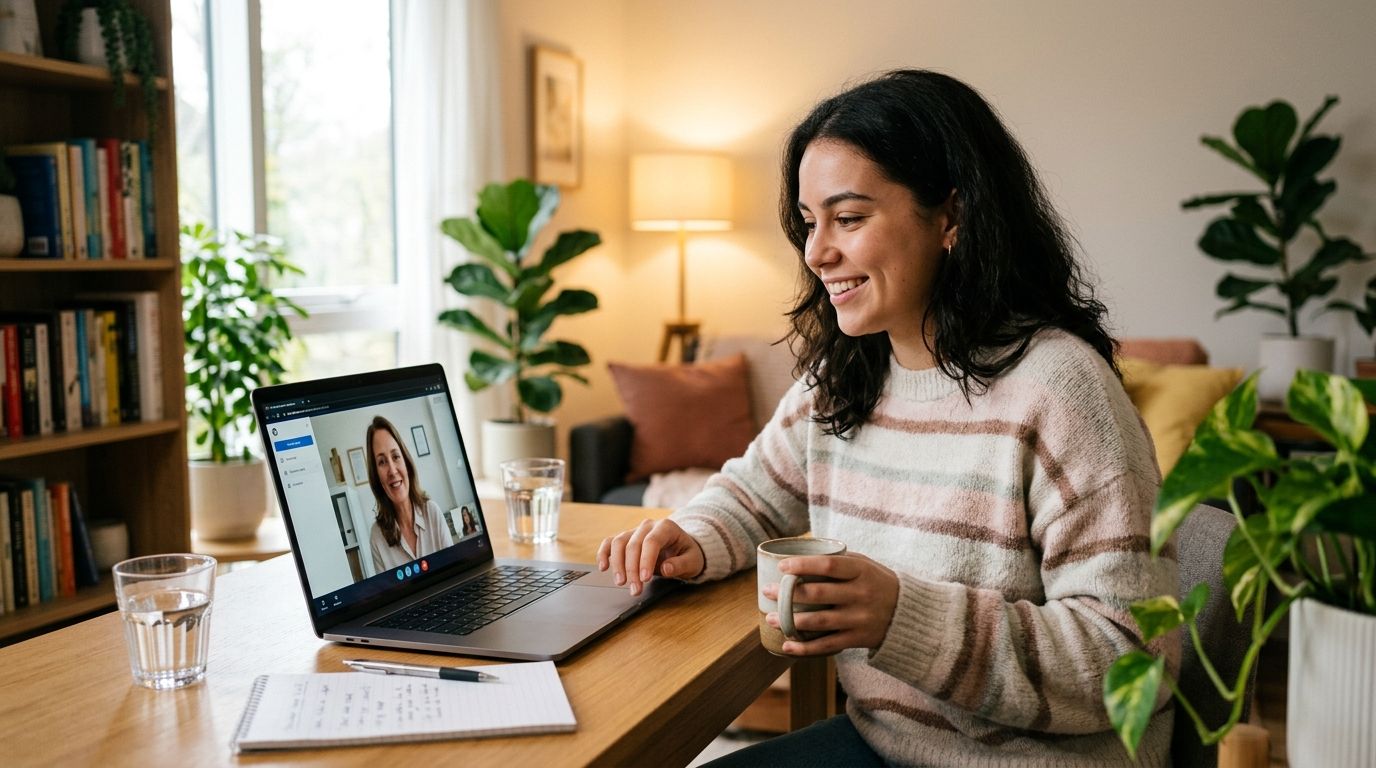
Eating disorder telehealth support is remote, provider-guided monitoring and care coordination for anorexia, bulimia, binge eating disorder, and related conditions, built to keep a patient connected to a care team between in-person visits. This segment needs more than a single video call a month — it needs a schedule, a monitoring plan, and a clear line to a clinician who can escalate care fast if something changes.
- Eating disorder telehealth support works as one piece of a multidisciplinary plan, never as a stand-alone treatment.
- Weekly or biweekly video check-ins catch relapse warning signs that a single monthly in-person visit misses.
- Telehealth cannot replace in-person labs or vitals checks for a medically unstable patient in 2026.
- A HIPAA-compliant platform with licensed clinician review is the floor, not the ceiling, for any eating disorder telehealth support program.
- Medication management for co-occurring anxiety or depression is one part telehealth handles reliably today.
Why eating disorder telehealth support matters for this segment
Eating disorders don't relapse on a schedule that matches a monthly office visit. The gap between appointments is where weight loss accelerates, binge frequency climbs, or a patient quietly stops eating in front of anyone who'd notice. A platform built around provider-guided visits and licensed clinician review — the model NowCare uses across its own service lines — shows the baseline any eating disorder telehealth support workflow needs before a family or a treatment team should trust it with monitoring.
This segment also carries a specific access problem. Specialized eating disorder centers cluster in a handful of metro areas, and rural patients or college students living away from their home care team often go months without an in-person check. Telehealth doesn't fix the underlying illness. It fixes the distance problem, and in 2026 that's a real gap to close.
Build your care team before you book a single video visit
Eating disorder recovery runs on more than one clinician. A therapist alone can't track cardiac risk. A dietitian alone can't manage an SSRI taper. Telehealth only works well when the team behind the screen is already coordinated.
- List a therapist trained specifically in eating disorders, not general talk therapy
- Add a registered dietitian who does meal-plan work, not general nutrition coaching
- Confirm a primary care provider or psychiatrist who can order labs and manage medication
- Ask each provider who covers weekends or after-hours concerns
- Get written consent forms signed so the three providers can actually talk to each other
Choose a HIPAA-compliant telehealth platform
Before comparing calendars or video quality, confirm the platform meets baseline privacy and clinical standards. Eating disorder records are sensitive, and a patient using a consumer video app instead of a clinical platform is taking on risk nobody flagged for them. NowCare's own HIPAA-compliant telehealth platform guidance covers the checklist worth applying to any provider, eating-disorder-specific or not.
- Confirm secure intake forms instead of email or text-based history collection
- Check that prescriptions, when needed, route to a pharmacy the patient chooses
- Ask whether session notes sync across the therapist, dietitian, and physician
- Verify the platform documents licensed clinician review, not just an automated intake form
Set a check-in cadence that matches your risk level
A patient who's weight-restored and stable can often manage on biweekly check-ins. A patient recently discharged from a higher level of care, or showing early relapse signs, needs weekly contact at minimum — sometimes twice weekly during a rough stretch.
- Weekly video check-ins for patients within 90 days of a higher level of care
- Biweekly check-ins once weight and behaviors have stabilized for 8+ weeks
- A same-week backup slot built into the schedule, not an afterthought
- A clear rule for who gets called first if a check-in reveals a red flag
“Relapse rarely happens during the video call — it happens in the fourteen days between two of them.”
Track vitals and weight data between sessions
Self-reported numbers drift. A patient who's struggling tends to under-report, not lie outright, and telehealth teams need a system that catches that drift early rather than at the next scheduled weigh-in.
- Use a home scale calibrated the same way every time, same time of day
- Log resting heart rate and blood pressure if the care team has flagged cardiac risk
- Keep a simple daily log of meals and behaviors, shared with the dietitian weekly
- Route any concerning reading to the physician the same day, not at the next visit
Loop in medication management for co-occurring symptoms
Anxiety, depression, and OCD symptoms show up alongside eating disorders often enough that medication management deserves its own line item in the plan. Telehealth handles this piece well — it's one of the more mature use cases in virtual care right now. NowCare's mental health medication management service is built for exactly this kind of ongoing prescription oversight, separate from the eating-disorder-specific therapy and nutrition work.
- Confirm which prescriber owns psychiatric medication versus general primary care
- Schedule medication check-ins on a different cadence than therapy sessions
- Ask about interaction checks between psychiatric medication and any GI or cardiac medication
- Keep a running list of dose changes shared across the full care team
Build a crisis escalation plan before you need it
Every telehealth-based monitoring plan needs a written answer to "what happens if something goes wrong at 9pm on a Saturday." Waiting to figure this out during an actual crisis costs time nobody has.
- Name the specific person or service to call for a medical emergency
- Confirm which local ER or urgent care the patient would use if needed
- Give a support person (parent, partner, roommate) written instructions, not verbal ones
- Set a rule for when a telehealth check-in escalates to an in-person visit
Prepare for your first telehealth appointment
The first session sets the tone for the whole monitoring relationship. A patient who shows up without history, current medications, or recent lab results loses most of that first visit to paperwork instead of care. NowCare's guide to preparing for your first telehealth appointment applies directly here.
- Have a list of current medications and doses ready before the call starts
- Bring recent lab or vitals data if any exists
- Write down the three things you most want the provider to know upfront
- Test the video platform and connection at least once before the scheduled time
Comparing eating disorder telehealth support options
| Option | Best for | Key limitation |
|---|---|---|
| Telehealth-only monitoring program | Stable, weight-restored patients needing consistent check-ins | Can't run in-person labs or vitals directly |
| Hybrid in-person + telehealth team | Patients needing regular medical monitoring alongside virtual therapy | Requires coordinating schedules across multiple providers |
| Residential or partial hospitalization program (PHP) | Patients with acute medical instability or high relapse risk | Delivered in person, not a virtual option |
| Self-directed tracking apps | Supplementing an existing care team with daily logs | No clinician oversight, no crisis escalation built in |
| Telehealth medication management | Managing co-occurring anxiety, depression, or OCD symptoms | Doesn't address nutritional rehabilitation on its own |
Verdict: telehealth monitoring works best layered onto an existing multidisciplinary team, not used as the only point of contact for a patient with active medical risk.
Common mistakes patients make with eating disorder telehealth support
- Treating video check-ins as optional once things feel better. Stability at week 8 doesn't predict week 12 — cadence should taper slowly, not stop.
- Skipping labs because a patient reports feeling fine. Self-report and lab values disagree often enough in this population that skipping labs defeats the point of monitoring.
- Using a therapy-only platform when medication management is also needed. Two separate logins and two disconnected records make coordination worse, not better.
- Waiting until a crisis to build an escalation plan. By the time it's needed, there's no time to figure out who to call.
- Assuming any telehealth platform is HIPAA-compliant by default. Not every video tool marketed to clinicians actually meets that bar — check before booking.
Manage co-occurring symptoms online
Provider-guided medication management for anxiety and depression alongside your care team.
FAQ
What is eating disorder telehealth support?
Eating disorder telehealth support is remote monitoring and care coordination delivered by video, covering check-ins, symptom tracking, and communication between a therapist, dietitian, and physician. It works alongside in-person care rather than replacing it for medically unstable patients.
Can therapy for anorexia or bulimia be done fully online?
Talk therapy sessions can run fully online for many stable patients, but medical monitoring like vitals and labs still needs an in-person component for anyone with active medical risk. A hybrid model is the standard approach in 2026.
Is telehealth safe for monitoring medically unstable eating disorder patients?
No — telehealth alone is not safe as the sole monitoring method for a medically unstable patient, since it can't capture in-person vitals or run labs. Unstable patients need a hybrid or higher level of care.
How often should eating disorder check-ins happen over telehealth?
Patients within 90 days of a higher level of care typically need weekly check-ins, while stable patients can often move to biweekly. The right cadence depends on how recently symptoms or vitals have shifted.
Does telehealth cover medication management for eating disorders?
Telehealth handles medication management for co-occurring anxiety, depression, and OCD symptoms well, since it's mostly prescription oversight and dose adjustment. It does not replace the nutritional and therapy work an eating disorder itself requires.
What's the difference between telehealth monitoring and in-person eating disorder treatment?
Telehealth monitoring covers check-ins, symptom tracking, and coordination between providers, while in-person treatment covers physical exams, labs, and any higher level of medical care. Most solid plans in 2026 use both.
How much does eating disorder telehealth support cost in 2026?
Cost varies widely by provider, session type, and insurance coverage, so check current rates directly with the platform or clinician you're considering. Ask specifically whether medication management and therapy are billed separately.
Is telehealth eating disorder support covered by insurance?
Coverage depends on the specific plan and provider network, and varies enough that a direct call to the insurer is the only reliable way to confirm it. Ask about both therapy and medication management coverage separately.
One last thing
The patients who do best with eating disorder telehealth support in 2026 aren't the ones with the most sessions booked — they're the ones whose therapist, dietitian, and physician can actually see the same notes. A monitoring plan without that connective tissue is just three separate calendars that happen to be about the same person.


