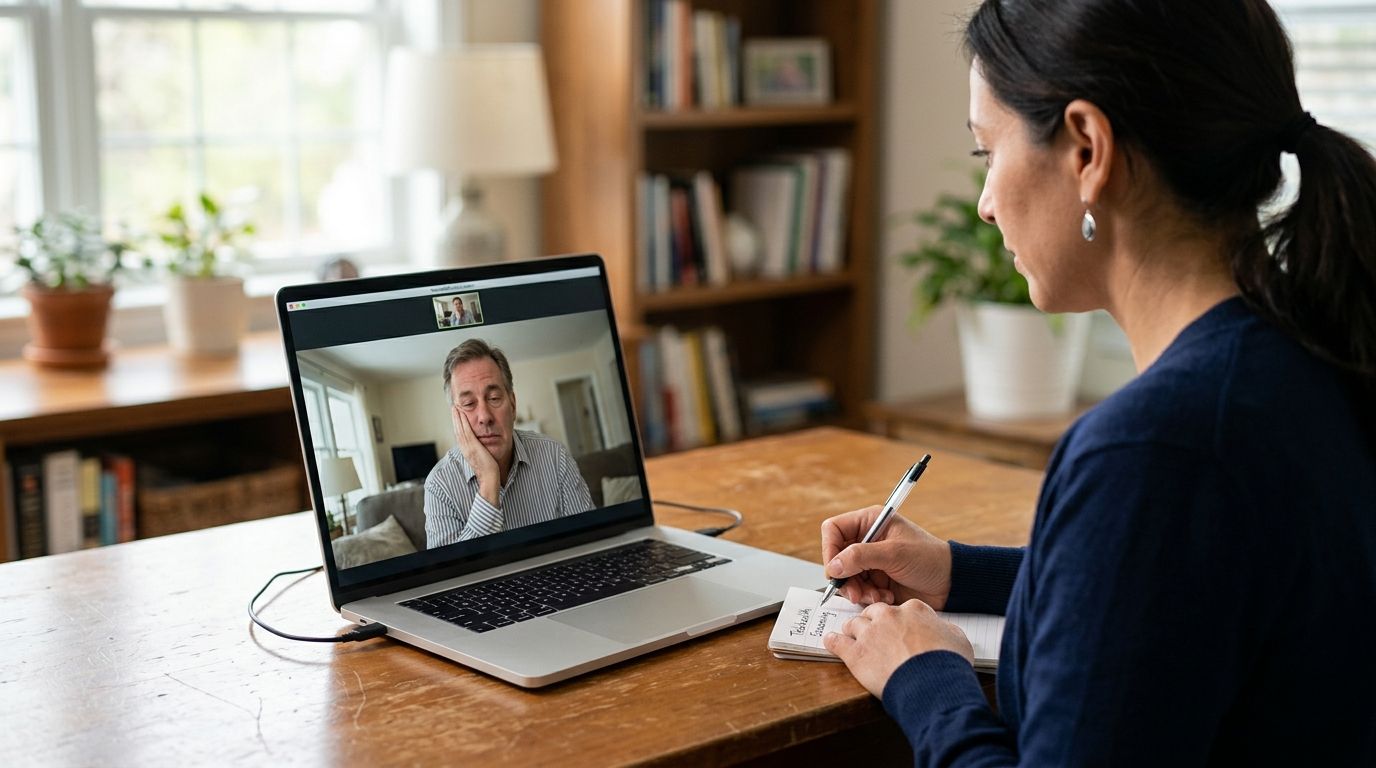
Excessive daytime sleepiness telehealth screening is a virtual visit that reviews your sleep pattern, checks for red-flag conditions like sleep apnea, and routes you to testing or treatment without a stand-alone sleep clinic referral. People who fall asleep at their desk, nod off at red lights, or need three alarms just to function need a faster diagnostic path than the multi-week wait many sleep clinics run in 2026 — a symptom-first screening call sorts the likely cause before anyone commits to an overnight lab stay.
- Excessive daytime sleepiness telehealth screening starts with a clinician visit, not a sleep lab referral.
- The Epworth Sleepiness Scale (0-24 points) is the standard opening self-check; a score of 10 or higher flags a problem.
- A STOP-BANG score of 3 or more signals high sleep apnea risk and usually means a home sleep apnea test comes next.
- Causes span sleep apnea, restless leg syndrome, insomnia, and medication side effects — a virtual visit sorts which one fits.
- Skip urgent care for routine daytime drowsiness in 2026; book a virtual screening visit first and escalate only for red flags.
Why excessive daytime sleepiness telehealth screening matters
The CDC has reported for years that roughly 1 in 3 U.S. adults don't get enough sleep, and that baseline shortfall is the first thing any screening has to rule out before looking at medical causes. Excessive daytime sleepiness (EDS) is different from being tired after a bad night — it's a persistent inability to stay alert during normal daytime activity, even after adequate time in bed.
That distinction matters because EDS overlaps with several conditions that need different treatment paths: obstructive sleep apnea, restless leg syndrome, chronic insomnia and sleep issues, depression, and side effects from common medications like antihistamines and beta blockers. A telehealth visit that takes a full symptom and medication history in one sitting catches overlaps that a rushed in-person visit often misses.
The people who benefit most from a virtual screening path are those who already suspect a specific cause — loud snoring, restless legs at night, shift work — and just need a clinician to confirm it and order the right next step.
How to get screened for excessive daytime sleepiness online
Track your sleep pattern for two weeks
Before any clinician visit, a plain sleep log gives the most useful data. Do this the free, manual way first:
- Log bedtime, wake time, and total hours slept every night
- Note caffeine intake after 2 p.m., including hidden sources like tea and soda
- Track alcohol within three hours of bedtime
- Record screen time in the hour before sleep
- Flag nights with snoring, gasping, or leg twitching reported by a partner
- Note weekday vs. weekend sleep difference (a gap over 2 hours suggests sleep debt, not a medical cause)
Self-screen with the Epworth Sleepiness Scale
The Epworth Sleepiness Scale (ESS) rates how likely you are to doze off in eight everyday situations, each scored 0-3, for a total between 0 and 24.
- Score each situation honestly, not how you'd like to answer
- A total under 10 is generally normal
- A score of 10-15 suggests mild to moderate excessive sleepiness
- A score of 16 or higher suggests severe excessive sleepiness and warrants a same-week visit
- Retake the scale after any new medication or dose change
Rule out the obvious drains first
Most daytime drowsiness traces back to habits, not disease. Check these before assuming something's medically wrong:
- Caffeine or nicotine use within six hours of bedtime
- Irregular shift schedules or rotating night shifts
- Over-the-counter sleep aids that leave residual grogginess the next day
- Undiagnosed anxiety or low mood affecting sleep quality
- New prescriptions with drowsiness listed as a side effect
- Alcohol used as a sleep aid, which fragments deep sleep
Book a virtual visit for a full symptom review
Once the sleep log and ESS score point toward something beyond habit, a clinician visit is the faster path than waiting on a sleep center referral. NowCare's Virtual Urgent Care covers everyday medical concerns like this through a provider-guided visit — a licensed clinician reviews your sleep log, ESS score, and medication list, then decides whether a home sleep apnea test, a specialist referral, or a treatable condition workup makes sense. Every plan gets reviewed by a licensed clinician before anything is prescribed or ordered.
Complete a home sleep apnea test if referred
If sleep apnea risk is high, a home sleep apnea test (HSAT) is usually faster and less disruptive than an overnight lab study.
- Confirm the device measures airflow, oxygen levels, and effort — not just snoring
- Wear it for at least one full night, two if the first result is inconclusive
- Return or ship the device per the instructions provided with the kit
- Expect results reviewed by a clinician, not an automated score alone
Address the underlying cause
Once a cause is identified, treatment is specific to what's driving the sleepiness — there's no single fix for EDS as a category.
- Sleep apnea: CPAP therapy, weight management, or positional therapy depending on severity
- Restless leg syndrome: medication management and iron level checks
- Insomnia: cognitive behavioral therapy for insomnia (CBT-I) or short-term medication
- Medication side effects: dose timing changes or a substitute prescription
Follow up and re-score
Retake the Epworth Sleepiness Scale four to six weeks after starting treatment. A drop of several points confirms the plan is working; no change means the visit needs a second look at the diagnosis.
Know when to escalate beyond telehealth
Some symptoms need in-person, same-day evaluation instead of a scheduled virtual visit: sudden loss of muscle tone with strong emotion (a hallmark of narcolepsy called cataplexy), chest pain with sleep apnea symptoms, or sleepiness severe enough to cause a driving incident. Telehealth screening is the right first step, not the right step for every symptom.
Comparing screening options for excessive daytime sleepiness
| Option | Best for | Key limitation |
|---|---|---|
| NowCare Virtual Urgent Care | Fast symptom review and referral routing for EDS | Not a substitute for in-person emergency evaluation |
| In-person primary care visit | Patients who want an existing doctor to coordinate care | Appointment wait times often run longer than a virtual visit |
| In-person sleep specialist clinic | Complex cases needing polysomnography (full lab sleep study) | Referral and scheduling wait can run several weeks |
| Home sleep apnea test (mail-order) | Confirmed high sleep apnea risk from a STOP-BANG or ESS screen | Not sensitive enough for suspected narcolepsy or complex sleep disorders |
Verdict: for most adults with new-onset excessive daytime sleepiness, a virtual screening visit is the right first stop in 2026 — it's the only option on this list built to triage before you commit to a lab study.
Common mistakes people make with excessive daytime sleepiness
- Blaming it on age or a busy schedule instead of running the Epworth Sleepiness Scale, which delays sleep apnea diagnosis by months in a lot of cases
- Increasing caffeine intake to mask symptoms rather than treating the cause, which raises the risk of a driving or workplace incident
- Self-treating with OTC sleep aids that cause next-day grogginess and get mistaken for the original problem
- Skipping the STOP-BANG questionnaire and jumping straight to a full overnight sleep study when a home sleep apnea test would answer the same question faster
- Leaving medications off the intake form — antihistamines, muscle relaxants, and some blood pressure medications are common, overlooked causes of daytime drowsiness
Book a virtual sleepiness screening
Get a provider-guided review of your symptoms and next steps.
FAQ
What is excessive daytime sleepiness telehealth screening?
It's a virtual visit where a licensed clinician reviews your sleep pattern, symptom history, and medication list to identify what's causing daytime drowsiness and decide on next steps like a home sleep apnea test or specialist referral.
Can a telehealth visit diagnose sleep apnea?
A telehealth visit can't run a lab study itself, but it can screen your risk with tools like STOP-BANG and order a home sleep apnea test, which many patients use instead of an overnight lab stay in 2026.
What's the difference between the Epworth Sleepiness Scale and STOP-BANG?
The Epworth Sleepiness Scale measures how likely you are to doze off during daily activities on a 0-24 point scale. STOP-BANG is a separate 8-item risk checklist specifically for sleep apnea; a score of 3 or more suggests elevated risk.
How much sleep is enough to rule out simple sleep deprivation?
The CDC recommends 7 or more hours of sleep per night for adults. If a two-week sleep log shows consistently less than that, sleep deprivation should be ruled out before assuming a medical cause.
Is excessive daytime sleepiness a sign of narcolepsy?
It can be, especially when paired with cataplexy (sudden muscle weakness triggered by emotion), but narcolepsy is rarer than sleep apnea or simple sleep debt and usually needs an in-person sleep specialist for confirmation.
Can restless leg syndrome cause daytime sleepiness?
Yes. Restless leg syndrome fragments overnight sleep even when total hours look normal, and the resulting daytime sleepiness responds to targeted medication and iron level checks rather than general sleep hygiene fixes.
How fast can I get a home sleep apnea test after a virtual visit?
Timing depends on the ordering clinician and the test provider, but a home sleep apnea test is generally faster to schedule in 2026 than an in-lab polysomnography study, which can carry a multi-week wait.
Does NowCare treat sleep apnea directly?
NowCare's Virtual Urgent Care handles the symptom review, screening tools, and referral routing for excessive daytime sleepiness; ongoing sleep apnea treatment like CPAP setup is typically coordinated with a sleep specialist after screening.
One last thing
The Epworth Sleepiness Scale is built on just eight everyday situations — reading, watching TV, sitting in traffic — yet it's still the standard opening question in sleep clinics in 2026 because it's fast and it correlates well with real risk. If your score sits at 16 or higher, don't wait on a routine appointment slot; that range warrants a same-week visit, virtual or in-person.


