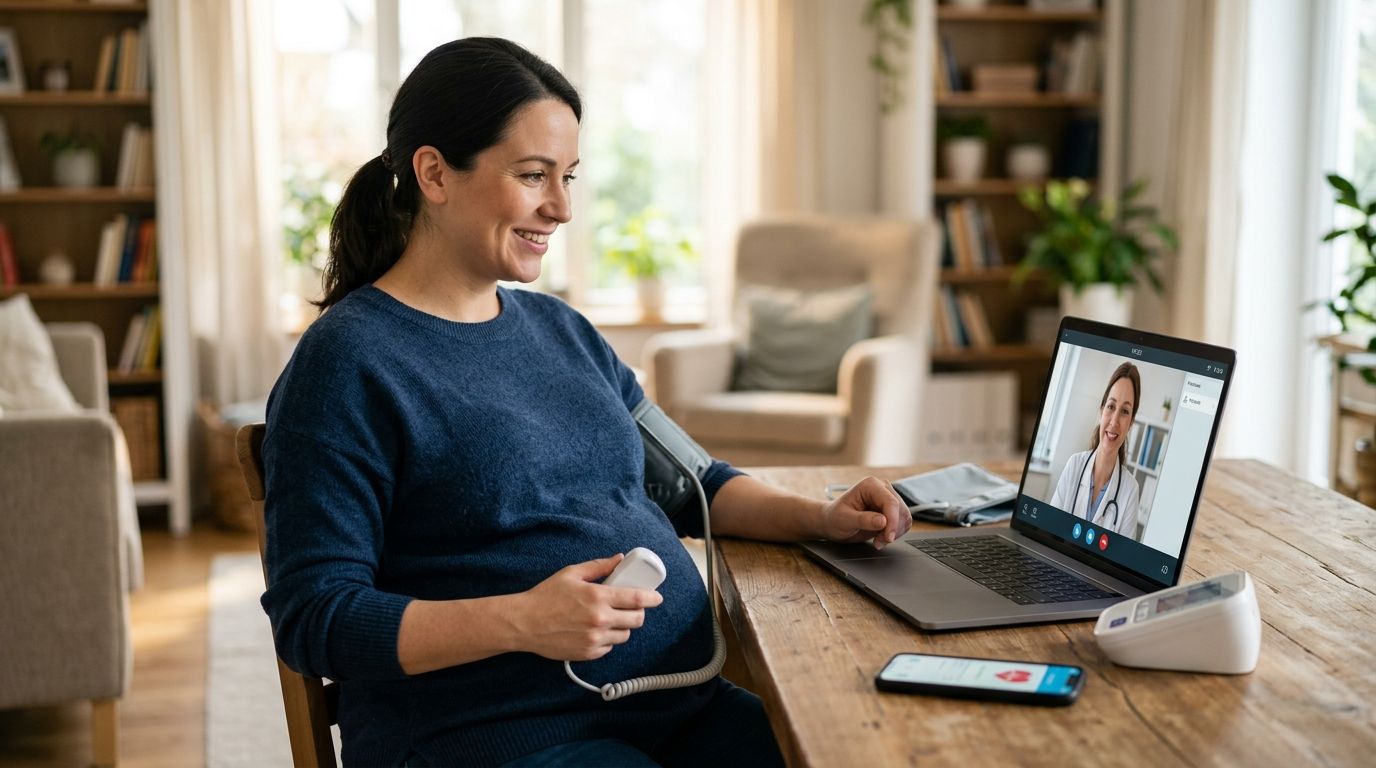
High-risk pregnancy telehealth monitoring is remote symptom tracking and follow-up care used alongside in-person maternal-fetal medicine (MFM) visits, not instead of them, with the goal of catching complications between office appointments without adding unnecessary trips to a specialist's office. This segment needs more frequent contact than a typical pregnancy but can't rely on video visits for the ultrasounds, non-stress tests, or fetal heart monitoring that define high-risk obstetric care. The right approach mixes scheduled in-person OB/MFM care with telehealth for the symptoms and logistics that happen in between.
- Telehealth for high-risk pregnancy supplements in-person maternal-fetal medicine care — it never replaces ultrasounds or fetal monitoring.
- NowCare virtual care fits the non-obstetric gaps: colds, UTIs, rashes, approved refills, and postpartum mental health support.
- Home blood pressure and glucose logs paired with a telehealth check-in catch trend changes between scheduled OB visits.
- Red-flag symptoms — severe headache, vision changes, reduced fetal movement — go to your OB team or the ER, never a general telehealth queue.
Why telehealth matters for high-risk pregnancy monitoring
A high-risk designation — from gestational diabetes, preeclampsia risk, multiples, or a prior complication — usually means more appointments, not fewer. That scheduling load is exactly what telehealth absorbs well.
The gap isn't obstetric monitoring itself. It's everything around it: a UTI at 28 weeks, a refill needed before a long weekend, a rash that shows up two days before the next MFM appointment. Routing those through a specialist's already-full schedule delays care. Routing them through telehealth keeps the specialist's time for the monitoring only they can do.
The prenatal check-ins page covers the routine, lower-acuity visits that fit this pattern — symptom questions, coordination between appointments, and follow-ups that don't need imaging.
Confirm what has to stay in person
Start every high-risk pregnancy telehealth plan by writing down what your OB or MFM specialist requires face-to-face in 2026. This list is the boundary telehealth never crosses.
- Non-stress tests and biophysical profiles
- Growth ultrasounds and Doppler studies
- Blood pressure checks tied to a preeclampsia workup
- Any visit your specialist flagged as in-person only in your care plan
- Lab draws that require a phlebotomist on site
- Cervical checks or exams related to preterm labor risk
If a check appears on this list, telehealth is the wrong channel for it — full stop.
Set up home monitoring between visits
Most high-risk pregnancy plans include home monitoring: a blood pressure cuff for preeclampsia risk, a glucometer for gestational diabetes, or kick counts for fetal movement tracking.
- Use the exact cuff or meter model your OB team recommended, not a random drugstore pick
- Log readings at the same time each day so trends stay comparable
- Agree on a threshold with your OB that triggers an immediate call rather than a wait-and-see
- Bring the log — paper or app — to every visit, in person or virtual
- Mention your high-risk plan at the start of any telehealth visit for a non-obstetric issue
Build a symptom-tracking routine
Between MFM visits, a simple daily routine catches changes early. This is where high-risk patients either stay ahead of problems or fall behind on them.
- Track swelling, headaches, and vision changes daily, not only when something feels off
- Note fetal movement patterns starting in the third trimester
- Keep a running question list for your next OB appointment instead of calling for every minor item
- Flag anything matching your OB's written call-immediately list — those bypass telehealth entirely
- Review the list weekly with a partner or support person so nothing gets missed
Use telehealth for the non-obstetric symptoms
Pregnancy doesn't pause colds, UTIs, skin flare-ups, or the need for a refill. This is the layer where a general telehealth platform like NowCare does real work without touching the high-risk monitoring itself.
- A UTI, sinus infection, or rash that needs a same-week answer instead of a scarce OB slot
- Refilling a maintenance medication your OB already approved for pregnancy
- Mental health check-ins for anxiety or mood changes that start before delivery
- Postpartum symptom follow-up once your OB has cleared routine discharge care
- General questions that don't meet your OB's in-person threshold
For mood symptoms that carry into the fourth trimester, postpartum depression screening and support is built for that handoff.
Coordinate medication refills across two care teams
High-risk pregnancy patients often see an OB, an MFM specialist, and a primary care provider in the same month. Refills fall through the cracks when nobody owns the list.
- Keep one written, dated medication list shared with every provider you see
- Confirm pregnancy-safety status before any telehealth provider issues a new prescription
- Use telehealth for refills your OB already approved, not new starts
- Ask your OB team before adding any over-the-counter medication or supplement
- State your due date and risk designation at intake for every telehealth visit
Line up postpartum support before delivery
The transition out of high-risk monitoring is its own gap. Contact often drops off sharply at delivery, right when new physical and mental symptoms appear.
- Schedule your first postpartum check before you leave the hospital, not after
- Ask your OB which symptoms warrant an in-person recheck versus a virtual one
- Set up new parents and postpartum checkups access in advance so there's no gap while you wait on an OB follow-up
- Screen for postpartum mood symptoms at two weeks, not only at the standard six-week visit
- Confirm who to call first for urgent postpartum symptoms — OB, telehealth, or ER
Choose a HIPAA-compliant platform for records continuity
High-risk pregnancy care involves more providers than a typical pregnancy, which means more records moving between systems. A platform that mishandles that creates real risk, not just inconvenience.
- Confirm visit notes go back to your OB or are available on request
- Check that intake is secure, not plain email attachments
- Verify prescriptions route to the pharmacy you choose
- Ask whether the platform documents your high-risk designation for continuity
- Read how to choose a HIPAA-compliant telehealth platform before enrolling in any new service mid-pregnancy
“Telehealth for high-risk pregnancy works as a supplement to in-person maternal-fetal medicine care, never a replacement for the monitoring only a specialist can do.”
Comparing the options for high-risk pregnancy patients
| Option | Best for | Key limitation |
|---|---|---|
| In-person MFM specialist | Ultrasounds, non-stress tests, fetal monitoring | Requires travel and specialist scheduling |
| Hospital remote monitoring program | Patients already issued connected BP or glucose devices | Only available through specific hospital systems |
| General telehealth (NowCare) | Non-obstetric symptoms, approved refills, postpartum mood support | Not a substitute for ultrasound or fetal monitoring |
| Home devices alone | Daily blood pressure or glucose tracking | No clinician review unless paired with a visit or program |
Verdict: use the MFM specialist for anything obstetric, and NowCare or a comparable provider-guided telehealth service for the everyday symptoms and refills that would otherwise wait weeks for a specialist slot.
Handle everyday symptoms without the wait
Provider-guided care for non-obstetric concerns between OB visits.
Common mistakes high-risk pregnancy patients make
- Treating a general telehealth visit as an OB substitute. No video call replaces a growth ultrasound or a non-stress test, and the substitution delays real monitoring.
- Not disclosing high-risk status at telehealth intake. A clinician handling a rash or UTI needs that context to flag anything unusual.
- Dropping the daily BP or glucose log once things feel stable. Trend data catches what a single reading misses.
- Waiting until the six-week visit to mention mood symptoms. Two-week screening catches problems earlier.
- Requesting new prescriptions through general telehealth before checking with the OB team. Pregnancy-safety decisions belong with the provider holding the full chart.
FAQ
Can telehealth manage a high-risk pregnancy on its own?
No. Telehealth for high-risk pregnancy supplements in-person maternal-fetal medicine care for ultrasounds, non-stress tests, and fetal monitoring. Those visits stay in person.
What can NowCare help with during a high-risk pregnancy?
NowCare covers non-obstetric concerns through provider-guided virtual care: UTIs, rashes, colds, everyday medical questions, and approved medication refills. Postpartum check-ins are available once your OB clears routine care.
Is it safe to get a prescription refill through telehealth while pregnant?
Refills of medications your OB already approved as pregnancy-safe are reasonable through telehealth in 2026. New prescriptions should go through your OB or MFM team first.
What symptoms should skip telehealth entirely during a high-risk pregnancy?
Severe headache, vision changes, sudden swelling, decreased fetal movement, or vaginal bleeding go straight to your OB team or the ER. A general telehealth queue is the wrong channel for those.
How often should I log blood pressure or glucose during a high-risk pregnancy?
Follow the schedule your OB sets, which is often daily. Bring the log to every visit so trends rather than single readings guide decisions.
When should postpartum telehealth support start?
Set up a first postpartum check within two weeks of delivery instead of waiting for the standard six-week visit. Mood symptoms in particular show up well before week six.
Does insurance cover telehealth visits during a high-risk pregnancy?
Coverage varies by plan and provider in 2026, so confirm with your insurer before booking. NowCare care is priced per plan and does not require insurance.
Can a telehealth visit replace an OB appointment if I am short on time?
No. Skipping a scheduled OB or MFM appointment risks missing the monitoring that defines high-risk care. Use telehealth for the symptoms that fall outside that monitoring.
One last thing
The patients who handle high-risk pregnancy telehealth monitoring best in 2026 aren't the ones using it most. They're the ones who drew a clean line between what the OB team must see in person and what a virtual visit can handle in between — written down, shared with every provider, and reviewed at each appointment. That line is worth more than any app.


