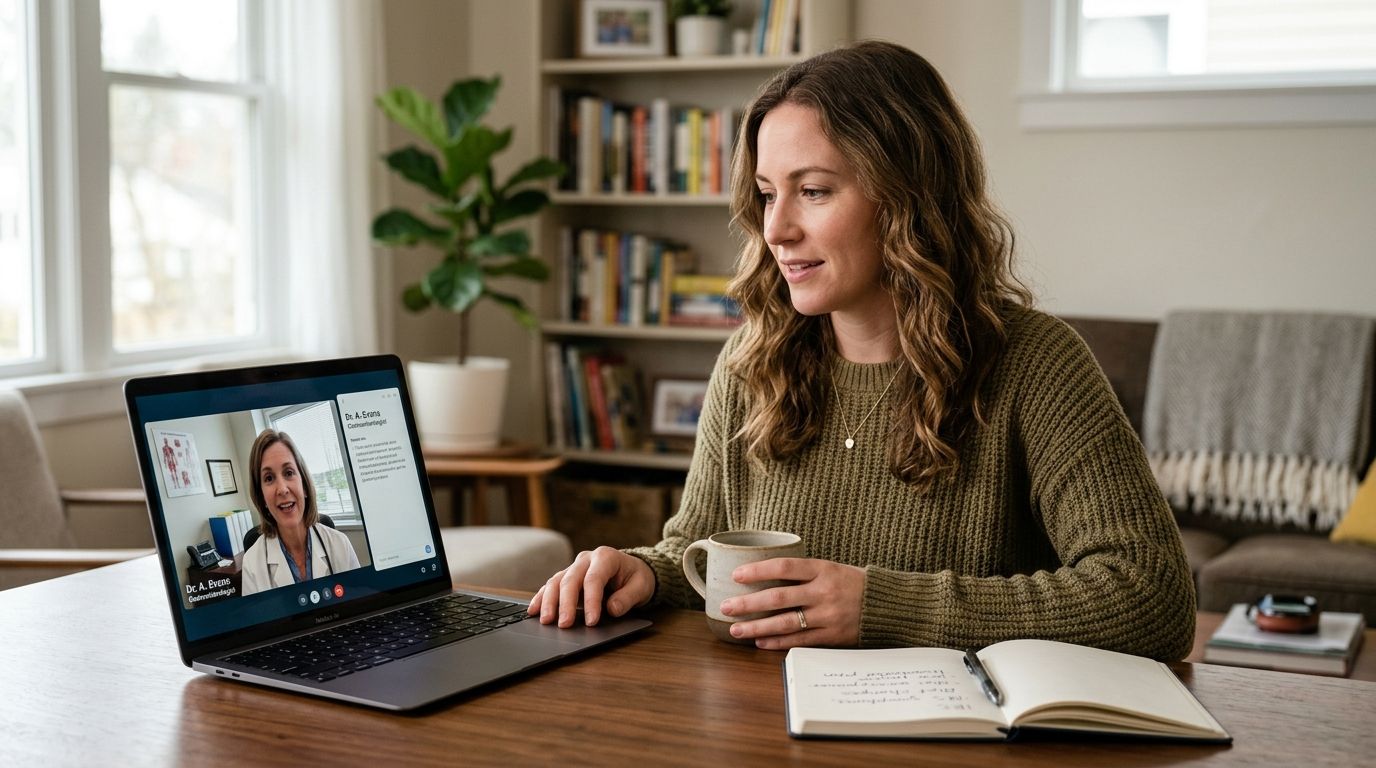
IBS telehealth treatment is virtual care for people with irritable bowel syndrome and other chronic digestive issues, built around ongoing symptom management rather than a single office visit. Chronic digestive conditions don't resolve after one prescription — they need tracking, dietary adjustment, and periodic reassessment, which is exactly what a recurring virtual care relationship is built for, not a one-time urgent care visit.
- IBS telehealth treatment works best for ongoing symptom management, not a first-time diagnosis of red-flag symptoms.
- Rome IV diagnostic criteria for IBS are symptom-based, which is why a licensed clinician can evaluate them over video.
- Blood in stool, unexplained weight loss, or nighttime symptoms need in-person workup before any virtual visit.
- Low-FODMAP diet trials and medication adjustments are the two most common first-line treatments started online in 2026.
- NowCare's Virtual Urgent Care plan covers everyday digestive concerns and can route you to specialist referral when needed.
Why telehealth matters for IBS and chronic digestive issues
IBS is diagnosed almost entirely by symptom history, not by a physical exam a camera can't replace. The Rome IV criteria — recurrent abdominal pain tied to changes in stool frequency or form — are questions a clinician asks, not tests only available in an exam room.
That makes IBS one of the conditions telehealth handles well, with one big caveat: a virtual visit only works after red-flag symptoms have been ruled out. Roughly 10-15% of US adults report IBS symptoms at some point, per widely cited NIDDK estimates, and most of that population manages the condition for years, not weeks.
A condition managed for years needs a care model built for check-ins, refills, and adjustment — not a single urgent care call. NowCare structures its Virtual Urgent Care plan around exactly that kind of everyday, recurring concern, which is why it fits the early stages of an IBS workup better than a one-off appointment.
How IBS telehealth treatment works, step by step
Track your symptoms before your first visit
A clinician can't order a scope over video, but they can read a symptom pattern — if you bring one.
- Log bowel habits daily using the Bristol stool chart for 1-2 weeks
- Note food and drink that precede flares
- Track pain timing, location, and duration
- Record stress levels and sleep quality
- List every current medication and supplement
Rule out red-flag symptoms first
This step protects you more than any prescription does. Any of these means an in-person workup, not a video call, comes first:
- Blood in stool or black, tarry stools
- Unexplained weight loss
- Iron-deficiency anemia
- Symptoms that wake you up at night
- A family history of colorectal cancer or inflammatory bowel disease
- New symptoms after age 50 with no prior GI history
Confirm your diagnosis or subtype
Once red flags are cleared, a clinician can work through the Rome IV criteria and classify your pattern.
- IBS-C (constipation-predominant)
- IBS-D (diarrhea-predominant)
- IBS-M (mixed)
- Rule-out labs for celiac disease if not already done
- Review of any prior colonoscopy or bloodwork results
Start with diet and lifestyle changes
Most IBS treatment plans in 2026 still start here, before medication — it's the lowest-risk, highest-yield first move.
- A structured low-FODMAP elimination trial, typically 2-6 weeks
- Soluble fiber adjustment (psyllium over wheat bran for most patients)
- Consistent meal timing instead of skipped meals
- Hydration targets tied to stool consistency
- Stress-reduction routines, since gut-brain signaling drives flares
Request medication management if lifestyle changes aren't enough
This is where a recurring telehealth relationship starts to pay off over a single urgent care visit — a clinician needs to see how you respond before adjusting anything.
- Antispasmodics for cramping
- Fiber supplements or osmotic laxatives for IBS-C
- Antidiarrheal agents for IBS-D
- Low-dose antidepressants targeting gut-brain signaling, not mood, at IBS doses
- Prescription IBS-specific medications for patients who've failed first-line steps
A preparing for your first telehealth appointment checklist helps here — bring your symptom log and medication list to the visit instead of reconstructing it live on camera.
Set up recurring check-ins instead of one-off visits
IBS management is a maintenance relationship, not a single transaction. Quarterly or monthly check-ins catch medication drift before it becomes a flare.
- Symptom score comparison against your baseline log
- Medication dose adjustment based on response
- Refill scheduling before you run out, not after
- A standing plan for what to do during a flare
Get a referral when you need in-person testing
Telehealth manages IBS; it doesn't run a colonoscopy or a SIBO breath test. Knowing when to escalate is part of good care, not a failure of the virtual model.
- Colonoscopy for anyone over 45 without a prior screening, or with red flags
- Breath testing for suspected small intestinal bacterial overgrowth (SIBO)
- Imaging when structural causes are suspected
- A referral to a GI specialist through telehealth when symptoms don't respond to first-line treatment
“If your symptoms include blood in your stool or unexplained weight loss, that's not a video call — that's an in-person workup first.”
Comparing your options for IBS telehealth treatment in 2026
| Option | Best for | Key limitation |
|---|---|---|
| Primary care telehealth (general) | First-line diet and lifestyle guidance | Limited ability to manage complex or refractory IBS |
| GI specialist telehealth | Confirmed IBS needing prescription-level management | Longer wait times than general telehealth |
| NowCare Virtual Urgent Care | Everyday digestive symptoms and initial triage | Not a substitute for colonoscopy or specialist procedures |
| In-person gastroenterologist | Red-flag symptoms, testing, and procedures | Requires scheduling, travel, and often a wait for a new-patient slot |
Verdict: start with a virtual visit for tracking and lifestyle changes, and reserve in-person GI care for testing and red-flag symptoms. Most IBS patients never need to skip the virtual step — they need to not skip the escalation step when red flags appear.
Start managing your symptoms today
Provider-guided virtual care for everyday digestive concerns from NowCare.
Common mistakes IBS patients make with telehealth
- Treating a flare as an emergency instead of a pattern. One bad week doesn't need a new diagnosis — it needs a look at what changed in your log.
- Self-diagnosing IBS without ruling out celiac disease or IBD. These conditions share symptoms but need different labs and different treatment.
- Stopping medication the moment symptoms improve. IBS medications often need a maintenance dose, not just a rescue dose.
- Skipping the symptom log before the visit. A clinician working from a two-minute verbal summary makes a weaker plan than one working from two weeks of data.
- Ignoring red flags because a virtual visit feels easier than a specialist referral. Convenience is not a substitute for a colonoscopy when one is indicated.
FAQ
What is IBS telehealth treatment?
IBS telehealth treatment is virtual care where a licensed clinician evaluates irritable bowel syndrome symptoms, recommends diet or lifestyle changes, and manages medication over video or messaging instead of an in-person visit. It works well for ongoing management once red-flag symptoms are ruled out.
Can a virtual doctor diagnose IBS?
Yes — IBS is diagnosed using the Rome IV criteria, a set of symptom-based questions about pain and stool changes rather than a physical exam finding. A clinician can walk through these criteria over a video visit as long as red-flag symptoms have already been ruled out.
Is IBS telehealth treatment covered without insurance?
Coverage and cost structures vary by platform and plan, so check the specific terms of the service you choose. Some telehealth plans, including NowCare's Virtual Urgent Care option, are structured as flat-rate plans rather than per-visit insurance billing.
How do doctors treat IBS symptoms online?
Most plans start with a low-FODMAP diet trial, fiber adjustment, and stress management before adding medication. If those don't control symptoms, a clinician can add antispasmodics, fiber supplements, or prescription IBS medications through the same virtual relationship.
When should IBS symptoms be treated in person instead of virtually?
Blood in stool, unexplained weight loss, anemia, nighttime symptoms, or a family history of colorectal cancer all require in-person evaluation and testing, not a video visit. New GI symptoms after age 50 with no prior screening also warrant an in-person workup first.
Can telehealth doctors prescribe IBS medication?
Yes, licensed clinicians can prescribe antispasmodics, fiber supplements, antidiarrheals, low-dose antidepressants for gut-brain signaling, and some IBS-specific prescription medications through a telehealth visit. Prescriptions are sent to the pharmacy you choose after the clinician confirms the plan is appropriate.
How often do you need follow-up visits for chronic digestive issues?
Most IBS management plans use monthly or quarterly check-ins to adjust medication and review symptom logs, rather than a single visit. Follow-up frequency depends on how well symptoms respond to the initial treatment plan.
What's the difference between IBS and IBD, and can telehealth tell them apart?
IBS is a functional disorder diagnosed by symptom pattern, while IBD (Crohn's disease or ulcerative colitis) involves visible inflammation confirmed by colonoscopy and labs. A telehealth clinician can screen for IBD risk factors and order labs, but confirming IBD requires an in-person procedure.
One last thing
The Rome IV criteria that define an IBS diagnosis don't require a single lab test, scan, or scope — they're built entirely on symptom pattern and timing. That's the exact reason IBS telehealth treatment holds up medically in 2026 where a lot of other conditions don't: the diagnostic tool was designed around a conversation, not an exam table. The catch is that clinicians still have to actively rule out the conditions that look like IBS but aren't, which is why the red-flag screening step matters more than the diet plan that comes after it.


