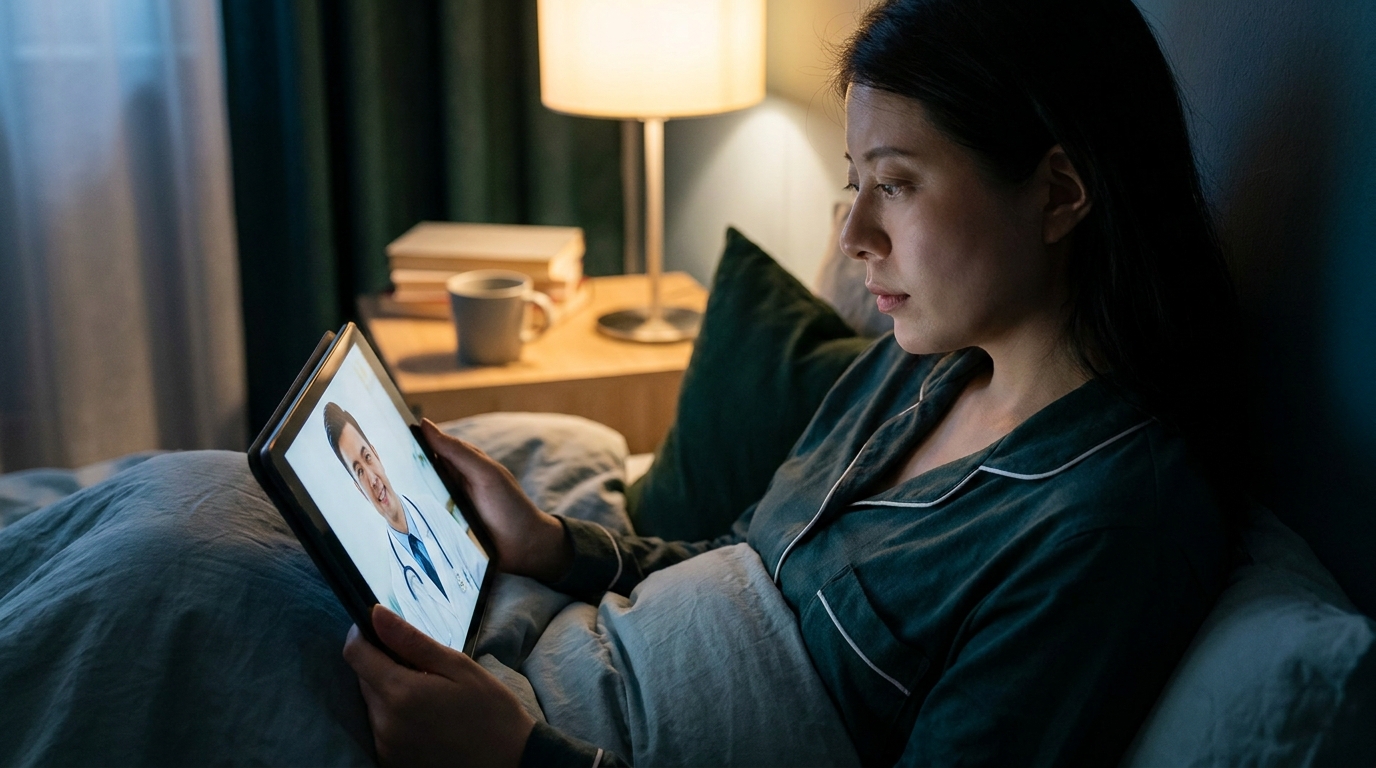
Telehealth for insomnia and sleep issues puts a licensed clinician between you and 3 a.m. — someone who can figure out whether the problem is anxiety, thyroid function, menopause, or just a schedule that never lets your body wind down, all without an office visit.
- Telehealth insomnia sleep issues care works when a clinician first checks for anxiety, thyroid, or menopause triggers — Buy.
- NowCare's anxiety and menopause telehealth visits catch hormonal and stress-driven insomnia that sleep apps miss — Consider.
- Skip any platform that prescribes sedatives without a follow-up visit inside 30 days — Skip.
- CBT-I coaching through telehealth outperforms melatonin gummies for chronic insomnia per ACP guidance — Buy.
- Same-day telehealth slots matter most in the first two weeks of a new sleep problem, not month six — Consider.
Why this matters
Insomnia is rarely just insomnia. It's a symptom that shows up when something else is off — cortisol running high from anxiety, a thyroid that's underactive, hormone shifts during perimenopause, or a chronic condition that's never been managed well enough to let you rest. A telehealth visit that only asks "do you want a sleeping pill" skips the diagnostic step that actually fixes the problem in 2026.
The convenience of virtual care is real — no waiting room, no half-day off work, appointments that fit around a schedule that's already the reason you're not sleeping. But convenience without a real evaluation just delays the fix. NowCare's licensed clinicians model — provider-guided, treatment only when medically appropriate — is the standard to measure any sleep-focused telehealth option against.
Who this is for
This guide is for adults dealing with chronic sleep disruption: trouble falling asleep, waking at 2 a.m. and staying awake, or sleep that never feels restorative even after eight hours in bed. It's built for people who suspect their insomnia is tied to something else — anxiety, perimenopause, a thyroid condition, or a chronic illness that's poorly controlled — and who want a telehealth option that actually investigates instead of just prescribing.
What to look for in telehealth for insomnia and sleep issues
A real intake, not a symptom checklist
A platform worth paying for asks about caffeine timing, screen habits, shift work, anxiety symptoms, and menstrual or hormonal history before suggesting anything. If the intake form takes under two minutes and leads straight to a prescription screen, that's a sign the visit is transactional, not clinical.
Licensed clinicians who screen for underlying causes
Insomnia tied to anxiety needs a different plan than insomnia tied to hypothyroidism or menopause. A clinician who asks about mood, weight changes, hot flashes, and energy levels is doing the job right — one who jumps straight to zolpidem is not.
CBT-I access, not just medication
Cognitive behavioral therapy for insomnia (CBT-I) is the first-line treatment recommended by the American College of Physicians, ahead of sleep medication. A telehealth service that can point you toward CBT-I coaching or refer you appropriately is doing more for you long-term than one that only refills prescriptions.
Follow-up cadence for medication titration
If a clinician does prescribe something, a second visit inside 2-4 weeks should be standard to check effectiveness and side effects. No follow-up scheduled means no one is tracking whether the medication is actually working — or whether it's masking a bigger issue.
Scheduling speed when the problem is new
A new, sudden sleep disruption — especially with signs of gasping, snoring, or daytime collapse — needs a same-day or next-day slot, not a two-week wait. Chronic, months-old insomnia has more flexibility, but the first visit for a new problem should not.
Top picks for telehealth insomnia and sleep issues care
The stress-driven insomnia pick. If racing thoughts at bedtime are the real problem, an anxiety-focused visit beats a generic sleep consult — cortisol dysregulation from chronic stress is one of the most common, and most fixable, insomnia triggers seen in primary care in 2026. NowCare's telehealth care for anxiety and stress management builds sleep evaluation into the same visit instead of treating it as a separate problem. Buy if bedtime rumination is your main symptom.
The hormonal-shift pick. Roughly 40-60% of women report sleep disruption during perimenopause, driven by night sweats and hormone swings rather than anxiety alone. NowCare's telehealth for menopause symptom management treats the hormonal driver directly instead of only addressing the sleeplessness it causes. Buy for women 40+ whose sleep changed alongside irregular cycles or hot flashes.
The metabolic pick. An underactive thyroid slows metabolism enough to disrupt deep sleep stages, and it's caught with a simple TSH panel most sleep-only telehealth services never order. NowCare's telehealth for thyroid management covers that screening as part of ongoing care. Consider if fatigue, weight changes, or cold intolerance show up alongside the insomnia.
The fast-access pick. For a sleep problem that started in the last week — new medication, new stress, a health scare — same-day telehealth availability matters more than any other feature. Platforms with next-day virtual slots close the gap before insomnia becomes a chronic pattern lasting months instead of days. Consider for acute, recent-onset sleep disruption.
The medication-management pick. For sleep issues tied to a broader condition that's already being tracked — diabetes, high blood pressure, chronic pain — ongoing primary care telehealth that manages the whole picture beats a one-off sleep prescription. Consider if insomnia is one symptom on a longer chronic-condition list.
What to avoid
- Sedative-first platforms with no follow-up scheduled. If a service writes a prescription for zolpidem or trazodone in a 10-minute visit and doesn't book a check-in, it's optimizing for volume, not outcomes.
- Sleep apps marketed as "telehealth" with no licensed clinician involved. Meditation timers and white-noise subscriptions have their place, but they aren't a substitute for a clinical evaluation when insomnia has lasted more than a month.
- Generic wellness telehealth that skips hormone and thyroid screening. If perimenopause or thyroid symptoms are present and nobody asks about them, the visit missed the actual cause.
“If you're prescribed a sleeping pill before anyone asks about your thyroid or your stress levels, that's a red flag, not a fast track.”
Verdict comparison
| Pick | Best for | Clinician focus | Follow-up cadence | Verdict |
|---|---|---|---|---|
| Anxiety-focused telehealth | Racing-thoughts insomnia | Mental health + sleep | 2-4 weeks | Buy |
| Menopause-focused telehealth | Perimenopause sleep disruption | Hormonal + sleep | 4-6 weeks | Buy |
| Thyroid-management telehealth | Fatigue + poor sleep | Metabolic + sleep | 6-8 weeks | Consider |
| Same-day telehealth slot | New, acute sleep disruption | General intake | As needed | Consider |
| Chronic-condition primary care | Sleep tied to broader illness | Whole-picture | Ongoing | Consider |
FAQ
What's the best telehealth option for insomnia in 2026?
The best option is a telehealth visit that screens for underlying causes — anxiety, thyroid function, or hormonal shifts — before jumping to medication. A generic sleep-only app that skips that screening isn't the best first step even if it's the fastest.
Can a telehealth doctor prescribe sleep medication?
Yes, licensed clinicians on telehealth platforms can prescribe non-controlled sleep aids and some prescription sleep medications depending on state rules and clinical judgment. Controlled substances typically require stricter follow-up and may not be prescribed on a first virtual visit.
Is CBT-I available through telehealth?
Cognitive behavioral therapy for insomnia is increasingly delivered through telehealth coaching and behavioral health platforms. It's the first-line treatment recommended by the American College of Physicians, ahead of sleep medication, for chronic insomnia.
Is telehealth as effective as in-person care for insomnia?
For evaluation and ongoing management, telehealth works as well as in-office visits for most insomnia cases that don't require a sleep study. Cases involving suspected sleep apnea still need in-person or at-home diagnostic testing.
Can telehealth diagnose sleep apnea?
A telehealth clinician can screen for sleep apnea symptoms like loud snoring and daytime fatigue and refer you for a home or in-lab sleep study, but the diagnosis itself requires that separate test. Telehealth manages the referral, not the diagnostic study.
How fast can I get a telehealth appointment for a sleep issue?
Many telehealth platforms offer same-day or next-day virtual appointments for new sleep complaints in 2026. Ongoing, chronic insomnia visits typically have more scheduling flexibility since the timeline is less urgent.
Does menopause cause insomnia?
Yes, hormonal shifts during perimenopause and menopause disrupt sleep for a large share of women through night sweats and hormone fluctuations. A telehealth visit focused on menopause symptom management addresses that root cause directly.
What questions should a telehealth insomnia visit ask?
A thorough visit asks about caffeine and screen habits, anxiety symptoms, menstrual or hormonal history, weight changes, and any snoring or gasping during sleep. If a visit skips all of these and goes straight to a prescription, it's not a complete evaluation.
One last thing
The American College of Physicians has recommended CBT-I as the first-line treatment for chronic insomnia since 2016 — ahead of medication — and most patients still never hear that recommendation from whoever writes their prescription. Ask directly whether a telehealth clinician can point you toward CBT-I before you accept a refill as the only plan.


