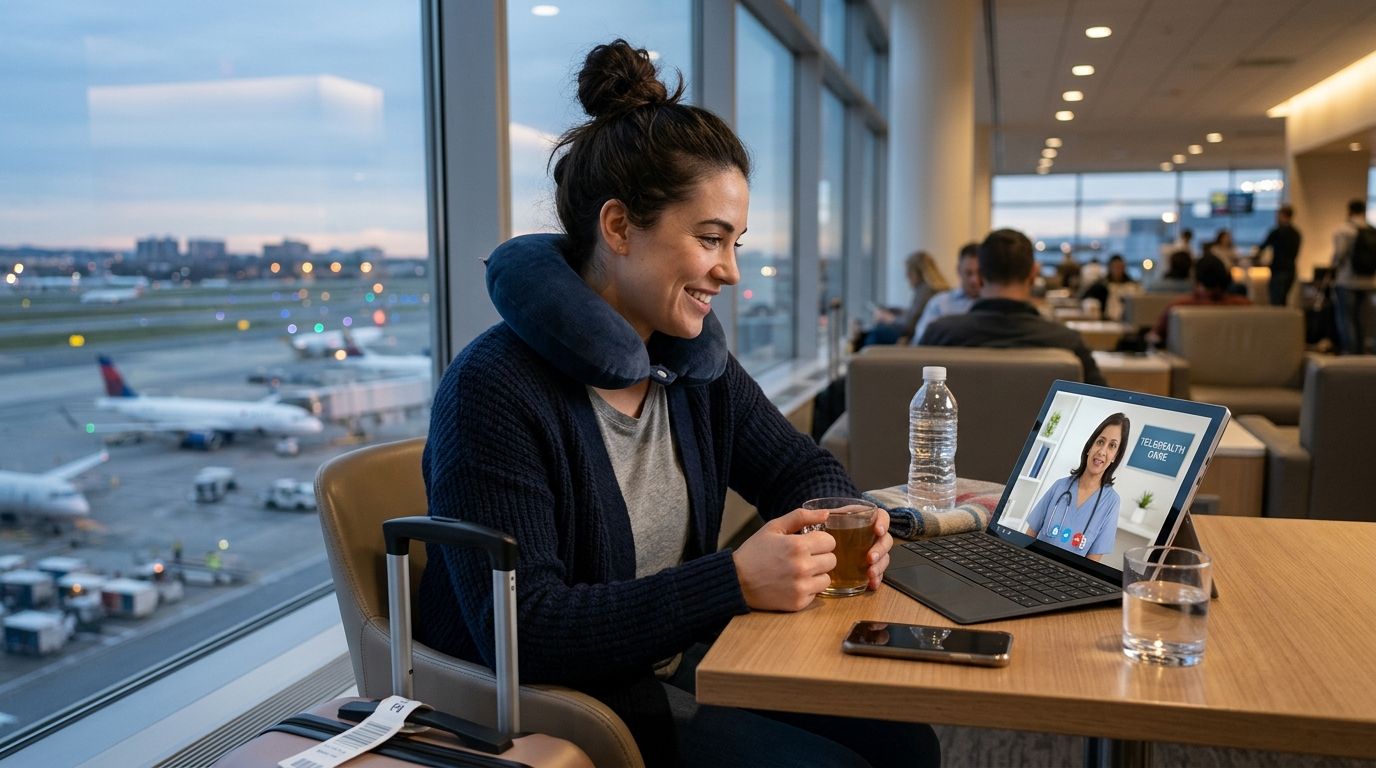
Frequent travelers use telehealth for jet lag to get a licensed clinician's read on symptoms without hunting for an in-network urgent care clinic in a city they've never been to. Jet lag itself isn't a diagnosable illness a doctor treats with a prescription, but the symptoms that ride along with it — sinus pressure from cabin pressure changes, skin flare-ups, stomach upset, insomnia that won't break — are exactly the kind of everyday medical concerns a virtual visit is built for.
Why telehealth matters for frequent travelers
A business traveler landing in a new time zone at 11pm local doesn't have the option of "see how you feel in the morning and call your regular doctor." The regular doctor's office is closed, in a different time zone, and probably not accepting new-patient same-day calls anyway. NowCare built its Virtual Urgent Care plan around exactly this gap — skin & hair, men's health, women's health, ENT, and everyday medical concerns, reviewed by a licensed clinician, with a prescription (if medically appropriate) sent to whatever pharmacy is closest to the hotel.
The practical case for telehealth here isn't convenience marketing — it's logistics. You don't know the local urgent care network. You don't know if your insurance is in-network three states or three countries away. A virtual visit removes both variables: same clinician-review process wherever you're standing, and no need to locate an in-network provider before you can get seen.
Fix the flight before you fix the symptoms
Reset your sleep schedule pre-flight
The manual, free version of jet lag management starts before you board. It's not glamorous, but it's the highest-leverage step and it costs nothing.
- Shift bedtime 30-60 minutes toward your destination time zone for 2-3 nights before departure
- Get direct sunlight exposure in the morning if you're flying east, in the evening if flying west
- Cut caffeine after early afternoon starting 2 days out
- Book flights that land in the early evening destination time when you can
- Avoid alcohol on the flight — it worsens dehydration and disrupts REM sleep more than it "helps you sleep"
Manage hydration and cabin air during the flight
Cabin humidity sits around 10-20%, far drier than anywhere on the ground, and that alone accounts for a chunk of the fatigue people blame on time zones.
- Drink roughly 8 oz of water per hour in the air, more on flights over 6 hours
- Skip the second in-flight coffee even if you're tired — it delays adjustment
- Use saline nasal spray if you're prone to sinus pressure or nosebleeds at altitude
- Move every 90 minutes to reduce ankle and leg swelling
- Pack electrolyte tablets rather than relying on juice or soda for rehydration
Treat skin and sinus flare-ups after landing
This is where a virtual visit starts to outperform "wait it out." Dry cabin air plus a new climate is a common trigger for breakouts, eczema flares, and sinus congestion that doesn't clear on its own within a day or two.
- Track whether congestion is one-sided (possible sinus infection) versus both sides (likely just dryness)
- Note new rashes or breakouts against products you packed versus hotel toiletries you didn't
- Use a humidifier or a damp towel near the vent if your hotel room is dry
- If symptoms haven't improved by day 2-3, a Virtual Urgent Care visit through NowCare gets a licensed clinician looking at it the same day, without finding a local walk-in first
- Keep photos of any rash progression — clinicians ask for this in a virtual visit and it speeds up the assessment
Get a same-trip virtual visit when symptoms won't quit
This is the step where telehealth stops being a backup plan and becomes the primary path. If you're three days into a trip with a sinus infection, a stomach bug that isn't settling, or a skin issue that's spreading, waiting until you're home is the wrong call.
- Book a Virtual Urgent Care visit through NowCare from the hotel room, no in-network search required
- Have your travel pharmacy's name and address ready — prescriptions, if appropriate, route there directly
- Mention any medications you're already taking, including ones you brought from home in different time-zone dosing
- Expect the visit to run through everyday concerns, ENT, or skin & hair depending on what's flaring
- Skip this step only if symptoms are mild and clearly improving day over day
Rebuild your routine once you land for good
Jet lag recovery doesn't stop at the airport exit. The body needs 1 day of adjustment per time zone crossed, on average, before circadian rhythm fully resets — that's a widely cited rule of thumb in sleep medicine, not a guarantee.
- Get outside within the first hour of waking at your new local time
- Keep meal timing anchored to local time even if you're not hungry
- Avoid a long nap longer than 20-30 minutes in the first 48 hours
- Resume normal exercise on day 2, not day 1
- Log how you're sleeping for the first week — a pattern that doesn't normalize by day 5-7 is worth a virtual check-in
Watch for swelling that isn't just travel fatigue
Ankle and foot swelling after a long flight is common and usually resolves within 24-48 hours of movement and hydration. Swelling that's one-sided, painful, or paired with warmth or redness is a different category and shouldn't be chalked up to jet lag.
- One swollen leg, not both: get it checked, don't wait
- Swelling with calf pain or tenderness: same-day evaluation, not a wait-and-see
- Swelling in both legs that improves with elevation: typically travel-related, monitor it
- New shortness of breath with swelling: this isn't a telehealth situation — seek in-person emergency care
Get seen without leaving the hotel
NowCare's Virtual Urgent Care connects you to a licensed clinician the same day.
Comparing your options as a frequent traveler
| Option | Best for | Key limitation |
|---|---|---|
| NowCare Virtual Urgent Care | Skin flare-ups, sinus congestion, everyday concerns while traveling | Not built for emergencies or conditions needing in-person exams |
| Local urgent care / walk-in clinic | In-person exams, X-rays, situations needing hands-on assessment | Insurance network unknown, wait times unpredictable in unfamiliar cities |
| Hotel or airport health kiosk | Very minor, immediate needs (headache, dehydration) | No licensed clinician review, no prescription pathway |
| Wait until you're home | Mild symptoms clearly trending better each day | Delays care 3-7 days on a longer trip; risky for anything worsening |
NowCare's Virtual Urgent Care is the right call for the middle ground — symptoms real enough to need a clinician's eyes, not severe enough to need an ER. It's the wrong call for anything involving chest pain, one-sided leg swelling with warmth, or breathing trouble; those need in-person emergency evaluation regardless of your itinerary.
Common mistakes frequent travelers make
- Treating every symptom as "just jet lag." One-sided swelling, fever over a couple of days, or a rash that's spreading isn't fatigue — it's a reason to get evaluated.
- Self-dosing melatonin at the wrong time. Taken at the wrong point in your travel schedule, melatonin can push your circadian rhythm the wrong direction instead of resetting it.
- Ignoring sinus symptoms until the flight home. Untreated sinus pressure on descent is one of the more preventable travel miseries, and it's exactly what a same-trip virtual visit is for.
- Assuming insurance networks travel with you. Frequent travelers often delay care because they're not sure what's covered locally — telehealth sidesteps that question entirely.
- Skipping hydration tracking on connecting flights. Two short-haul legs plus a layover adds up to more dehydration than one long-haul flight, and it compounds fatigue fastest.
FAQ
Is there a specific telehealth treatment for jet lag?
No single prescription cures jet lag itself — it resolves as your circadian rhythm adjusts, roughly a day per time zone crossed. Telehealth is useful for the symptoms that ride along with travel fatigue: sinus congestion, skin flare-ups, and stomach upset, which NowCare's Virtual Urgent Care can evaluate.
Can a virtual visit send a prescription to a pharmacy in another city?
Yes, when a prescription is medically appropriate, it routes to the pharmacy you choose, which is useful when you're traveling and don't have a regular pharmacy nearby.
How long does jet lag actually last in 2026 travel patterns?
Most people need about one day of recovery per time zone crossed, though this varies by direction of travel and individual sleep patterns. Symptoms lasting well past a week are worth a check-in rather than assuming they're travel-related.
Should I use telehealth or an in-person clinic for swelling after a flight?
Mild, two-sided swelling that improves with movement and elevation is common after long flights and can be discussed virtually. One-sided swelling, pain, warmth, or redness needs in-person evaluation, not a virtual visit.
Does NowCare treat jet lag directly?
NowCare's Virtual Urgent Care plan covers the everyday medical concerns travelers develop around jet lag — skin, ENT, and general symptoms — rather than jet lag as a standalone diagnosis, since jet lag itself isn't treated with a prescription.
What's the fastest way to reset sleep after a long-haul flight?
Get direct sunlight exposure at your new local morning time, keep meals anchored to local time immediately, and avoid naps longer than 20-30 minutes for the first two days.
Is a virtual visit enough for a sinus infection picked up while traveling?
For congestion, pressure, and drainage that hasn't cleared in 2-3 days, a virtual visit with a licensed clinician is often sufficient to assess and, if appropriate, prescribe. High fever or facial swelling warrants in-person care.
One last thing
The symptom people misjudge most on trips isn't fatigue — it's dehydration mimicking jet lag. A traveler who feels foggy, headachy, and irritable 36 hours after landing usually blames the time change when the actual fix is 16-20 oz of water and an hour of sunlight, not another night of forced early bedtime. Track hydration for one trip and you'll likely find the "jet lag" clears faster than the folklore around it suggests.


