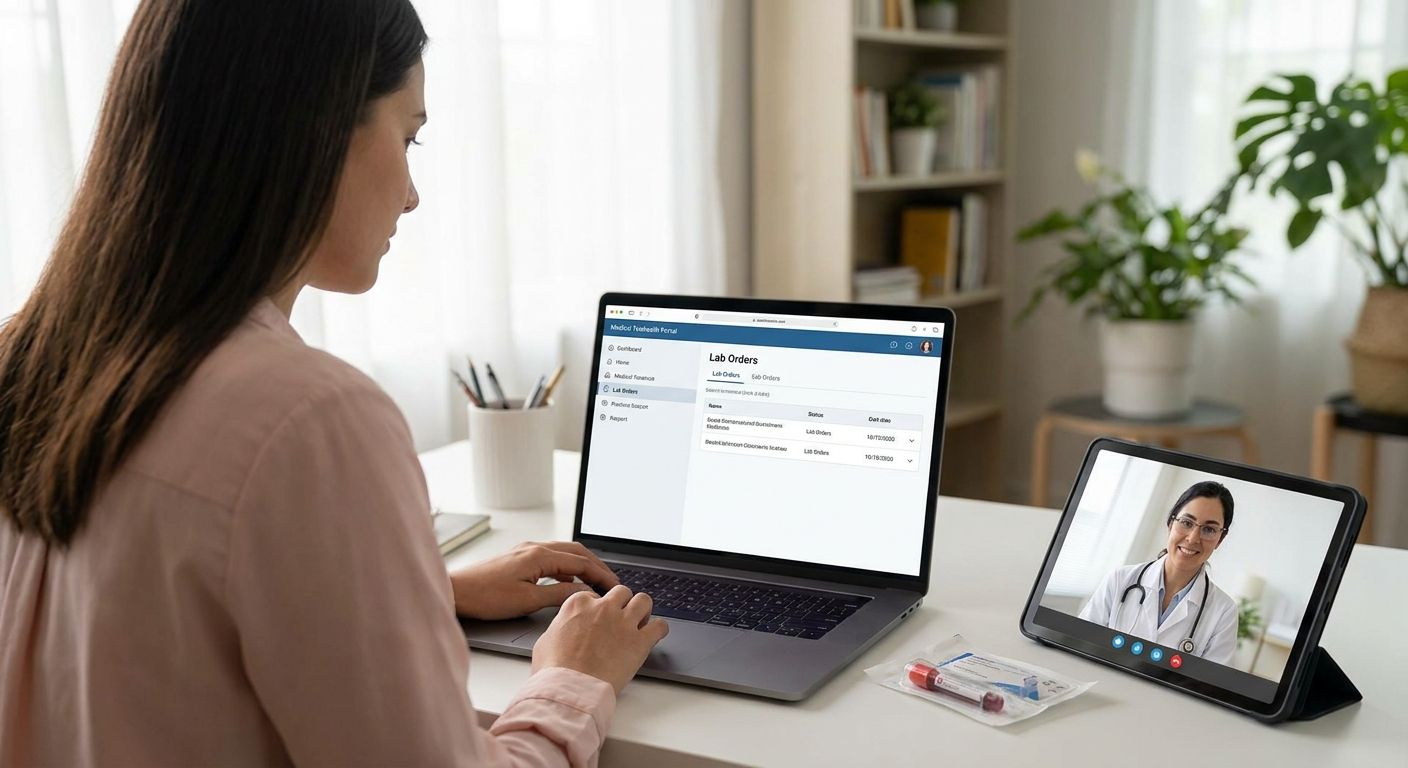
Getting bloodwork done without sitting in a lab waiting room sounds simple until you try to find a telehealth service that actually orders the right panels, reviews the results with a licensed clinician, and adjusts your treatment based on what comes back. This guide covers who needs telehealth lab work orders, what separates a real provider-guided program from a lab-test vending machine, and which condition-specific pathways build monitoring into the plan itself in 2026.
- Telehealth lab work orders work best for ongoing condition management, not one-off bloodwork requests.
- GLP-1 weight loss, testosterone replacement, and thyroid programs need baseline labs before a clinician prescribes anything.
- Skip any site selling lab tests with no physician review of the results.
- NowCare's GLP-1 programs run as 1- or 3-month plans built around physician-guided, lab-informed dosing.
- The American Diabetes Association recommends an A1C recheck every 3 to 6 months for anyone on a treatment plan.
Why this matters
A lot of "telehealth lab work" marketing is a direct-to-consumer test kit with no clinician attached — you pay, you get a number back, and nobody tells you what to do with it. That's not care, it's data. Real telehealth lab work orders sit inside a treatment relationship: a licensed clinician orders the panel, reads the result against your history, and changes the plan if the numbers say so.
This matters most for conditions where dosing depends on lab values — GLP-1 weight loss medication, testosterone replacement, thyroid management, and diabetes. Order the wrong way and you either get an aggressive prescription with no safety check, or a static maintenance refill nobody is actually watching. Both fail the patient in 2026's crowded telehealth market.
Who this is for
This guide is for adults already managing, or about to start, a condition that requires periodic bloodwork — thyroid disease, low testosterone, type 2 diabetes, or a physician-guided weight loss program — and who want that monitoring handled through NowCare or a comparable provider-guided telehealth platform instead of scheduling separate lab visits and follow-ups. If you just need a single walk-in lab draw for insurance purposes, this isn't your use case — you want a standing relationship with a clinician who reviews results and adjusts care.
What to look for in telehealth lab work orders
A licensed clinician reviews every order
A lab requisition with no physician behind it is just paperwork. The value of telehealth lab work is the review step — a licensed clinician has to look at the number and decide what it means for your dose, your diagnosis, or your next visit.
Baseline labs before any prescription
Any program that starts you on testosterone, a GLP-1 medication, or a thyroid drug without checking baseline values first is skipping a safety step. Baseline labs catch contraindications before they become a problem, not after.
A monitoring cadence, not a one-time draw
Chronic conditions need recurring labs on a schedule — not a single test that gets filed away. The American Diabetes Association recommends an A1C recheck every 3 to 6 months for anyone on active treatment; a telehealth diabetes program that doesn't build that cadence into the plan isn't managing the condition, it's guessing.
State-licensed to order in your state
Lab orders and prescriptions both require the clinician to be licensed where you live, not just where the company is headquartered. Confirm this before you pay for anything — a plan that can't legally order labs in your state is a dead end.
Transparent pricing with no insurance required
Lab work billed through insurance can surface surprise costs weeks later. Telehealth programs that quote one flat, upfront price for the plan including any required labs remove that guesswork entirely.
Secure result delivery
Results need to land somewhere HIPAA-compliant and reviewed, not sent as a plain PDF with no clinician commentary attached. Secure intake and result delivery is table stakes for any legitimate telehealth provider in 2026.
Find the right lab-monitored program
See which NowCare programs build bloodwork into the plan.
Top picks: telehealth pathways that actually order and use labs
GLP-1 weight loss programs — the safest starting point
One spec that matters: NowCare's medical weight loss programs run as 1- or 3-month one-time programs with 1:1 physician guidance, and treatment only proceeds when it's medically appropriate. Baseline metabolic labs are standard practice before starting a GLP-1 medication because they help a clinician confirm the medication fits your health picture. This is the pathway with the most built-in lab logic because dosing decisions depend directly on what the labs show. Verdict: Buy if you're starting a GLP-1 weight loss program — check eligibility through NowCare's GLP-1 qualification guide.
Testosterone replacement therapy — the numbers-driven pick
One spec that matters: clinical guidelines call for two separate morning testosterone draws before a TRT diagnosis is confirmed, because a single low reading isn't reliable on its own. A telehealth TRT program that skips the second draw is cutting a corner that affects your actual diagnosis. Verdict: Buy if the program requires both draws and ongoing hematocrit checks — see telehealth for testosterone replacement therapy for how the visit works.
Thyroid management — the quiet workhorse
One spec that matters: a normal TSH reference range runs roughly 0.4 to 4.0 mIU/L, and dosing adjustments for thyroid medication are made against that range, not against symptoms alone. Thyroid management is a slow-moving condition, but the lab cadence still needs to be consistent — skipping rechecks means dosing drifts. Verdict: Buy for anyone already on thyroid medication who wants recheck labs without a specialist referral — details at telehealth for thyroid management.
Diabetes management — the highest-stakes monitoring
Diabetes management through telehealth depends entirely on the A1C cadence mentioned above — a 3 to 6 month recheck window that catches drift before it becomes a complication. This pathway carries the most risk if monitoring lapses, so verify the recheck schedule is explicit before enrolling. Verdict: Consider, and confirm the cadence in writing before you commit.
What to avoid
- Direct-to-consumer lab kits with no clinician attached. You get a number, not a diagnosis or a plan — that's not telehealth lab work, that's a mail-order test.
- Programs that prescribe before baseline labs come back. If a site lets you start testosterone, a GLP-1 medication, or thyroid treatment before any lab is drawn, that's a red flag, not a shortcut.
- One-time "lab order" services with no follow-up visit. A number with no clinician interpretation and no next step is close to useless for a chronic condition.
Verdict comparison
| Pathway | Baseline labs required | Recheck cadence | Verdict |
|---|---|---|---|
| GLP-1 weight loss | Metabolic panel before start | Per program length (1 or 3 months) | Buy |
| Testosterone replacement | Two morning testosterone draws | Ongoing hematocrit checks | Buy |
| Thyroid management | TSH, free T4 | Periodic recheck against 0.4-4.0 mIU/L range | Buy |
| Diabetes management | A1C, fasting glucose | Every 3-6 months (ADA) | Consider |
FAQ
Can a telehealth doctor order bloodwork in 2026?
Yes, a licensed telehealth clinician can order bloodwork as long as they're licensed in your state. The order routes to a local lab or draw site, and results go back to the clinician for review before any treatment decision.
What is the best telehealth option for ongoing lab monitoring?
The best option is a condition-specific program that builds lab rechecks into the plan itself, such as GLP-1 weight loss, testosterone replacement, or thyroid management. A one-time lab test with no clinician review isn't a substitute for ongoing monitoring.
Do I need insurance for telehealth lab work orders?
No, many telehealth programs quote one flat price that covers the visit and any required labs, with no insurance required. Confirm this upfront since coverage and out-of-pocket costs vary by provider.
How often do I need bloodwork for a GLP-1 weight loss program?
Baseline labs typically happen before starting the medication, with rechecks depending on the length of the program. NowCare's GLP-1 programs run as 1- or 3-month plans with 1:1 physician guidance built around that timeline.
Is telehealth bloodwork HIPAA compliant?
A legitimate telehealth provider uses secure, HIPAA-compliant intake and result delivery, meaning your lab results aren't emailed as plain attachments. Confirm this before you share any health information with a new platform.
How many testosterone tests do I need before starting TRT?
Clinical guidance calls for two separate morning testosterone draws before confirming a low-testosterone diagnosis. A single reading isn't considered reliable enough to start treatment on its own.
What TSH range is considered normal for thyroid monitoring?
A normal TSH range generally falls between 0.4 and 4.0 mIU/L, though your clinician may target a narrower range depending on your history. Thyroid medication dosing is adjusted against this range over time.
How often should A1C be rechecked for diabetes management?
The American Diabetes Association recommends rechecking A1C every 3 to 6 months for patients on active treatment. A telehealth diabetes program without that cadence built in isn't managing the condition closely enough.
One last thing
The programs that treat lab work as a gate, not a formality, are the ones worth paying for in 2026 — a baseline test before the first prescription and a recheck on a real schedule tells you the clinician on the other end is actually reading the numbers. If a telehealth site can't tell you when your next lab is due, that's the question to ask before you enroll, not after.


