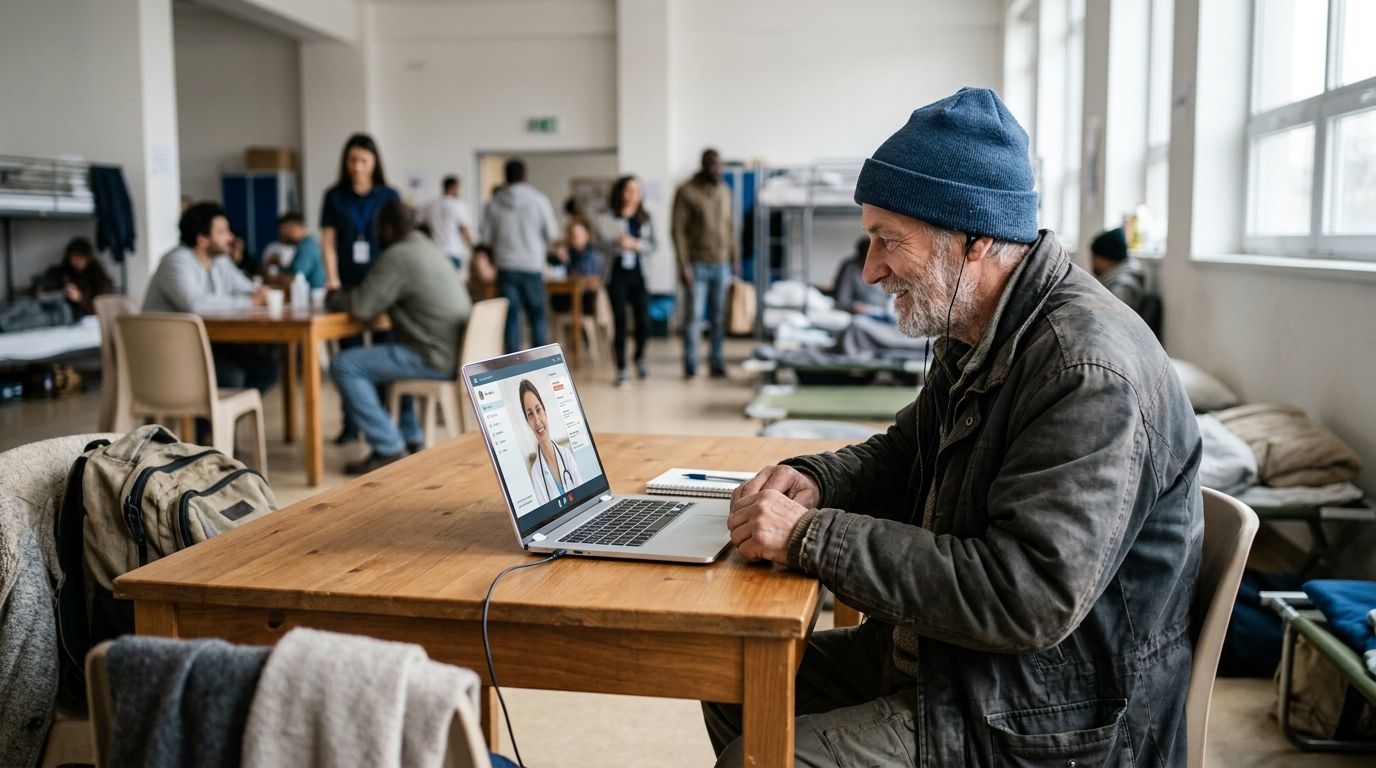
Telehealth for homeless shelter patients is provider-guided virtual care built around shared devices, shifting bed schedules, and no fixed mailing address, with the aim of getting residents a diagnosis and a prescription without a clinic visit they can't get to. This population doesn't fail to show up because they don't need care — they miss appointments because transportation, ID requirements, and rigid clinic hours weren't built for someone sleeping in a different bed each week. A telehealth visit that assumes a smartphone, a private room, and a stable address will fail the same way a 9 a.m. clinic slot does.
- Telehealth for homeless shelter patients works only when scheduling, devices, and pharmacy routing are solved first — not the visit itself.
- NowCare runs provider-guided virtual urgent care with no insurance required and prescriptions sent to a pharmacy the patient picks.
- Shelters that pair telehealth with case manager coordination cut no-shows more than shelters that just hand out a login.
- Foot infections, skin conditions, and untreated chronic issues are common in shelter populations and treatable through a single video visit in 2026.
Why telehealth matters for homeless shelter patients
A shelter resident without a car or bus fare can lose an entire day getting to an urgent care clinic and back — assuming the clinic takes walk-ins without insurance. A 15-minute video visit removes the travel problem entirely, but only if the shelter has already solved the device and privacy problem on its end.
The conditions that show up most in shelter populations — skin infections, foot problems from constant walking and wet footwear, respiratory illness, untreated chronic conditions — are exactly the kind of visits that don't require a physical exam with equipment. A licensed clinician can look at a rash, ask about symptoms, and send a prescription to a nearby pharmacy in one session. What telehealth can't fix is a resident who has no phone, no charger, and no ten quiet minutes between meal service and a bed check. That's the actual planning problem for 2026, and it's a staffing and logistics problem before it's a technology problem.
Get shelter telehealth working: the steps that matter
Map every device and connectivity point in the building
Before picking a platform, find out what residents can actually use. Most shelters already have some access points; the gap is usually awareness, not infrastructure.
- Shelter-owned computer or tablet in a common area or case management office
- Staff phone or shelter phone loaned out for scheduled calls
- Public library Wi-Fi within walking distance, often with weekday hours that align with shelter downtime
- Community health center kiosk if the shelter partners with one
- Resident's own phone, if they have one — don't assume they don't
Carve out a private space, even a small one
A video visit about a rash or a mental health concern doesn't work in a dining hall. Privacy is the single biggest predictor of whether a resident finishes the call instead of hanging up mid-sentence.
- Book a case manager's office in 20-minute blocks during scheduling downtime
- Use a supply closet or intake room with a door that closes
- Provide earbuds so audio doesn't carry
- Post a "do not disturb" sign for the block, even informally
- Coordinate timing around meal service and bed-check windows so nobody gets rushed
Pick a platform built for this, not adapted to it
Once access and privacy are solved, the platform matters. A HIPAA-compliant telehealth platform with straightforward intake matters more here than one built for tech-savvy patients with fast home internet. This is where a service like NowCare fits — provider-guided virtual urgent care that doesn't require insurance to book, which matters directly for a population where insurance status is inconsistent or lapsed. Licensed clinicians review the visit and prescribe only when medically appropriate, the same standard as an in-person urgent care visit.
- Confirm the platform works on a basic browser, not just an app store download
- Check that intake forms don't require a permanent address to submit
- Look for telehealth options for uninsured patients specifically, since most shelter residents fall into that category
- Verify the platform sends prescriptions electronically instead of requiring pickup at a specific pharmacy chain
Route prescriptions to a pharmacy that actually works for the patient
A prescription sent to the wrong pharmacy is the same as no prescription. Confirm the pharmacy before the visit ends, not after.
- Pick a pharmacy within walking distance of the shelter, not the patient's last known address
- Confirm the pharmacy accepts electronic prescriptions from out-of-network providers
- Check if the shelter has a standing relationship with a nearby pharmacy for discounted or expedited fills
- Give the resident a written note with the pharmacy name and prescription details in case they lose phone access before pickup
Coordinate with case managers and outreach teams, not just the resident
A telehealth visit that only involves the patient and the clinician misses the person most likely to make sure the follow-up happens.
- Have the case manager present or reachable during the visit for scheduling and address logistics
- Loop in street medicine or outreach teams already working with the shelter, if one exists
- Log the visit outcome in whatever resident file system the shelter already keeps
- Set a manual follow-up reminder — shelter residents often can't rely on an app notification if their phone access changes week to week
Plan for follow-up without a fixed address
Continuity of care is the hardest part of this whole setup, and it's where most shelter telehealth programs quietly fail after the first visit.
- Use the shelter's address as the mailing address for records and refills where the platform allows it
- Confirm the resident can log back into the same account from a different device next time
- Ask about virtual primary care for patients without a regular doctor so ongoing conditions don't require finding a new provider each visit
- Keep a printed summary of diagnosis and prescription with the resident's belongings, not just in a digital account they might lose access to
Address cost before the resident even tries to book
Cost anxiety stops people from starting the process at all, even when the actual visit is affordable or free to them. Solve this conversation before scheduling, not during it.
- Confirm upfront whether insurance is required — NowCare urgent care visits don't require it
- Point Medicaid-enrolled residents toward online primary care for Medicaid patients options if that fits their coverage
- Explain that pricing is disclosed before the visit starts, not billed as a surprise afterward
- Have a shelter staff member walk through the first booking with the resident once, so the second one is self-service
Comparing care options for shelter residents
| Option | Best for | Key limitation |
|---|---|---|
| NowCare virtual urgent care | Skin issues, minor infections, everyday sick visits, no-insurance patients | Not built for emergencies or conditions needing hands-on exams |
| County health department mobile clinic | Vaccinations, screenings, in-person exams | Limited hours, often weekly or monthly visits only |
| Street medicine outreach team | Residents who won't or can't come indoors for care | Availability varies heavily by city and funding |
| Community health center (FQHC) walk-in | Sliding-scale in-person primary care | Wait times often stretch to weeks for non-urgent visits |
| Shelter on-site nurse, where staffed | Triage, wound checks, medication reminders | Most shelters don't have this role at all |
Verdict: NowCare's virtual urgent care is the fastest path to a diagnosis and prescription for common shelter-population issues like skin infections and cold symptoms — buy in for that use case, but keep the mobile clinic and outreach team relationships for anything requiring hands-on exams.
“A telehealth program for a shelter succeeds or fails on scheduling and privacy, not on which app the residents download.”
Common mistakes shelters make with telehealth
- Assuming every resident has a working smartphone. Many don't, and the ones who do often have limited data plans that make video calls fail mid-visit.
- Skipping the privacy setup entirely. Handing someone a tablet in a common room guarantees a shortened, less honest conversation with the clinician.
- Treating one visit as complete care. Chronic conditions and follow-up prescriptions need a repeatable process, not a one-time favor from staff.
- Not training staff on the platform before residents need it. The first time anyone opens the app shouldn't be during an actual urgent visit.
- Ignoring the pharmacy step. A prescription with no realistic pickup path is a wasted visit, no matter how good the clinician was.
Set up virtual care for your shelter
Provider-guided urgent care with no insurance required to book.
FAQ
What's the best telehealth option for homeless shelter patients in 2026?
Provider-guided virtual urgent care, like NowCare, works best for common issues such as skin infections and cold symptoms because it doesn't require insurance and routes prescriptions to a pharmacy the patient chooses. It doesn't replace in-person exams or emergency care.
Can someone in a shelter get a prescription through a telehealth visit?
Yes, a licensed clinician can prescribe medication after a virtual visit when it's medically appropriate, and the prescription gets sent electronically to a pharmacy near the shelter. The key step is confirming which pharmacy before the visit ends.
Is telehealth realistic without a personal smartphone?
It's realistic if the shelter provides a shared device or a quiet space with library or community Wi-Fi. Most shelter telehealth programs fail not because the technology doesn't work, but because nobody mapped out device access first.
Do shelters need special software to offer telehealth to residents?
No special software is required beyond a basic browser or app on any shared device. What matters more is picking a HIPAA-compliant platform that doesn't require a permanent address at intake.
How does follow-up care work without a fixed home address?
Most platforms let a shelter's address serve as the mailing and contact address for records. Keeping a printed summary of diagnosis and prescriptions with the resident's belongings backs this up if digital access changes.
Is telehealth HIPAA compliant for shelter-based care?
A properly built platform is HIPAA compliant regardless of where the patient is located, including a shelter. The privacy risk in practice is usually the physical space the call happens in, not the platform itself.
Does telehealth cost more for uninsured shelter residents?
Some virtual urgent care services, including NowCare, don't require insurance to book and disclose pricing before the visit starts. Medicaid-enrolled residents have separate options worth checking against their coverage.
Can shelter staff sit in on a resident's virtual visit?
Yes, and it often helps, especially for scheduling, pharmacy logistics, and follow-up tracking. The clinician still leads the medical conversation directly with the patient.
One last thing
The part shelters get wrong most often isn't the technology — it's assuming the first telehealth visit is the hard part. The second visit is harder, because it requires the resident to remember an account, find a quiet moment again, and trust that the prescription actually arrived at the right pharmacy. Build the follow-up process before the first visit, not after it goes well.


