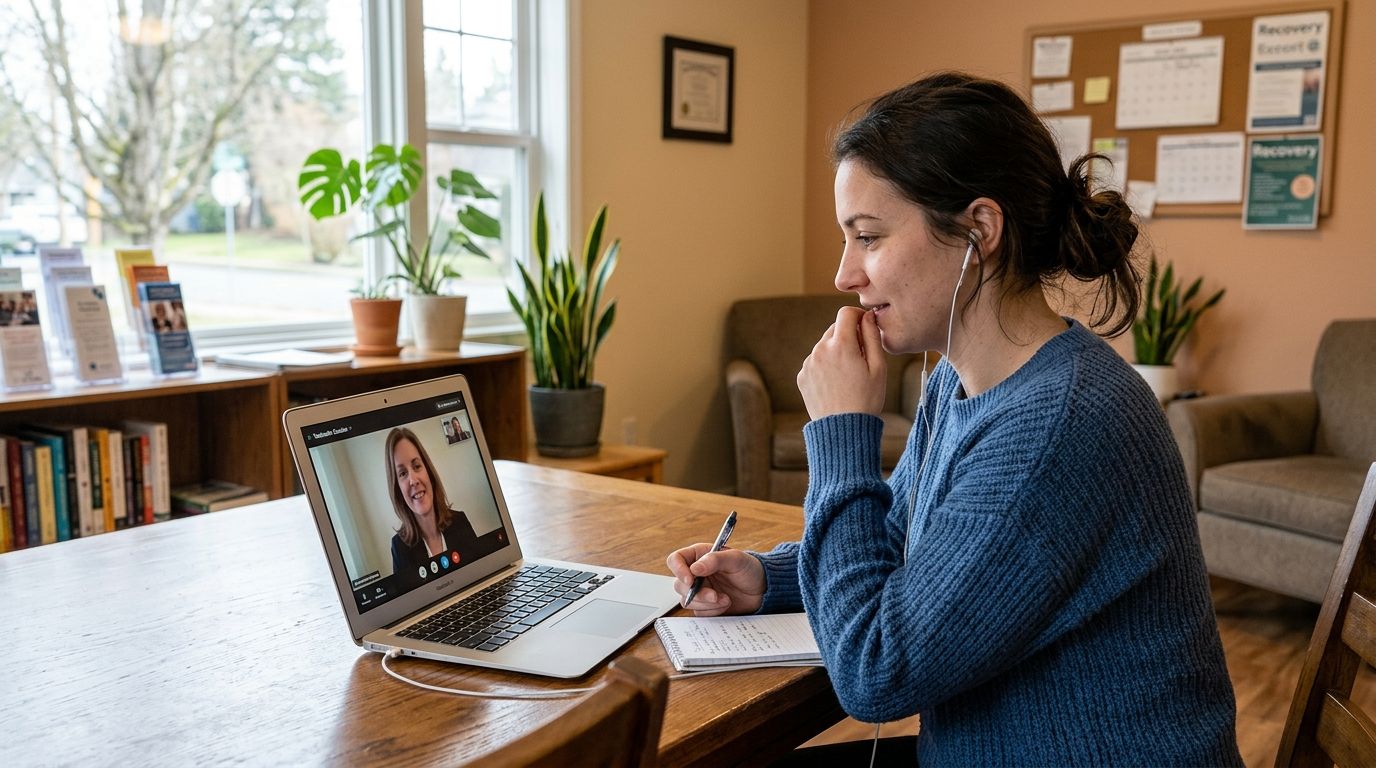
Telehealth for sober living residents is remote, provider-guided medical care that lets people in addiction recovery housing see licensed clinicians from a phone or laptop instead of arranging transportation, taking a bed out of rotation, or missing house programming. Early recovery comes with its own constraints — curfews, shared cars, limited insurance, and a house policy that may restrict certain medications — so the visit has to work around the house, not against it.
- Telehealth for sober living residents works best for non-controlled prescriptions, follow-ups, and skin issues that don't need a physical exam.
- NowCare offers provider-guided virtual urgent care that fits around house curfews and meeting schedules in 2026.
- Federal telehealth rules still limit remote prescribing of many controlled substances, so ask any platform this before booking.
- House staff coordination matters more than platform features — confirm your recovery house's telehealth policy before your first visit.
Why telehealth matters for residents of addiction recovery housing
Most recovery houses run on a fixed schedule: house meetings, curfews, shared transportation, and often a house manager who signs off on outside appointments. A traditional doctor visit means requesting time off the schedule, coordinating a ride, and explaining an absence to staff or roommates. A telehealth visit takes 15 to 30 minutes from a private room in the house.
The bigger issue is continuity. People in sober living often lose their prior doctor when they change housing, cities, or insurance status. Telehealth closes that gap by giving residents a consistent, provider-guided point of contact for physical and mental health instead of starting over with a new in-person provider every time housing changes.
Stigma plays a role too. A resident managing anxiety, insomnia, or a skin infection may not want to explain the recovery house address to a walk-in clinic receptionist. A video visit keeps that detail out of the conversation entirely.
How to set up telehealth as a sober living resident
Confirm your house's telehealth policy first
Most licensed recovery houses have rules about outside appointments, device use, and medication storage. Check these before booking anything.
- Ask whether the house requires staff notification before a virtual visit
- Find out if there's a quiet, private room available during common visit hours
- Confirm whether medications go to the resident directly or through a house manager
- Check the house's policy on controlled substances, since most sober living programs restrict them regardless of what a provider prescribes
- Ask if the house Wi-Fi supports video calls, or if you'll need a phone hotspot
Set up a private, secure intake
A telehealth visit only works if the resident can speak freely. Shared living space makes this harder than it sounds.
- Book appointments during hours when common rooms are empty
- Use headphones so conversations aren't overheard
- Complete intake forms on a personal device, not a shared house computer
- Confirm the platform is HIPAA compliant with secure intake before entering any health history
- Save the visit confirmation and after-visit summary somewhere private, not a shared house binder
Match the request to what's appropriate for early recovery
Not every complaint needs a telehealth visit, and not every telehealth visit ends in a prescription. Licensed clinicians review each case and treat only when medically appropriate — that's how NowCare operates, and it's the standard worth demanding from any platform.
- Skin issues (rashes, athlete's foot, minor infections) are common telehealth candidates
- Anxiety, low mood, and sleep issues can often be managed with non-controlled medication plus follow-up visits
- Chronic conditions like high blood pressure or diabetes can be monitored remotely between in-person checks
- Pain complaints get more scrutiny in early recovery, since some standard pain medications aren't appropriate
- Anything requiring a physical exam, imaging, or a lab draw gets referred out, not handled on video
Handle prescriptions the safe way
This is where sober living residents hit the most confusion, and it's worth getting right before the visit, not after.
- Ask upfront whether the provider can prescribe non-controlled medications for anxiety, sleep, or mood
- Understand that federal telehealth rules limit remote prescribing of many controlled substances — this applies across platforms, not just one
- Confirm which pharmacy the house allows residents to use, since the Rx is sent to a pharmacy of your choosing
- Ask about alternatives if a first-choice medication is a controlled substance the house prohibits
- Keep a saved copy of every prescription in case house policy requires staff review
Residents managing substance use disorder alongside daily medical needs should know that dedicated support exists separately from a general visit — see telehealth for alcohol use disorder support and telehealth for opioid use disorder treatment support for how those visits typically work.
Loop in house staff without oversharing
House staff usually need to know that a resident has an appointment, not what the appointment is about.
- Share the appointment time, not the diagnosis, unless house policy requires more
- Ask the provider for a general after-visit note if the house requires proof of attendance
- Keep medication logistics separate from clinical details
- Clarify who at the house, if anyone, needs copies of prescriptions
Plan around insurance gaps
Many residents enter sober living without active insurance, between jobs, or mid-transition on Medicaid. Transparent, one-time pricing avoids the surprise-bill problem that stops people from seeking care at all in 2026. NowCare requires no insurance for a visit.
- Ask for the total visit cost before booking, not after
- Confirm whether care is billed per visit or as a plan covering a set period
- Check whether the platform requires insurance at all, since some models don't
- Ask what happens if a follow-up is needed — new charge or included
Comparing care options for sober living residents
| Option | Best for | Key limitation |
|---|---|---|
| House manager or in-house check-in | Basic wellness checks, medication reminders | Not a licensed clinician; can't diagnose or prescribe |
| County or sliding-scale clinic | Uninsured residents needing hands-on exams | Long wait times, transportation required |
| Telehealth visit (NowCare model) | Non-controlled prescriptions, skin issues, anxiety and sleep management, follow-ups | Can't handle exams requiring hands-on assessment or most controlled substances |
| Peer support meeting or sponsor check-in | Emotional support, accountability | Not a substitute for medical or psychiatric care |
The clearest verdict for most sober living residents in 2026: use telehealth for everyday medical needs and non-controlled prescription management, and keep an in-person referral path open for anything requiring a physical exam or a controlled substance.
Book a provider-guided visit
Licensed clinicians review every plan before any prescription is sent. No insurance required.
Common mistakes sober living residents make with telehealth
- Assuming any platform can prescribe anything. Most can't touch controlled substances without an in-person exam first, and learning that mid-visit wastes the appointment.
- Booking during a house meeting or curfew window. Visits get rushed or interrupted, and no clinician can do a thorough intake in five minutes.
- Skipping the house policy check. A resident books a visit, gets a prescription, then finds out the house won't allow that medication on-site.
- Using a shared device for intake forms. Health history left logged in on a common computer is a real privacy risk in a shared house.
- Treating telehealth as a replacement for addiction treatment. It's maintenance care for physical and mental health alongside recovery programming, not a substitute for it.
FAQ
Can telehealth providers prescribe medication to sober living residents?
Yes, for non-controlled medications, after a licensed clinician reviews the case and determines treatment is appropriate. Controlled substances are restricted under federal telehealth rules, which applies to every platform, not just one.
Is telehealth for sober living residents private?
A HIPAA-compliant platform with secure intake keeps visit details between the resident and the provider. House staff typically only see what the resident chooses to share, unless house policy requires more.
What conditions can telehealth actually treat for someone in recovery housing?
Skin issues, minor infections, anxiety and sleep concerns, chronic condition monitoring, and prescription follow-ups are the common ones. Anything needing a physical exam, imaging, or a controlled substance gets referred to in-person care.
Do sober living residents need insurance to use telehealth?
No. NowCare requires no insurance and uses transparent one-time pricing, which matters because many residents enter sober living mid-transition on coverage.
How does a recovery house find out about a resident's telehealth visit?
Only what the resident shares or house policy requires, which is usually the appointment time rather than clinical details. Medication logistics are often the only piece house staff need to coordinate.
Can telehealth help with anxiety or insomnia during early recovery?
Yes, non-controlled medication options and follow-up visits are common telehealth uses for anxiety and sleep issues in 2026. A licensed clinician reviews the case first and treats only when medically appropriate.
What is the biggest limitation of telehealth for this group?
Controlled substance restrictions under federal telehealth rules are the main limitation, alongside anything requiring a hands-on physical exam. Both route to in-person care.
How long does a telehealth visit take for a sober living resident?
Most visits run 15 to 30 minutes including intake. That fits inside a typical house free-time window without disrupting meetings or curfew.
One last thing
The detail most residents miss until it costs them an appointment: federal telehealth rules on controlled substances have not loosened as much as marketing copy implies in 2026. Ask any platform directly whether a specific medication can be prescribed remotely before you book, not after. That one question saves a wasted visit and a house policy conflict.


