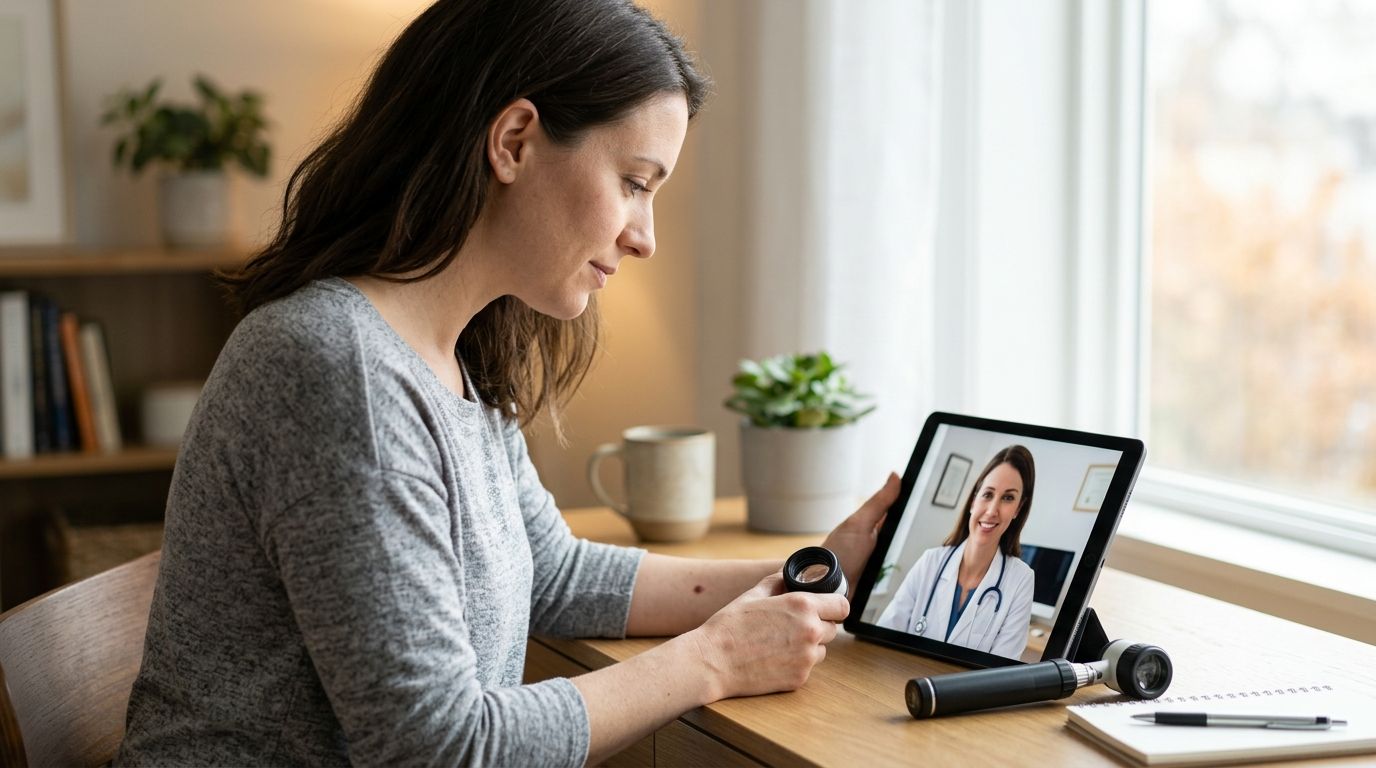
Mole check telehealth turns a new or changing mole into a same-day virtual triage instead of a multi-week wait for a dermatology appointment. A licensed clinician reviews your photos, asks about the ABCDE warning signs, and tells you whether you need an in-person biopsy now, a scheduled specialist referral, or nothing at all. Skin tags get the same first look, but the questions a clinician asks differ because skin tags rarely carry cancer risk while moles sometimes do.
- Mole check telehealth through NowCare screens new or changing moles and skin tags by photo review — best for fast triage, not diagnosis.
- A mole over 6mm, asymmetric, or changing color usually needs in-person biopsy — telehealth can't take a tissue sample.
- Telehealth mole check visits work well for benign-looking skin tags and routine monitoring, not confirmed melanoma cases.
- Request a specialist referral through telehealth once a clinician flags a mole as suspicious for biopsy.
Why mole check telehealth matters in 2026
Most new moles are harmless, and most skin tags are just skin tags. The problem is that the visual signs separating a benign spot from an early melanoma are subtle: asymmetry, an irregular border, more than one color in the same lesion, a diameter over 6mm, and evolution in size or shape over a few months. That's the ABCDE checklist dermatologists have used for decades, and it translates well to a photo.
Dermatology practices in most metro areas book new-patient visits weeks out in 2026, and a mole that's been changing doesn't pause while you wait for an opening. Mole check telehealth exists to close that gap — a clinician looks at your photos within a single visit and tells you whether the wait is safe or whether you need to move faster.
Skin tags create a different kind of anxiety: people worry a benign growth is actually a mole, or that removal requires surgery. A telehealth visit answers that question in minutes instead of leaving it open until a dermatology slot opens up.
Photograph the mole or skin tag correctly
A clinician can only judge what the photo shows, so the setup matters more than people expect.
- Use natural daylight, not a flash, which washes out true color
- Include a coin or ruler in one shot for scale
- Take one close-up and one wider shot showing surrounding skin
- Re-photograph from the same angle and distance each time you're tracking change
- Avoid filters or auto-enhance features on your phone's camera app
Track changes over time
A single photo tells a clinician what the mole looks like today. A log tells them what's changing.
- Keep a simple dated log with photo timestamps
- Note itching, bleeding, tenderness, or crusting
- Record when the mole first appeared, if you remember
- Watch for new "satellite" spots near the original mole
- Note any family history of melanoma or skin cancer
Request a telehealth skin review
Once you have photos and a timeline, book a Virtual Urgent Care visit for skin conditions and acne through NowCare, which covers skin and hair concerns under provider-guided review. This is the faster path once you've done the photo work above — it's not a substitute for it.
- Have your dated photos ready to upload
- Write a one-line symptom timeline before the visit
- List current medications and any prior skin cancer history
- Note whether the spot bleeds, itches, or has changed shape recently
- Prepare two or three specific questions for the clinician
Get a referral to a specialist when needed
If a clinician flags a mole as suspicious, the next step is a specialist referral, not more monitoring at home.
- Ask for a written referral you can take to a dermatologist
- Confirm which local dermatologist has the fastest new-patient opening
- Request your telehealth photos and notes be sent ahead of the appointment
- Ask directly whether the plan is a shave biopsy, punch biopsy, or full excision
- Clarify who follows up with you once pathology results are back
NowCare's referral to a specialist through telehealth process exists specifically for this handoff — a clinician documents findings so the in-person dermatologist isn't starting from zero.
Know what telehealth can't do
Be honest with yourself about the limits before you rely on a virtual visit for a serious concern.
- It can't take a tissue sample or biopsy the lesion
- Most setups don't include dermoscopy, the magnified skin exam dermatologists use in person
- It can't rule out melanoma with certainty from a photo alone
- It can't remove a mole or skin tag remotely
- It's not a substitute for an annual in-person skin check if you're high-risk
Follow up after a biopsy or referral
A referral only helps if you act on it.
- Schedule the biopsy within the window your clinician recommends
- Ask how long pathology turnaround typically takes at that lab
- Request results be logged with your telehealth record
- Ask what happens next if the result comes back atypical
- Keep the referring clinician updated once you have an answer
Know when to skip telehealth entirely
Some situations need an in-person visit first, no photo review in between.
- The lesion is bleeding heavily or won't stop weeping
- It's ulcerated or has an open sore that isn't healing
- It grew visibly larger over days, not months
- It's on the scalp, genitals, or somewhere hard to photograph clearly
- You have a personal history of melanoma
Comparing your options for a mole or skin tag check
| Option | Best for | Key limitation | Verdict |
|---|---|---|---|
| Telehealth mole check (NowCare Virtual Urgent Care) | Quick triage on a new or slow-changing mole or skin tag | Can't biopsy or use dermoscopy remotely | Use first |
| In-person dermatologist | Confirmed suspicious lesions needing biopsy | Multi-week new-patient wait in many areas in 2026 | Book after telehealth flags it |
| Urgent care walk-in | Bleeding, painful, or rapidly changing lesions same day | Rarely staffed with dermatology-trained clinicians | Use for urgent symptoms only |
| At-home monitoring only | Stable, long-standing moles with no ABCDE signs | No professional check means early changes can go unnoticed | Skip once the mole starts changing |
Mole check telehealth is best for people who need a fast answer on whether a spot is worth worrying about — it's not the right tool for a lesion that's already bleeding, ulcerated, or growing by the day.
Get a skin concern reviewed today
Provider-guided visits cover moles, skin tags, and other skin concerns online.
Common mistakes people make with mole check telehealth
- Waiting for the mole to "get worse" before booking anything — early evaluation is the point, not a last resort
- Using a mole-checking phone app as the final word instead of a clinician review
- Photographing in dim light or with flash, which hides the color changes a clinician needs to see
- Treating a skin tag and a mole as the same question — removal criteria and cancer risk differ between them
- Skipping the in-person biopsy after telehealth flags a mole as suspicious, then re-monitoring at home instead
FAQ
What is mole check telehealth?
Mole check telehealth is a virtual visit where a licensed clinician reviews photos of a mole or skin tag and decides whether it needs an in-person biopsy, a specialist referral, or no action. It works as a first triage step, not a final diagnosis.
Can a telehealth visit diagnose skin cancer?
No. Telehealth can flag a mole as suspicious based on photos and symptoms, but confirming skin cancer requires an in-person biopsy read by a pathologist. Telehealth speeds up getting to that biopsy, it doesn't replace it.
How much does a mole check telehealth visit cost?
Cost depends on the specific visit type and plan, so check current pricing directly on the provider's site before booking. Most telehealth skin visits are priced as a flat one-time fee rather than billed per test.
Is a skin tag ever dangerous enough to need a mole check?
Skin tags themselves are almost always benign, but a spot that looks like a skin tag can sometimes be a mole or growth worth a second look. If it changes color, bleeds, or grows quickly, treat it like a mole concern, not a routine skin tag.
How fast can I get a mole check telehealth appointment compared to a dermatologist?
Telehealth visits are typically same-day, while new-patient dermatology appointments often book weeks out in most areas in 2026. Telehealth doesn't replace the dermatologist visit for a confirmed suspicious mole, it moves you toward that referral faster.
What size mole should be checked by a doctor?
A mole larger than 6mm across, roughly the size of a pencil eraser, is one of the five ABCDE warning signs dermatologists screen for. Size alone isn't diagnostic, but it's a reason to get the mole looked at rather than wait.
Can telehealth refer me directly to a dermatologist for biopsy?
Yes. A telehealth clinician can issue a written referral and send your photos and notes ahead so the in-person dermatologist isn't starting from scratch. That's the main value of doing the telehealth step first.
One last thing
Most melanomas are first noticed by patients themselves, not caught during a routine clinical exam — which is exactly why the photo-tracking habit matters more than the visit itself. The mole you keep meaning to photograph next week is the one worth photographing today, especially if it's already changed once. A single telehealth visit only works if you show up with the timeline that makes the change visible.


