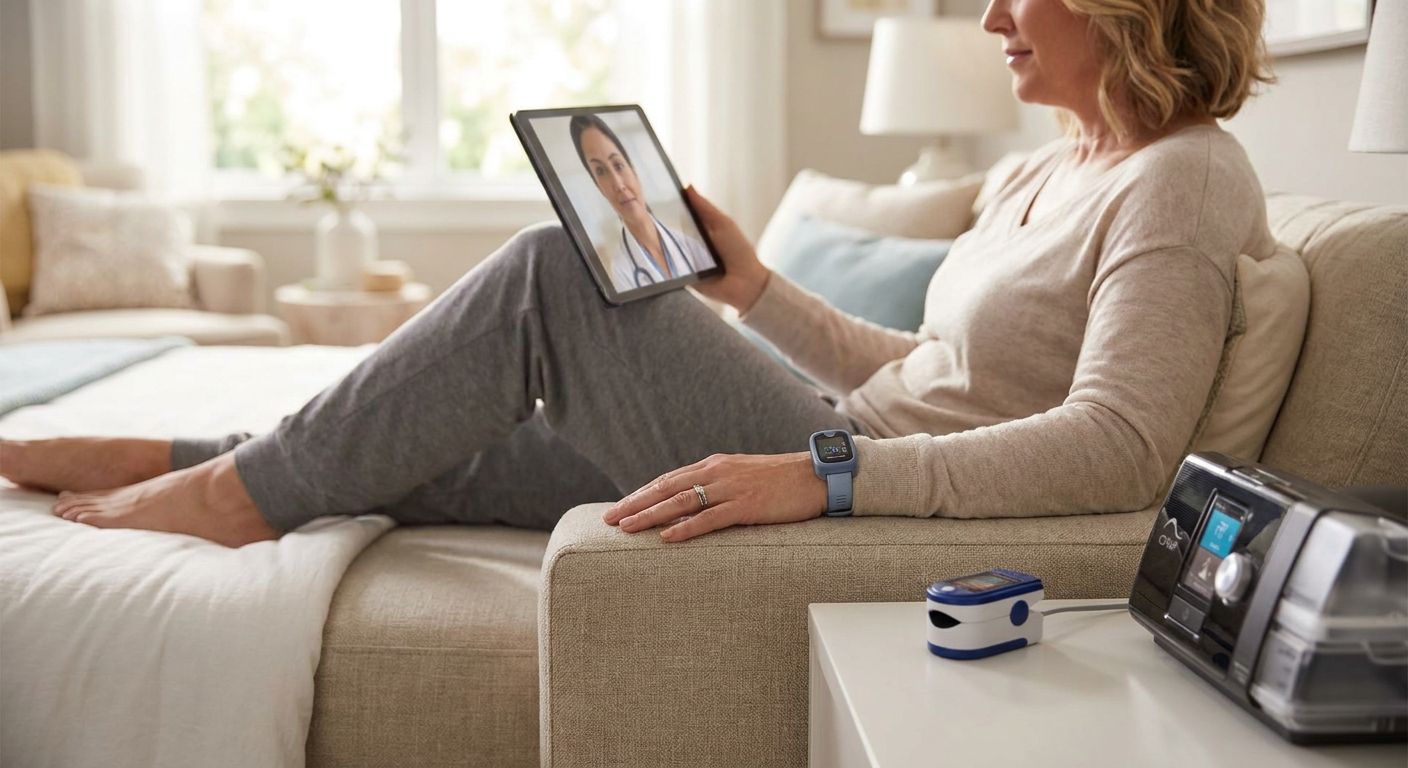
Telehealth sleep apnea screening lets you complete a symptom questionnaire and a video visit before you ever set foot in a sleep lab, and in many cases it routes you toward a home sleep apnea test (HSAT) instead of an overnight facility stay. The pathway that matters most is the one with a licensed clinician reviewing your results, not the one with the flashiest app.
- Telehealth sleep apnea screening in 2026 starts with a validated questionnaire and a video visit, not a device shipped to your door.
- Weight is the biggest modifiable risk factor for obstructive sleep apnea (OSA) — a provider-guided GLP-1 program addresses that directly. Consider it.
- Skip any screening tool that hands you an AHI number with no licensed clinician reviewing it.
- Patients managing hypertension, diabetes, or Medicare-age risk need ongoing primary care after a screen, not a one-time test.
Why this matters
Obstructive sleep apnea doesn't announce itself the way a sore throat does. Snoring, morning headaches, and daytime fatigue get written off as "just getting older" for years before anyone orders a test. Telehealth closes that gap by putting a screening conversation one video visit away instead of a months-long wait for a sleep clinic referral.
The catch in 2026 is that "telehealth sleep apnea screening" gets used loosely. Some platforms are genuinely provider-guided, walking you through a questionnaire, a clinician review, and a referral for testing. Others are little more than a mail-order gadget with a login screen attached. Knowing the difference before you hand over a credit card matters more than the marketing copy on either one.
Who telehealth sleep apnea screening is for
This is for adults who snore loudly, wake up gasping, feel exhausted no matter how many hours they sleep, or have been told by a partner they stop breathing at night. It's also for people carrying known risk factors — excess weight, high blood pressure, a thick neck circumference, or a family history of OSA — who want a starting point before committing to an in-lab polysomnography study. If you already have a diagnosed severe case with cardiac or respiratory complications, telehealth screening is not a substitute for in-person specialist care; it's a triage step, not the endpoint.
Patients managing weight-related risk get an added angle here. A telehealth weight loss program with 1:1 physician guidance addresses the single biggest modifiable driver of OSA severity, which makes it a reasonable parallel track for anyone screening positive.
What to look for in telehealth sleep apnea screening
A validated screening questionnaire before any test ships
A legitimate pathway asks structured questions — snoring, tiredness, observed apneas, blood pressure, BMI, age, neck size, gender (the STOP-BANG model) — before recommending anything. If a site skips straight to "order your home sleep test now" with no intake, that's a red flag, not a shortcut.
Licensed clinician review, not just an app score
An algorithm that spits out a risk percentage is not a diagnosis. The screening only has clinical value if a licensed clinician reviews your questionnaire and, if applicable, your test data before recommending next steps. This is the difference between provider-guided care and a wellness gadget.
A real path to a home sleep apnea test or lab referral
Screening exists to answer one question: do you need a diagnostic test, and which kind? A telehealth platform worth using either facilitates an HSAT order through a clinician or refers you out to a sleep lab for in-lab polysomnography when your risk profile calls for it — severe cardiopulmonary disease, for example, usually needs the lab, not the mail-order kit.
Coordination with weight and chronic-condition management
OSA rarely travels alone. It clusters with obesity, type 2 diabetes, and hypertension. A pathway that connects screening to ongoing chronic condition management gets you further than a one-off test result sitting in an inbox.
Follow-up scheduled after diagnosis, not a one-time screen
A positive screen or a confirmed AHI reading is the start of care, not the finish line. Ask whether the service schedules a follow-up visit to discuss results and next steps (CPAP referral, oral appliance, weight management) or whether you're left to interpret a PDF on your own.
Transparent, insurance-optional pricing
Home sleep apnea testing typically runs $150 to $500 out of pocket depending on the device and interpretation fee. Look for a platform that states its pricing upfront instead of routing you through an insurance-verification maze before you see a number.
Top picks: pathways worth starting with
The symptom-first pick. If snoring, insomnia, or nighttime waking is your main complaint and you're not sure yet whether it's OSA, a sleep-issues telehealth visit is the lower-commitment entry point. It gets a licensed clinician looking at your symptoms before you spend money on a test kit. See telehealth for insomnia and sleep issues for that pathway. Consider this first if you haven't had any prior evaluation.
The risk-reduction pick. Weight loss of even 10% of body weight can meaningfully reduce OSA severity in patients carrying excess weight, according to widely cited sleep medicine research. A provider-guided GLP-1 program with 1:1 physician oversight, like the one detailed at how to start a telehealth weight loss program, tackles that risk factor directly rather than just measuring it. Buy in if your BMI and screening questionnaire both point to weight as a driver.
The comorbidity pick. If you're already managing hypertension, diabetes, or another chronic condition alongside suspected OSA, screening in isolation misses the bigger picture. Ongoing primary care for chronic condition management keeps your sleep findings tied to your broader treatment plan instead of siloed in a separate app. Consider this the coordination layer, not a replacement for a sleep specialist when severity is high.
What to avoid
- Devices with no clinician behind them. A pulse-oximeter ring that emails you an "apnea risk score" with no licensed provider reviewing it is a consumer gadget, not a medical screening.
- Skipping the questionnaire step. Any service that lets you buy a home sleep test with zero intake conversation is optimizing for a sale, not a diagnosis.
- One-and-done screening with no follow-up. A confirmed moderate-to-severe AHI reading (15-30+ events per hour) needs a scheduled next visit for CPAP or specialist referral — not a results page and silence.
Address OSA's biggest risk factor
Provider-guided GLP-1 weight loss, 1:1 physician oversight, little to no cost for medication.
Verdict comparison
| Pathway | Entry point | Clinician involved | Best for | Verdict |
|---|---|---|---|---|
| Sleep-issues telehealth visit | Symptom questionnaire + video visit | Yes | First-time screening | Consider |
| GLP-1 weight loss program | Intake + physician review | Yes | Weight-related OSA risk | Buy |
| Chronic condition management | Ongoing primary care visits | Yes | Comorbid hypertension/diabetes | Consider |
| Consumer wearable "apnea score" app | Device purchase only | No | Nobody making a diagnosis | Skip |
FAQ
Can telehealth diagnose sleep apnea?
Telehealth can screen for sleep apnea risk through a questionnaire and clinician visit, and in many cases facilitate a home sleep apnea test, but a formal diagnosis for moderate-to-severe or complicated cases usually still requires in-lab polysomnography or clinician-reviewed HSAT data.
How much does a telehealth sleep apnea screening cost in 2026?
A telehealth screening visit itself is typically a flat consultation fee, while a home sleep apnea test runs $150 to $500 out of pocket depending on the device and interpretation. Costs vary by provider, so confirm pricing before booking.
Is a home sleep apnea test as accurate as an in-lab study?
A home sleep apnea test is generally reliable for detecting moderate-to-severe obstructive sleep apnea in otherwise healthy adults, but it's less sensitive for mild cases or patients with other cardiopulmonary conditions, who usually need an in-lab study instead.
What is a STOP-BANG questionnaire?
STOP-BANG is a validated eight-question screening tool covering snoring, tiredness, observed apneas, blood pressure, BMI, age, neck size, and gender that estimates OSA risk before any testing begins. A higher score signals higher pretest probability of moderate-to-severe OSA.
Does losing weight help sleep apnea?
Weight loss is one of the most effective modifiable interventions for reducing OSA severity in patients carrying excess weight, with even a 10% reduction in body weight producing meaningful improvement in many cases. A provider-guided weight loss program is a reasonable parallel track alongside a formal sleep evaluation.
What AHI score counts as sleep apnea?
An apnea-hypopnea index (AHI) of 5-15 events per hour is generally classified as mild, 15-30 as moderate, and above 30 as severe obstructive sleep apnea. The threshold and treatment recommendation should come from a licensed clinician reviewing your test, not a raw number alone.
Can telehealth prescribe CPAP?
A telehealth provider who reviews a confirmed sleep apnea diagnosis can typically write a CPAP prescription and refer you to a durable medical equipment supplier, though the initial diagnostic test usually needs to happen first through an HSAT or in-lab study.
One last thing
The questionnaire is doing more work than most people give it credit for. A well-built STOP-BANG or similar intake, reviewed by a licensed clinician, catches a meaningful share of moderate-to-severe cases before a single test is ordered — which is exactly why the intake step, not the device, is the part worth scrutinizing when you pick a telehealth sleep apnea screening service in 2026.


