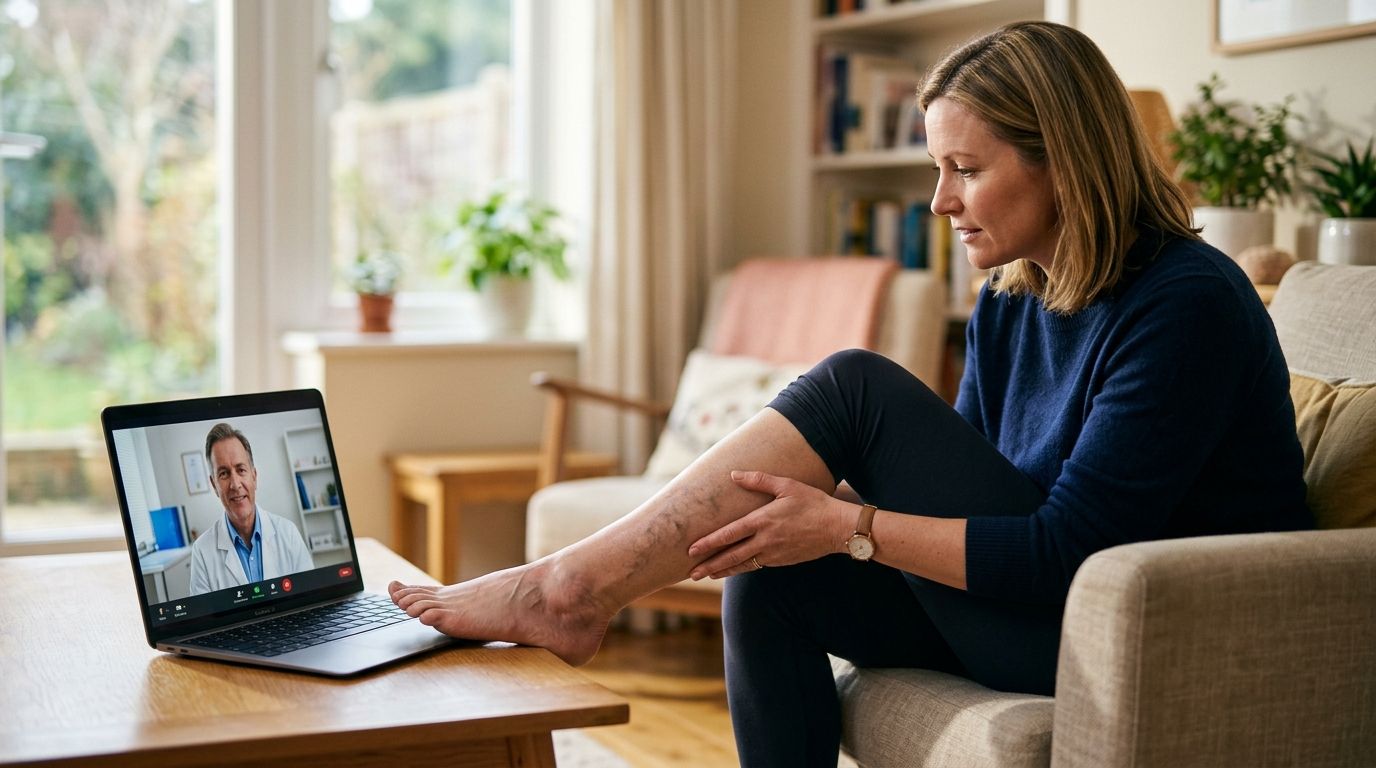
Telehealth for varicose veins and leg swelling evaluation puts a licensed clinician between you and a diagnosis in under a day, sorting garden-variety vein disease from swelling that needs a same-day in-person exam. It won't perform a vein procedure, but it will tell you fast whether you need one.
- Varicose veins telehealth visits triage swelling, skin changes, and pain, then route diagnosed vein disease to an in-person vascular specialist.
- NowCare's virtual urgent care handles leg swelling tied to diabetes or restless leg syndrome, not vein procedures like sclerotherapy or ablation.
- One-leg swelling with redness, warmth, or calf pain needs a same-day in-person visit in 2026 — it can signal a blood clot.
- Compression stockings and leg elevation manage symptoms while you wait on a specialist referral, telehealth or not.
Why varicose veins telehealth matters in 2026
Most leg swelling and visible vein complaints are chronic, not emergencies — until the pattern changes. A telehealth visit answers the sorting question first: manage this at home, book a specialist, or get seen in person today. That triage step is where a restless leg syndrome telehealth visit or a general virtual urgent care visit through NowCare earns its place, especially when the swelling shows up alongside a condition you're already managing.
A clinician reviewing photos, a symptom timeline, and your risk factors can rule out the red flags in minutes. That's faster than most people get an in-person appointment scheduled in 2026, and it costs you nothing if the answer is simply "watch it and follow up."
How to get a varicose veins telehealth evaluation right
Track the swelling pattern before you log on
A clinician works faster with data than with a vague description of "my legs are puffy."
- Photograph both legs at the same time of day, ideally morning and evening
- Note whether the swelling is in one leg or both
- Check if the skin looks shiny, discolored, or feels warm to the touch
- Press a finger into the swollen area for five seconds and note if it leaves a dent (pitting) or bounces back
- Track how the swelling changes after standing, sitting, or lying down
Rule out red flags before you book anything
Some symptoms mean skip telehealth entirely and go in person today.
- Sudden swelling in one leg only
- Calf pain or tenderness, especially when you flex your foot
- Warmth or redness over the swollen area
- Chest pain or shortness of breath alongside the leg swelling
- Fever with the swelling
- An open sore near a varicose vein that isn't healing
If any of these apply, the visit you need is urgent care or the ER, not a scheduled telehealth call.
Log the risk factors that shape your triage
The clinician's questions will move faster if you've already answered them for yourself.
- A job that involves prolonged standing or sitting
- Current or recent pregnancy
- Family history of varicose veins
- A prior blood clot
- Hormone medication or birth control use
- Age over 50
Book the telehealth visit for the non-emergency pattern
Once red flags are ruled out, a virtual urgent care visit is built for the everyday-symptom pattern: mild aching, visible surface veins, swelling that shows up by evening and resolves overnight. NowCare's virtual urgent care runs on secure intake and licensed-clinician review before any guidance or referral goes out, and it doesn't require insurance to book.
- Have your swelling photos and risk-factor list ready before the call
- Expect questions about medications, since several common ones cause ankle swelling as a side effect
- Ask directly whether your pattern fits vein disease, a circulation issue, or something else
- Confirm what happens next — referral, home management, or a follow-up check
Get the right referral out of the visit
A telehealth visit that ends with "see a doctor" isn't a complete visit. Push for specifics.
- Ask whether you need a vascular surgeon, a phlebologist, or a primary care follow-up
- Ask what imaging — usually a venous ultrasound — typically comes first
- Ask if compression garments make sense now or only after diagnosis
- Get the referral or next step in writing before you hang up
Manage symptoms while you wait on that referral
Waiting for a specialist doesn't mean doing nothing.
- Wear graduated compression stockings during the day
- Elevate your legs above heart level when resting
- Keep moving — the calf muscle acts as a pump that helps venous return
- Avoid crossing your legs or standing still for long stretches
- Keep watching for the red-flag list above the entire time you wait
Follow up on the condition actually driving the swelling
Diabetes, thyroid disease, restless leg syndrome, and heart or kidney issues can all show up as leg swelling before they show up as anything else. Treating the underlying condition often shrinks the swelling on its own, and a telehealth diabetes management visit is a reasonable place to start when swelling tracks alongside blood sugar changes.
Comparing your options for varicose veins and leg swelling
| Option | Best for | Key limitation |
|---|---|---|
| Telehealth virtual urgent care | Sorting mild or chronic swelling, ruling out non-emergency causes, managing a related condition | Can't perform vein procedures or physically image the leg |
| In-person vascular specialist / phlebologist | Diagnosed varicose veins needing sclerotherapy, ablation, or surgery | Longer scheduling lead time than a same-day virtual visit |
| Urgent care or ER | Sudden one-leg swelling, redness, warmth, or breathing trouble | Not built for ongoing chronic vein management |
| Primary care office visit | Baseline bloodwork, ultrasound orders, coordinating specialist care | Same-day slots are harder to get than telehealth |
NowCare's virtual urgent care is the right first stop for everyday varicose vein symptoms and swelling tied to a condition you already manage — it is not the visit that treats the vein itself.
“If the swelling is only in one leg and comes with calf pain, that's an emergency visit, not a telehealth booking.”
Not sure which visit type fits your swelling?
Get a same-day answer on podiatrist vs. urgent care before you book.
Common mistakes people make with leg swelling in 2026
- Waiting out one-sided swelling. Assuming it's "just veins" delays a clot diagnosis that needs same-day attention.
- Treating all leg swelling as vein disease. Heart, kidney, thyroid function, and medication side effects cause swelling too, and a telehealth intake is built to sort between them.
- Dropping compression stockings early. People give up on them once the swelling looks better and lose the benefit right when the underlying vein issue is still active.
- Forgetting to list medications. Calcium channel blockers and several diabetes drugs cause ankle swelling, and that detail changes the triage answer.
- Booking a vein specialist before ruling out a clot. Skipping the triage step telehealth is built for wastes the specialist's time and yours.
Diabetic foot swelling is its own category worth flagging separately — if swelling shows up with numbness or slow-healing skin, a diabetic foot care evaluation covers ground a general vein workup won't.
FAQ
Can telehealth diagnose varicose veins?
A telehealth visit can evaluate visible veins, swelling, and skin changes and give you a working diagnosis. Confirming the extent of vein disease usually needs a venous ultrasound ordered as a next step.
Can a virtual doctor treat varicose veins?
No — sclerotherapy, laser ablation, and vein stripping all require in-person procedures. Telehealth handles the evaluation, referral, and symptom management around them, not the procedure itself.
What leg swelling needs emergency care instead of telehealth?
Sudden one-leg swelling with calf pain, warmth, redness, or shortness of breath needs an in-person visit the same day. That pattern can signal a blood clot, and it should never wait for a scheduled virtual appointment.
Does NowCare treat varicose veins directly?
NowCare's virtual urgent care evaluates leg swelling and related symptoms and refers out for vein-specific procedures. It also covers related conditions like restless leg syndrome and diabetic foot health.
What's the difference between varicose veins and edema?
Varicose veins are twisted, enlarged surface veins you can usually see. Edema is fluid buildup under the skin that can occur with or without visible veins and often has a separate cause, like heart or kidney function.
Can restless leg syndrome cause visible veins or swelling?
Restless leg syndrome itself doesn't cause varicose veins, but the two conditions share several risk factors and sometimes overlap in symptoms. That overlap is exactly what a clinician sorts out during intake.
Is leg swelling a sign of diabetes?
Leg and foot swelling can be an early sign of diabetes-related circulation or nerve changes. That's why diabetic foot health checks routinely include a look at swelling patterns, not just the skin and nails.
How much does a varicose veins evaluation cost?
Cost depends on whether imaging, a specialist referral, or a procedure follows the initial visit. Check current visit details directly on the platform you choose rather than assuming one flat number.
One last thing
Unilateral leg swelling with calf tenderness is one of the more reliable bedside signs clinicians use to flag a possible blood clot — it's the single detail worth mentioning first, before you describe anything else, in any 2026 telehealth intake. If swelling doesn't ease after you elevate the leg above heart level and rest, treat that as your cue to get seen in person rather than waiting for the next scheduled slot.


