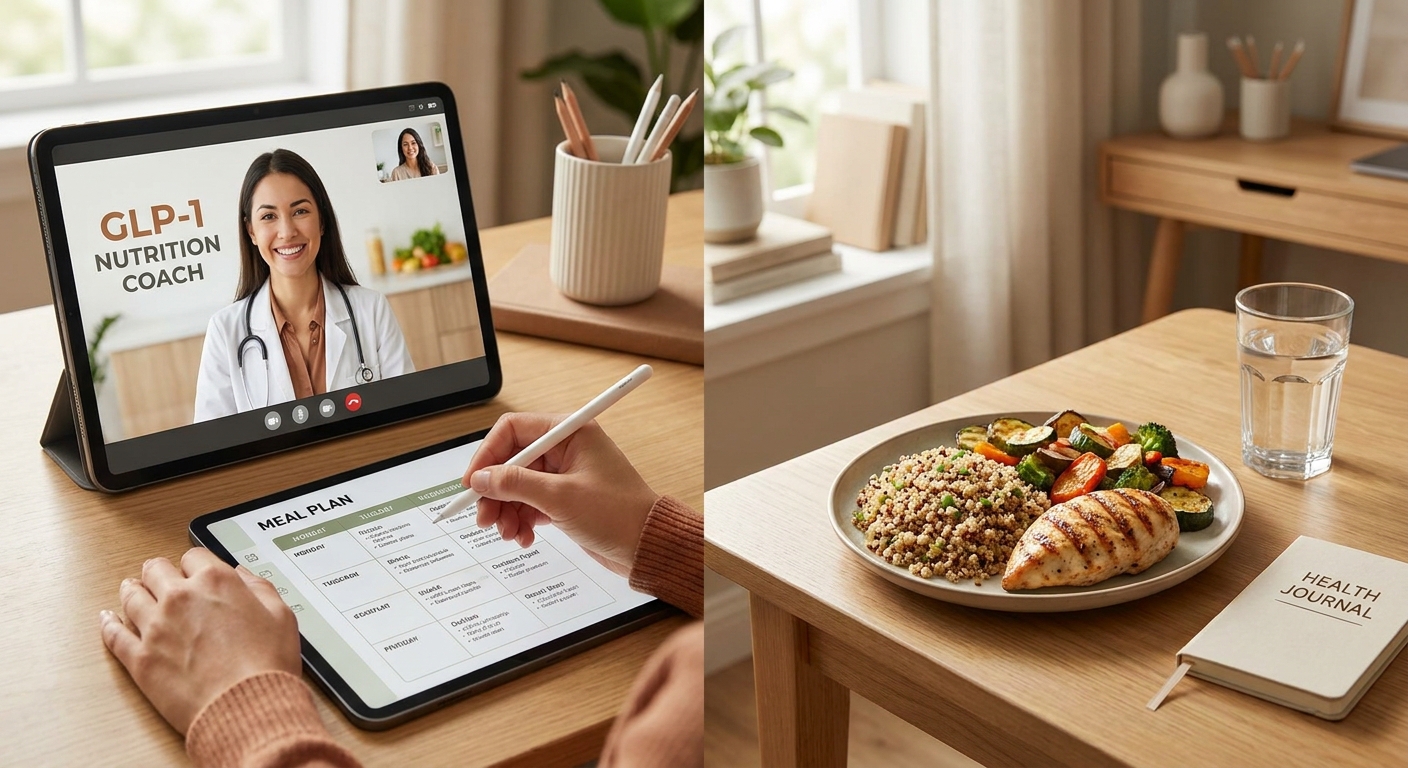
GLP-1 nutrition coaching telehealth pairs the medication with a licensed provider who adjusts your protein targets, GI symptom plan, and portion strategy as your dose changes — not a generic meal-plan PDF.
- GLP-1 nutrition coaching telehealth works best when a licensed clinician reviews your titration schedule every 2-4 weeks — Buy into programs that do this.
- Skip any coaching add-on that never talks to your prescribing provider; disconnected advice causes most GLP-1 dropout by month 3.
- Protein-first coaching (70-100g daily) protects lean muscle during rapid GLP-1 weight loss in 2026 protocols.
- NowCare's telehealth weight loss pathway pairs GLP-1 prescribing with provider-guided nutrition check-ins — Consider it if you want one platform for both.
Why this matters
GLP-1 medications suppress appetite fast. That's the point — but it also means most patients cut calories before anyone checks whether they're still eating enough protein, fiber, or electrolytes.
Clinical follow-up data on semaglutide and tirzepatide use consistently flags lean muscle loss as a side effect of aggressive appetite suppression without structured nutrition support. A coach who never sees your labs or your dose can't catch that. A telehealth program that loops your nutrition coaching into the same visit as your prescribing clinician can.
In 2026, most GLP-1 telehealth platforms bolt on a nutrition app as an afterthought. The ones worth paying for build coaching around your titration schedule, not around a 12-week calendar that ignores it.
Who this is for
This guide is for anyone already on — or actively qualifying for GLP-1 weight loss medication online — who wants nutrition guidance that adjusts as their dose changes. That includes people managing nausea during dose escalation, people worried about muscle loss on a calorie deficit, and people who tried a generic meal-tracking app and quit because it didn't account for GLP-1 appetite suppression at all.
It's not for someone who wants a one-time meal plan with no ongoing check-ins. GLP-1 nutrition needs shift monthly, sometimes weekly during titration — a static plan goes stale fast.
What to look for in GLP-1 nutrition coaching telehealth
Provider-guided macros, not generic templates
A coaching program that hands every patient the same 1,500-calorie plan isn't reading your labs or your dose. Provider-guided macros adjust protein and fiber targets as your appetite drops week over week — the whole reason "provider-guided" matters more than "personalized," which any app claims.
Protein targets tied to your body weight
Muscle preservation during GLP-1 weight loss depends on hitting roughly 0.6-0.8 grams of protein per pound of body weight daily. A coaching program that never mentions a protein gram target isn't tracking the thing most likely to determine whether your weight loss stays fat-only or eats into muscle.
GI symptom triage built into the same visit
Nausea, constipation, and reflux hit most patients during dose increases. Coaching that's separate from your medical visit means you're explaining symptoms twice, to two different people who don't talk to each other.
Session cadence matched to your titration schedule
Dose changes typically happen every 4 weeks on standard GLP-1 titration schedules. Coaching check-ins that happen less often than your dose changes are always one step behind your actual appetite and tolerance.
Coordination with your prescribing clinician
The coach and the prescriber should see the same chart. If your nutrition coach can't see your current dose, they're guessing at your calorie tolerance.
Cost transparency before you commit
Some programs bundle nutrition coaching into the medication cost; others charge a separate subscription on top. Ask what's included before your first visit, not after the second charge hits your card.
See if you qualify for GLP-1 coaching
Provider-guided telehealth visits, treatment only if medically appropriate.
Top picks
The all-in-one pick: provider + coach on one platform
Spec that matters: same-chart visibility between your prescriber and your nutrition coach. Programs like this schedule check-ins every 2-4 weeks, matched to a standard GLP-1 titration cadence. If you want one login and one care team, this is the setup to look for. Compare telehealth weight loss programs before picking one — the differences in visit frequency are bigger than the differences in price. Verdict: Buy if coordination between coaching and prescribing is your top priority.
The starter pick: structured onboarding before your first dose
The hook here is sequencing — nutrition baseline set before medication starts, not after appetite suppression hits. A program that walks you through how to start a telehealth weight loss program with an intake nutrition assessment gives you a before-and-after baseline that's genuinely useful at week 12. Verdict: Buy for anyone starting GLP-1 treatment for the first time in 2026.
The demographic-specific pick: coaching tuned to hormonal context
Women over 40 lose muscle mass faster on aggressive calorie deficits than younger patients, thanks to declining estrogen's effect on lean tissue. A program built around GLP-1 weight loss telehealth for women over 40 should set higher protein floors and slower titration pacing by default, not as a special request. Verdict: Consider if you're over 40 and muscle preservation is a bigger concern than raw speed of loss.
The skip: app-only "nutrition coaching" with no clinician review
The pitch sounds fine — an app that logs meals and pings you with tips. The problem: nobody with a medical license ever looks at what you log, so nausea, dehydration, or under-eating goes unnoticed until it's a problem. Verdict: Skip if the "coaching" is a chatbot and not a licensed clinician.
What to avoid
- Meal plans with no protein target. If a coaching program never states a daily protein gram goal, it's not accounting for the muscle-loss risk that comes with GLP-1 appetite suppression.
- Coaching that's disconnected from your prescriber. Two separate logins, two separate care teams, no shared chart — this is the single biggest cause of GLP-1 dropout by month 3.
- Fixed 12-week programs with no adjustment for dose changes. Your appetite in week 2 is not your appetite in week 10. A static plan built for week 2 stops working the moment your dose increases.
Verdict comparison
| Program type | Provider coordination | Protein target set | Check-in cadence | Verdict |
|---|---|---|---|---|
| All-in-one platform (prescriber + coach) | Yes, same chart | Yes | Every 2-4 weeks | Buy |
| Structured onboarding program | Yes, at intake | Yes | Baseline + monthly | Buy |
| Demographic-tuned coaching (40+, PCOS) | Yes | Yes, adjusted | Every 2-4 weeks | Consider |
| App-only meal tracker | No | Rarely | None | Skip |
Patients managing PCOS alongside GLP-1 treatment face a separate set of insulin-sensitivity variables — telehealth weight loss for people with PCOS covers what changes in that specific case.
FAQ
What is GLP-1 nutrition coaching telehealth?
It's remote nutrition guidance delivered alongside GLP-1 weight loss medication, coordinated with the prescribing clinician rather than run as a separate app or service. In 2026, the best versions adjust protein and calorie targets as your dose changes.
Is nutrition coaching necessary while taking GLP-1 medication?
It's not required by the medication itself, but it protects against lean muscle loss during rapid appetite suppression. Patients who skip structured nutrition support are more likely to see muscle loss alongside fat loss.
How often should I check in with a coach during GLP-1 treatment?
Match check-ins to your dose titration schedule — typically every 2 to 4 weeks. Less frequent coaching falls behind your changing appetite and tolerance.
How much protein do I need on GLP-1 medication?
A common target is 0.6 to 0.8 grams of protein per pound of body weight daily. This range protects muscle mass during a calorie deficit driven by appetite suppression.
Can nutrition coaching help with GLP-1 nausea and GI side effects?
Yes, when the coach has visibility into your dose and can adjust meal timing, fiber intake, and portion size around dose-increase weeks. This works best when coaching and prescribing happen on the same platform.
Is telehealth nutrition coaching covered separately from GLP-1 medication cost?
It depends on the program — some bundle coaching into the medication visit, others charge it as a separate subscription. Ask for the breakdown before your first visit in 2026, not after the first charge.
Do I need a referral to start GLP-1 nutrition coaching?
No referral is typically required for telehealth weight loss programs, but treatment and coaching intensity are only recommended when medically appropriate for your history.
What's the biggest mistake patients make with GLP-1 nutrition coaching?
Choosing a coaching add-on that never communicates with the prescribing clinician. Disconnected coaching and prescribing is the most common reason patients drop the nutrition piece by month three.
One last thing
The patients who stick with GLP-1 treatment past six months in 2026 aren't the ones who lost the most weight in month one — they're the ones whose protein intake and check-in cadence held steady through every dose increase. That consistency, not the dose itself, is what nutrition coaching is actually solving for.


