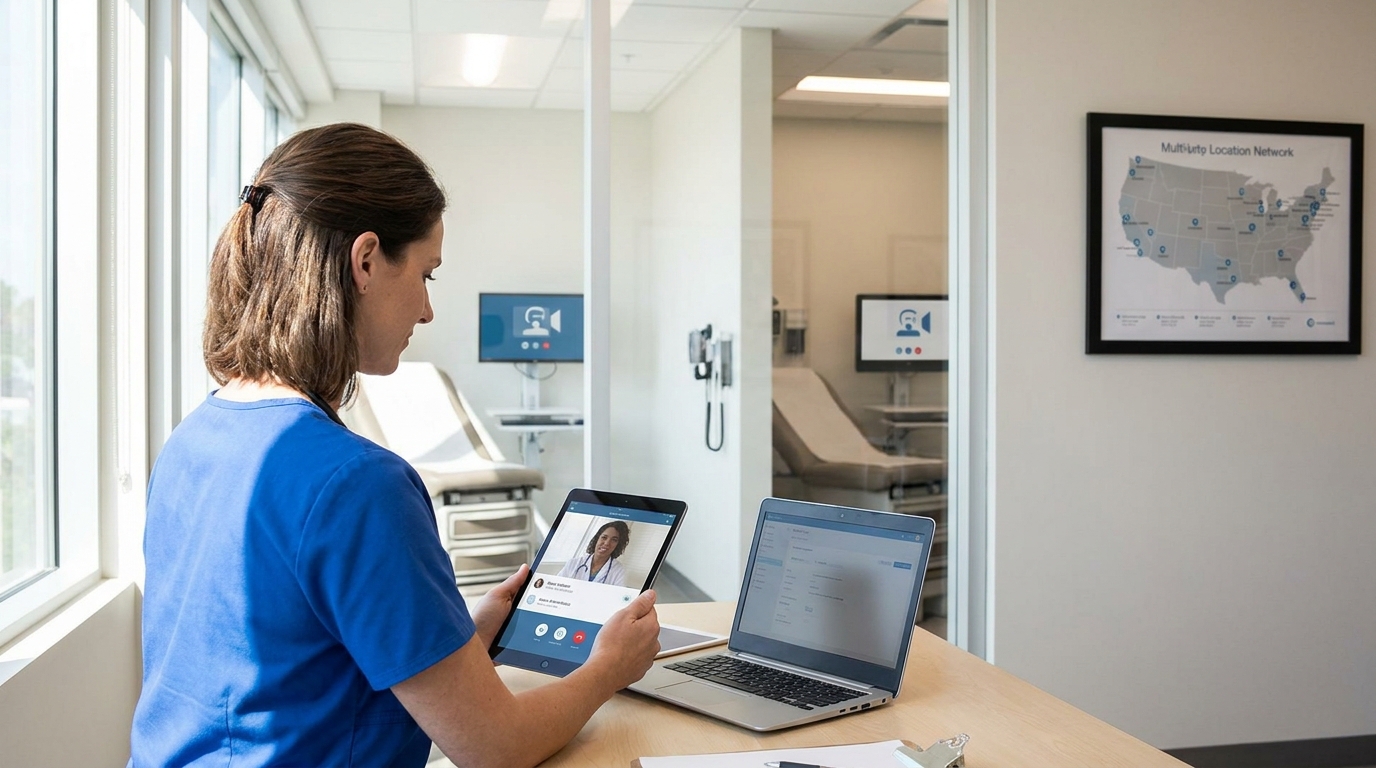
Multi-location clinic groups lose patients every time a satellite office can't offer same-day access — evaluating a telehealth platform for multi-location clinics means checking whether it scales across sites without multiplying admin work. This guide breaks down what to look for and where NowCare's provider-guided model fits into a franchise rollout in 2026.
- NowCare's Seven Pillars model gives clinic groups a telehealth platform for multi-location clinics without in-house build costs — Consider.
- Licensed clinician review on every plan clears HIPAA-compliance checks franchise operators need in 2026 — Buy for compliance.
- Flat one-month Virtual Urgent Care pricing beats per-visit billing when patient volume swings across sites.
- Skip platforms with siloed logins per location; centralized clinician oversight is what makes multi-site rollout work.
Who this is for
This is for operations directors and franchise owners running three or more clinic locations who need a telehealth option patients can use for overflow, after-hours, or specialty visits without hiring additional in-house staff at every site. If you're comparing a telehealth platform for multi-location clinics against building your own video-visit infrastructure, the criteria below apply whether you run urgent care storefronts, occupational health clinics, or concierge practices with satellite offices.
Why this matters
A single-location telehealth login doesn't survive contact with five or ten sites. Staffing gaps at one location shouldn't mean a patient can't get seen — the platform has to route intake, clinician review, and prescriptions the same way regardless of which storefront the patient walked (or clicked) into. Multi-location groups also carry more compliance exposure: more staff touching PHI, more state licensing questions, more audit surface. 2026 patients expect the same wait time whether they're at the flagship clinic or the newest franchise location.
What to look for in a telehealth platform for multi-location clinics
HIPAA-compliant intake across every site
Every location needs the same secure intake flow — not a patchwork of forms one manager built in a spreadsheet. A single HIPAA-compliant telehealth platform checklist should apply to all locations equally, because one non-compliant site is an audit risk for the whole group.
Licensed clinician review, not just video calls
A video call isn't care — it's a call. What matters is whether a licensed clinician reviews every visit and every prescription before it goes out. Groups that skip this step end up with liability sitting at the individual location level instead of a centralized care team.
Flat, transparent pricing that doesn't fight your billing system
Per-visit insurance billing across ten locations means ten sets of claims headaches. A flat-rate model, sold as clean 1-month plans, removes the insurance-eligibility bottleneck that slows down same-day visits at busy locations.
Breadth across specialty pillars, not just urgent care
A clinic group that only offers urgent-care telehealth still refers out for skin conditions, foot and ankle issues, hormone management, and weight loss. A platform covering six or seven distinct care pillars — from Virtual Urgent Care to Foot & Ankle Care to Medical Weight Loss — cuts down on how often patients get bounced to a competitor.
Same-day and after-hours availability
Locations close at 6pm. Patients get sick at 9pm. A platform that can absorb after-hours volume without opening a physical door protects revenue that would otherwise walk to an ER or urgent care chain.
Centralized reporting across sites
If you can't see visit volume, prescription patterns, or compliance flags across all locations from one dashboard, you're managing ten separate businesses instead of one network.
Where NowCare's model fits
The compliance answer. NowCare's intake is built HIPAA-compliant with licensed clinicians reviewing every plan before it ships — this is the baseline a multi-site group checks first, and it's documented step-by-step in the HIPAA-compliant telehealth platform guide. Buy for the compliance documentation alone.
The overflow valve. Virtual Urgent Care runs as a flat-rate 1-month plan covering skin & hair, men's and women's health, ENT, and everyday concerns — no per-visit insurance claim required. For a location that closes early or runs short-staffed, this absorbs volume without adding headcount. Consider for after-hours and overflow coverage.
The specialty gap-filler. Not every satellite location has behavioral health capacity in-house. NowCare's behavioral health support extends what a smaller location can offer without hiring a psychiatric nurse practitioner at every site. Consider if your satellite locations currently refer out for medication management.
The high-touch model. Concierge and boutique clinic groups running fewer, higher-touch locations look for a different fit than high-volume urgent care chains — a provider-guided model with ongoing care-team support maps better to that patient expectation than a bare video-call vendor. Consider for concierge-style rosters.
The workforce angle. Clinic groups that also run occupational health lines — pre-employment physicals, DOT screenings, workers' comp evaluations — need a platform that handles employer-facing volume differently than retail walk-in visits. Skip this angle if your locations are purely consumer-facing urgent care; buy in if occupational health is already a line of business.
See the NowCare care model
Review how Virtual Urgent Care, Foot & Ankle Care, and Medical Weight Loss cover multi-site patient needs.
What to avoid
- A platform that requires a separate contract per location. If pricing, intake, and clinician review reset at every site, you're not buying a network — you're buying ten smaller vendors.
- Video-call-only tools with no clinician review layer. A booking calendar attached to a webcam is not provider-guided care, and it leaves liability sitting with whichever manager approved the visit.
- Vendors with no visible pricing model. If you can't see whether it's flat-rate or per-claim before signing, budget forecasting across ten-plus locations becomes guesswork.
If a telehealth platform needs a separate login for every location, it is not built for multi-location care.
“If a telehealth platform needs a separate login for every location, it is not built for multi-location care.”
Verdict comparison
| Angle | Compliance fit | Best for | Verdict |
|---|---|---|---|
| HIPAA-compliant intake baseline | Documented, licensed clinician review on every plan | Any multi-site group starting due diligence | Buy |
| Virtual Urgent Care overflow | Flat-rate 1-month plan, no insurance claim needed | After-hours and short-staffed locations | Consider |
| Behavioral health add-on | Provider-guided medication oversight | Locations without in-house behavioral health | Consider |
| Concierge-style rollout | Ongoing care-team support model | Fewer, higher-touch locations | Consider |
| Occupational health line | Employer-facing screening workflow | Groups already running workers' comp/DOT lines | Buy in if applicable |
FAQ
What is the best telehealth platform for multi-location clinics in 2026?
The best fit depends on whether you need urgent-care overflow, specialty referral reduction, or occupational health support — NowCare's six-pillar model covers Virtual Urgent Care, Foot & Ankle Care, and Medical Weight Loss under one licensed clinician review process, which reduces the number of separate vendors a multi-site group has to manage.
Does a multi-location clinic need a HIPAA-compliant telehealth platform?
Yes — every location handling patient intake needs the same compliant workflow, not a patchwork built site by site. One non-compliant location creates audit exposure for the entire group.
How much does adding telehealth cost for a multi-site clinic group?
Costs vary by vendor and volume, but flat-rate plans (like NowCare's 1-month Virtual Urgent Care plan) are easier to forecast across multiple sites than per-visit insurance billing, which fluctuates with claim approval rates.
Is telehealth better than in-house urgent care for satellite locations?
Telehealth doesn't replace in-house care — it absorbs overflow and after-hours volume that would otherwise leave the network entirely. Locations that close at 6pm still lose patients to ERs without an after-hours option.
Can a telehealth platform handle occupational health screenings across locations?
Some platforms extend into employer-facing workflows like pre-employment physicals and workers' comp evaluations, which matters for clinic groups running occupational health as a line of business alongside consumer urgent care.
Do patients need insurance to use a multi-location telehealth platform?
Not with flat-rate models — NowCare's plans are priced as one-time or monthly fees with no insurance requirement, which removes a common friction point for walk-in-style patients.
How many care pillars should a telehealth platform cover for a clinic network?
More pillars mean fewer external referrals. A platform covering urgent care, foot and ankle conditions, and weight loss management under one clinician-review process keeps more patients inside the network instead of bouncing to a competitor.
What's the biggest mistake clinic groups make picking a telehealth vendor?
Signing per-location contracts instead of a single network agreement — it multiplies admin work and creates inconsistent compliance standards across sites.
One last thing
The locations that benefit most from adding telehealth aren't the flagship stores — they're the newest, thinnest-staffed satellite sites where a single sick call already breaks the schedule. Route those locations' overflow to a provider-guided platform before you route their front-desk hours.


