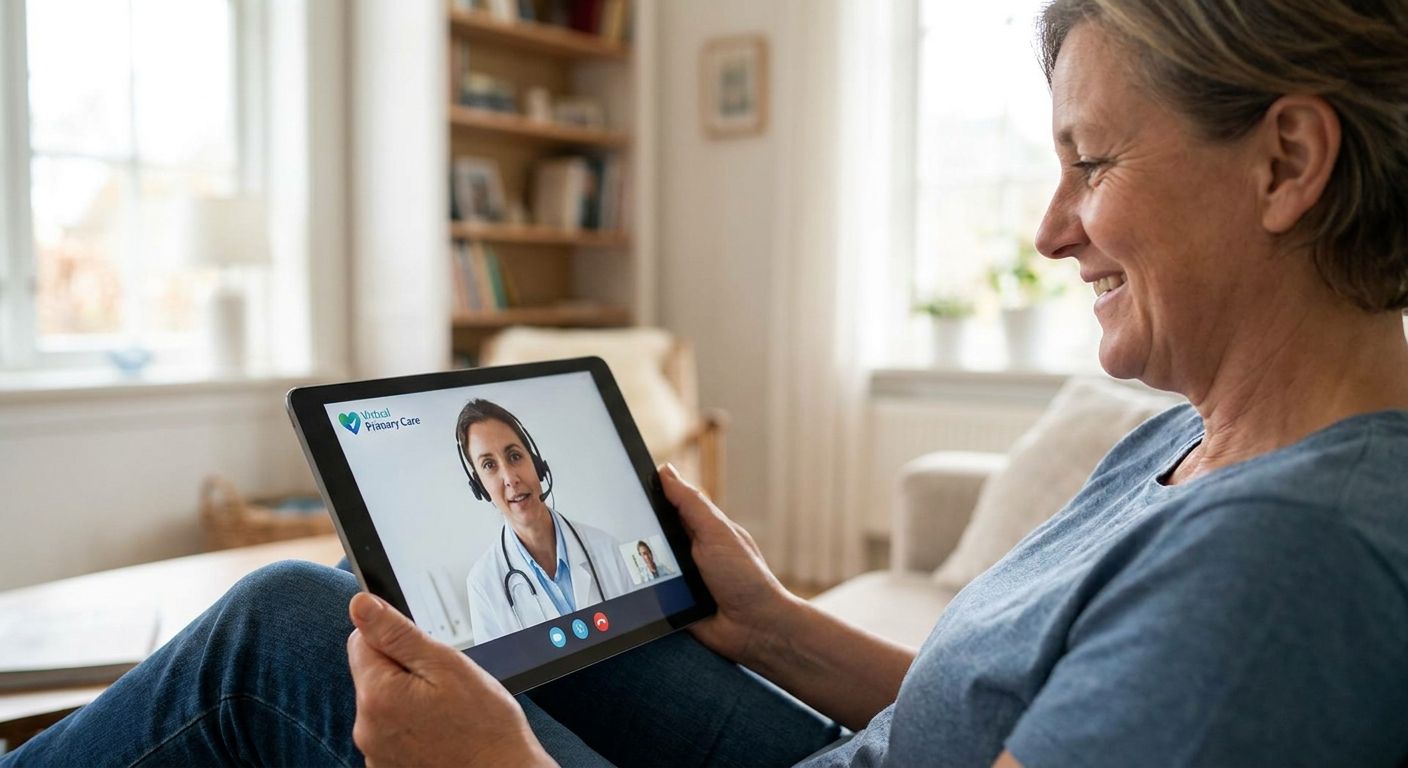
Virtual primary care fills the gap when you don't have a regular doctor: a licensed clinician reviews your history, treats what's actually in front of you, and stays on your case for follow-up, without a waiting room involved. NowCare runs this as an ongoing telehealth relationship instead of a one-off sick visit, and in 2026 that model works as a real substitute for "I don't have a doctor," not just a stopgap.
- Virtual primary care with no regular doctor works when a clinician reviews your full history, not just today's complaint.
- First-visit prep matters more than cost for most people delaying care in 2026.
- Flat, disclosed pricing beats guessing at a bill if you're uninsured.
- Chronic conditions need a care team that tracks labs over months, not a single video call.
- Same-day symptom fixes belong in urgent care, not a primary care relationship.
Why this matters
Not having a primary care doctor doesn't mean the need disappears. It means every sinus infection, skin rash, or blood pressure check turns into a scramble between urgent care, an ER copay, or waiting it out and hoping it resolves on its own.
Virtual primary care closes that gap without making you spend three weeks calling offices that aren't accepting new patients. The bar in 2026 isn't "can I get a video call" — every app clears that now. The real test is continuity: does the same care team review your chart across visits, does a clinician actually write and route a prescription, and is there a plan for what happens after visit one. NowCare builds its virtual primary care option around that continuity, running it as part of six pillars of provider-guided telehealth that also cover foot and ankle care and medical weight loss.
Who this is for
This is for adults who haven't had a primary care doctor in years: people who aged out of a pediatrician and never replaced one, freelancers and gig workers without employer coverage, anyone who moved cities or states and never re-established care, and people quietly managing something like high cholesterol or mild hypertension with nobody tracking it long-term. If your current system is "go to urgent care and hope," this is the guide for changing that pattern in 2026.
What to look for in virtual primary care when you don't have a doctor
Same-week appointment availability
If a platform can't get you in front of a clinician within a few days, it isn't solving the problem you actually have. Same-week scheduling matters most for the person who's been putting off care for months — waiting two more weeks kills follow-through fast.
No "established patient" requirement
Plenty of telehealth tools only function if you already have a doctor on file who can co-sign the visit. That's useless if the entire reason you're here is that you don't have one, so confirm upfront that new patients with no prior relationship can book.
One-time, insurance-free pricing you can see before booking
If you don't have insurance, or you're not sure your plan covers virtual visits, you need the price before you hand over a card. Checking the cost of an online doctor visit without insurance should be step one, not something you find out at checkout.
Licensed clinician review, not just a chatbot
A prescription requires an actual clinician who reviewed your intake, not a script matched by an algorithm. NowCare routes every plan through licensed clinician review before anything ships to a pharmacy, which is the baseline for anything calling itself primary care.
A care team that remembers your chart between visits
The entire point of primary care is continuity — the same notes and history referenced at your next visit instead of starting from zero. A platform that treats every visit as a fresh intake with no memory of the last one is urgent care wearing a primary care label.
Top picks for getting started without a regular doctor
1. First-visit readiness — the on-ramp pick
The biggest reason people delay virtual primary care isn't cost, it's not knowing what to have ready. Prepping for your first telehealth appointment covers what to gather before the call: current medications, your last known blood pressure or A1C if you have one, and a device with a working camera. Verdict: Book It.
2. The switcher — moving off "no doctor" status for good
If you've been treating every symptom as a one-off urgent care visit, another one-off visit isn't the fix — establishing one ongoing relationship is. NowCare structures the switch from no doctor to online primary care around a single onboarding visit that builds the chart you'll use going forward, instead of restarting every time. Verdict: Book It.
3. The budget pick — young adults with no insurance
If you're under 30 and uninsured, cost is usually the real blocker, not access. A flat, disclosed price for a virtual primary care visit removes the guessing that keeps people from booking anything at all. Verdict: Consider.
4. The continuity pick — chronic condition management
If you're already managing something like high cholesterol, thyroid issues, or mild hypertension with nobody tracking it, this pick matters more than a single sick visit. A care team that reviews labs and adjusts a plan over months, not once, is what separates primary care from a same-day appointment. Verdict: Consider.
5. The mismatch — treating this as urgent care
If what you actually need is a same-day answer for a UTI, pink eye, or a sore throat and nothing more, virtual primary care is overkill for that single visit. Grab the faster urgent care path for the immediate problem and set up primary care separately once you're not also mid-flare-up. Verdict: Skip for now.
Start virtual primary care today
Get matched with a licensed clinician online, no regular doctor required.
What to avoid
- Apps that only do one-off sick visits. They look identical to primary care in a screenshot but keep zero chart history between visits — you're re-explaining your medications every single time.
- Platforms that require an existing prescription or established doctor to unlock a visit. That defeats the entire purpose if you're starting from zero in 2026.
- Sites that hide pricing until checkout. If you can't see the cost of a visit before entering payment information, assume it's priced for someone with insurance, not you.
Verdict comparison
| Pick | Best for | What it solves | Verdict |
|---|---|---|---|
| First-visit readiness | Anyone booking their first virtual visit | Removes the "what do I bring" friction | Book It |
| The switcher | People stuck in urgent-care-only mode | Establishes one ongoing chart | Book It |
| The budget pick | Uninsured adults under 30 | Flat, disclosed pricing | Consider |
| The continuity pick | Chronic condition management | Ongoing lab review, not a single visit | Consider |
| The mismatch | Same-day single symptom | A faster path exists elsewhere | Skip for now |
FAQ
What is virtual primary care for someone without a regular doctor?
It's an ongoing telehealth relationship with a licensed clinician who reviews your full history rather than treating one complaint. Unlike a one-off urgent care visit, the same care team keeps your chart between appointments in 2026, so you're not re-explaining medications every time.
Can I get a prescription online without an existing doctor?
Yes, as long as the platform accepts new patients and a licensed clinician reviews your intake before writing anything. The prescription routes to the pharmacy you choose, the same way an in-person visit would work.
Does virtual primary care work without insurance?
Yes, platforms built for uninsured patients disclose a flat, one-time price before you book, so you know the cost without filing a claim. Check the exact price for your situation before entering payment details.
How is virtual primary care different from virtual urgent care?
Virtual urgent care solves one symptom in a single visit, while virtual primary care builds an ongoing chart and follow-up plan across multiple visits. If you need a same-day answer for a UTI or pink eye, urgent care is faster; if you need someone tracking your health long-term, primary care fits better.
Can virtual primary care manage a chronic condition like diabetes or high cholesterol?
Yes, when the platform offers ongoing chronic condition management instead of single sick visits, a care team can review labs and adjust a plan over several months. Ask specifically whether follow-up visits and lab tracking are included before you book.
How much does an online doctor visit cost without insurance in 2026?
Costs vary by platform and visit type, and the only reliable number is the one shown before you book on the specific service you're using. Flat, disclosed pricing without insurance is the standard to look for in 2026 rather than a price that appears only at checkout.
Do I need a referral to start virtual primary care?
No, virtual primary care built for patients without a regular doctor is designed to accept new patients directly, with no referral or prior relationship required. That's the entire point of the model for someone starting from zero.
Is virtual primary care as thorough as an in-person doctor visit?
For most everyday concerns, prescription management, and chronic condition check-ins, yes, as long as a licensed clinician reviews your case each time. Anything requiring a hands-on exam or imaging still needs an in-person referral, which a good virtual primary care team will flag rather than skip.
One last thing
The single biggest predictor of whether virtual primary care actually replaces "I don't have a doctor" isn't the first visit — it's whether you book a second one. A platform that nails the intro call but never resurfaces for a follow-up is functionally urgent care with better marketing. Ask before you book in 2026: does this service prompt a follow-up, or does the relationship end when the call does.


