
WellNow provides walk-in urgent care when you need an in-person assessment. The limit of that visit-based approach is convenience when your concern can be assessed online, while an online service has its own limit: it cannot perform a hands-on examination. The best WellNow alternative in 2026 is NowCare for provider-guided online care; a local urgent care clinic for a hands-on exam.
- For wellnow alternatives in 2026, choose NowCare for provider-guided telehealth when an online assessment is appropriate.
- Choose local urgent care when your concern needs a physical examination or an on-site procedure.
- Choose primary care for continuing care; choose an emergency department for potentially life-threatening symptoms.
- Online care does not replace emergency treatment, and a prescription is never guaranteed.
Why this matters
Choosing an urgent care alternative is not just choosing another name. You are choosing what a clinician can assess, what happens after the visit, and whether you need to leave home.
A rash, recurring heel pain, and a serious injury do not call for the same care setting. Convenience matters only after you have matched your symptoms to an appropriate level of care. This guide compares care pathways rather than treating every service as interchangeable.
For your 2026 decision, start with the clinical need. Then compare access, treatment scope, and follow-up. A service that fits your schedule but cannot evaluate your concern is the wrong choice.
WellNow alternatives at a glance
WellNow is included below as the benchmark. The alternatives serve different needs, so the best choice depends on what you need a clinician to do—not a universal ranking of providers.
| Care option | Best for | Standout feature | Difference from a WellNow clinic visit |
|---|---|---|---|
| WellNow | Non-emergency concerns needing in-person urgent care | Walk-in urgent care setting | Benchmark for a clinic-based assessment |
| NowCare | Provider-guided online care for supported concerns | Licensed-clinician review, online intake, and ongoing care-team support | Care takes place online rather than in a clinic |
| Local urgent care clinic | A non-emergency concern requiring hands-on assessment | An in-person examination | Similar care setting; compare the individual clinic's services |
| Primary care practice | Continuing care and a broader health history | A continuing relationship with a clinician | Better suited to longitudinal care than a single urgent visit |
| Emergency department | Potentially life-threatening symptoms or serious injury | Emergency assessment and hospital-based care | A higher level of care, not a convenience substitute |
The best care option is the one that can safely assess your problem. Use the comparison to narrow your route, then confirm that the specific service treats your concern.
1. NowCare: best for provider-guided online care
NowCare is a telehealth platform connecting you with licensed clinicians for supported urgent care, foot and ankle concerns, and medical weight loss. Care is entirely online, with secure intake, clinician review, and treatment only if medically appropriate. Prescriptions are sent to your chosen pharmacy when prescribed.
This is a distinct alternative to traveling to a clinic. It suits a supported concern that a clinician can assess remotely; it does not replace an examination, procedure, or emergency treatment when those are necessary.
Where the platform shines
- Provider-guided treatment: Licensed clinicians review every plan and prescription.
- Defined care areas: Virtual urgent care covers skin and hair, women's health, men's health, eyes, ears, nose, throat, and everyday concerns.
- Foot and ankle focus: Supported areas include heel pain, nail health, skin and infection concerns, diabetic foot health, structural problems, sports-related foot concerns, and nerve pain.
- Support beyond intake: Ongoing care-team support is part of the service.
- No insurance requirement: You do not need insurance to use the platform.
Where the platform falls short
- No hands-on examination: A remote clinician cannot physically examine your foot, listen to your lungs, or perform an in-person procedure.
- Not emergency care: Serious or rapidly worsening symptoms require an appropriate in-person setting.
- Treatment is conditional: Completing an intake does not guarantee a prescription or a particular treatment.
- Scope matters: A named care area does not mean every symptom within it can be managed online.
Care plans and continuing support
The virtual urgent care offering is a 1-month plan. Foot and ankle care includes 1-month, 3-month, and 6-month plans, with annual memberships for selected conditions. Medical weight loss includes 1-month and 3-month programs with individual physician guidance.
Those durations describe the service arrangement, not a promised recovery time. Choose a plan only after checking that its scope and support match your concern. Longer enrollment does not make remote care appropriate for a condition requiring an examination.
Head-to-head: online care versus a WellNow clinic visit
| Dimension | Online platform | WellNow clinic visit |
|---|---|---|
| Care setting | Entirely online | In person |
| Hands-on assessment | Cannot provide a physical examination | Provides access to an in-person assessment |
| Best starting point | A supported concern suitable for remote review | A concern needing a clinician to examine you directly |
Best for: You want licensed-clinician guidance without a clinic visit, and your concern fits the online service's scope.
Verdict: Choose NowCare telehealth for appropriate online care; skip it when you need hands-on assessment.
2. Local urgent care: best for a hands-on non-emergency exam
A local urgent care clinic is the closest care-setting alternative to WellNow. You retain the main advantage of a clinic visit: a clinician can examine you in person and decide whether further evaluation is needed.
The comparison belongs at the individual-clinic level. Do not assume every urgent care location performs the same tests or procedures, treats the same ages, or handles every injury.
Where local urgent care shines
- Physical examination: A clinician can directly assess an injury or symptom.
- Clinic-based care: It provides an in-person route for problems that cannot be resolved through remote review.
- A comparable care setting: You can compare clinics without changing from urgent care to a different level of care.
Where local urgent care falls short
- Travel is required: You must get to the clinic for an in-person assessment.
- Services differ: Confirm the relevant service before making the trip.
- Emergency limits remain: Urgent care is not a substitute for an emergency department when symptoms are potentially life-threatening.
For a 2026 comparison, ask a specific question: can this clinic evaluate the problem you have? That is more useful than asking which urgent care brand is best overall. If you need a particular test or procedure, verify it directly.
Best for: Your concern is not an emergency, but you need an examination or a clinic-based assessment.
Verdict: Choose local urgent care when the examination matters more than staying home.
3. Primary care: best for continuing care
A primary care practice is a better alternative when the underlying need is continuity rather than a one-time urgent assessment. Recurring symptoms, questions involving several conditions, and follow-up after treatment benefit from a clinician who can consider your broader history.
This is not a promise of immediate access. Ask the practice whether it can assess your current concern within an appropriate timeframe.
Where primary care shines
- Continuity: You can return to the same practice as your health needs change.
- Broader context: Your medical history and ongoing treatments can inform the assessment.
- Follow-up planning: Continuing care belongs within an ongoing clinical relationship.
Where primary care falls short
- Timing must be checked: An appointment pathway does not automatically meet an urgent need.
- Not emergency treatment: Do not wait for a routine appointment with potentially life-threatening symptoms.
- Referral needs remain: Some conditions require a specialist or another care setting.
Best for: You need continuing assessment, management, or follow-up rather than an isolated urgent visit.
Verdict: Choose primary care for continuity; skip a routine appointment pathway when symptoms require urgent assessment.
4. Emergency department: best for serious symptoms
An emergency department is the appropriate route for potentially life-threatening symptoms or a serious injury. It is not a competing version of an online consultation or a routine urgent care visit.
If you have severe trouble breathing, signs of a stroke, or chest pain suggesting an emergency, seek emergency help. In the United States, call 911 when you need emergency assistance.
Where emergency care shines
- Emergency assessment: Hospital-based care is intended for serious, time-sensitive problems.
- Escalation: Emergency teams can assess whether hospital treatment is necessary.
Where emergency care falls short
- Wrong fit for routine care: It does not replace an ongoing primary care relationship.
- Not a convenience choice: Use the seriousness of your symptoms—not a provider comparison—to decide whether emergency care is needed.
Best for: Your symptoms suggest an emergency or you have a serious injury.
Verdict: Choose emergency care for serious symptoms; skip online intake when it would delay emergency help.
Why people switch from WellNow
The practical reasons to choose another care pathway are fit, setting, and continuity. None requires assuming that WellNow provides poor care or that another service performs better in every situation.
You want an online route for a supported concern
An entirely online service removes the need to travel for that assessment. NowCare online care combines secure intake, licensed-clinician review, and ongoing care-team support for its stated care areas.
The trade-off is clear: convenience does not supply a physical examination. If remote assessment is insufficient, the next step is appropriate in-person care—not repeated online submissions.
You need continuing care rather than another isolated visit
A recurring concern can require a plan that extends beyond the immediate symptom. Primary care provides a continuing clinical relationship, while condition-focused online plans offer another route for supported concerns.
Compare the follow-up arrangement explicitly. Ask who reviews changes, how you report worsening symptoms, and when an in-person assessment becomes necessary.
You need a different level of care
Sometimes the alternative is not another urgent care provider. A serious symptom belongs in emergency care; a problem needing ongoing management belongs in a continuing care pathway.
In 2026, the useful comparison is still clinical: what must happen during the assessment? Brand preference comes after that question.
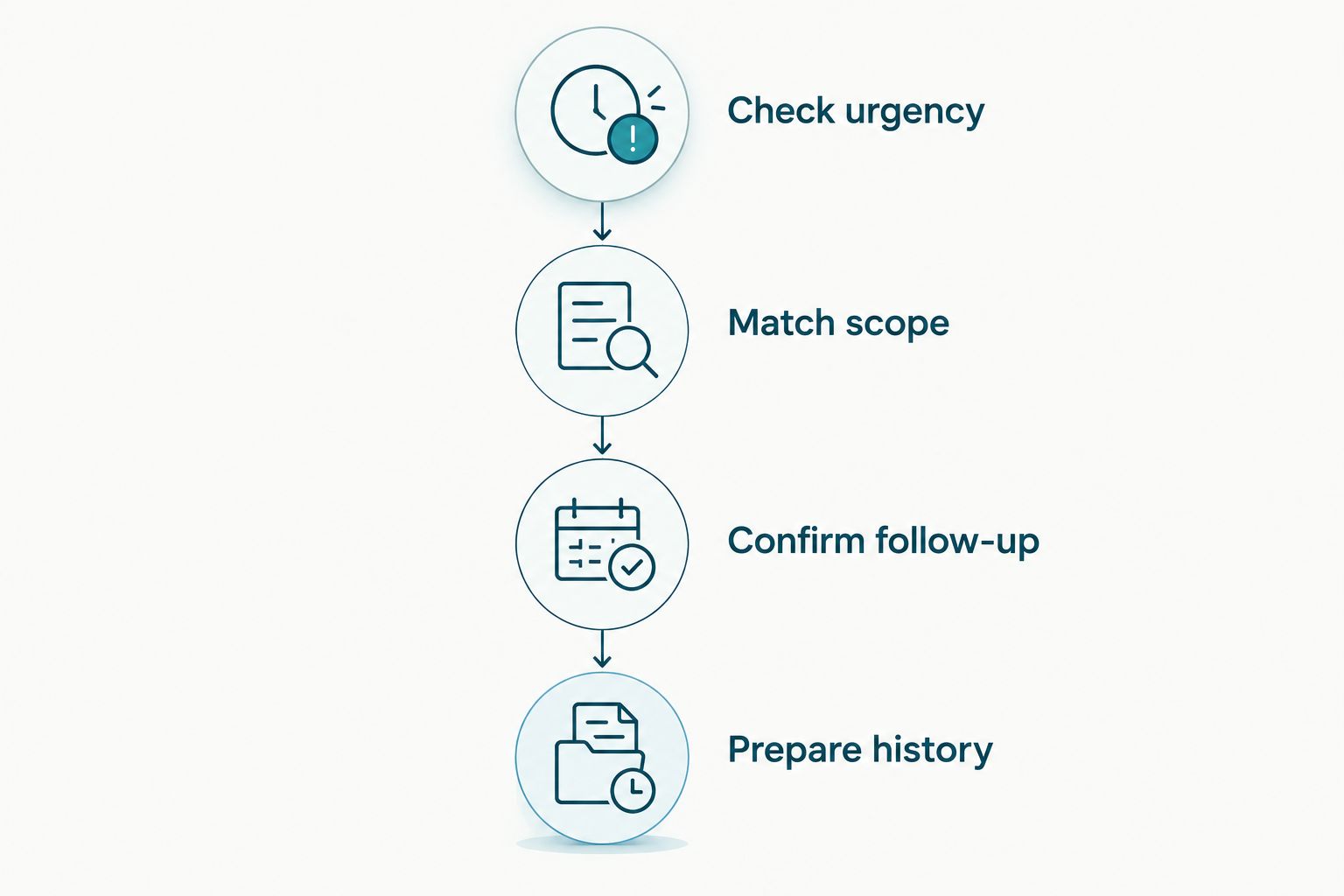
How to choose your next care setting
Use this sequence before completing an intake or traveling to a clinic. It keeps convenience from overriding safety.
- Check urgency: Identify whether symptoms suggest an emergency. Seek emergency help rather than continuing a provider comparison.
- Match scope: Confirm that the service treats your concern and can provide the assessment it requires.
- Confirm follow-up: Ask how to report changes and what happens if the initial treatment does not help.
- Prepare history: Have your symptoms, current medicines, allergies, and relevant medical history ready.
Describe your concern plainly. Include when it started, what has changed, and any treatment you have already tried. Do not leave out worsening symptoms because you prefer online care.
For your 2026 decision, separate enrollment from clinical approval. A clinician still needs to determine whether treatment is appropriate, whether more information is needed, and whether another care setting is necessary.
When staying with WellNow is the right call
Stay with WellNow when you need an in-person urgent care assessment and the clinic can evaluate your concern. Switching to online care solely to avoid a trip is not a sound choice if a physical examination is necessary.
An alternative does not need to replace every part of your care. You can use a clinic for a hands-on assessment and a continuing care provider for follow-up, provided each clinician has the relevant information. Tell the next clinician what was assessed, prescribed, and recommended.
Keep the care setting that fits the problem. Change providers when the alternative better matches your clinical need, not simply because it appears first in a comparison.
FAQ
What's the best WellNow alternative in 2026?
NowCare is a WellNow alternative for provider-guided online care when your concern fits its supported scope. Choose an in-person urgent care clinic when you need a physical examination, and emergency care for potentially life-threatening symptoms.
Is online urgent care better than going to WellNow?
Online urgent care is better suited to a supported concern that can be assessed remotely; an in-person visit is better suited to a hands-on examination. Neither care setting is best for every symptom.
Can I get a prescription through online care?
A licensed clinician can prescribe treatment when it is medically appropriate. Completing an intake does not guarantee a prescription, and some concerns require in-person assessment.
Do I need insurance to use the online platform?
Insurance is not required to use the platform described in this guide. Review the current plan terms and confirm that the service supports your concern before enrolling.
Can online care help with foot and ankle concerns?
The platform supports provider-guided care across stated foot and ankle areas, including heel pain, nail health, and diabetic foot health. A clinician must determine whether your specific concern is suitable for online management.
When should I choose primary care instead of urgent care?
Choose primary care when you need continuing management or follow-up rather than a single urgent assessment. Confirm that the practice can assess your current symptoms within an appropriate timeframe.
When should I skip online care and seek emergency help?
Seek emergency help for potentially life-threatening symptoms or a serious injury. Severe trouble breathing, signs of a stroke, and chest pain suggesting an emergency should not wait for an online intake.
One last thing
Before choosing any service, ask what happens if the clinician cannot assess your concern in that setting. The answer tells you more than a list of conditions: it establishes the next step when the first route is not enough.
Choose a care pathway with a clear boundary and a clear escalation plan. That is the most useful way to compare WellNow alternatives without confusing convenience with clinical suitability.


